Best Camping Gazebos Australia
Disclosure: We may earn a small commission if you purchase through our links, at no extra cost to you.
A gazebo is the piece of camp furniture Australian campers end up using most: it is the kitchen roof, the shade at the beach, the rain plan and the market-day base all in one. Choosing the best camping gazebo Australia conditions demand comes down to four things — size, frame strength, fabric and how honestly the wind rating was tested — because a gazebo that folds itself inside out in the first sea breeze is worse than none. This guide breaks down what actually matters, the types worth your money, and the anchoring habits that keep a gazebo standing when the afternoon wind arrives.
No prices or model-by-model specs here: gazebo pricing swings wildly with sales at the big camping retailers, so check current pricing at retailers when you shop. What does not change with the sales is the physics below — and the physics is what decides whether your gazebo lasts one summer or ten.
- 3m × 3m is the standard camp size; go 4.5m or 6m long for family kitchens and market setups.
- Frame and anchoring matter more than canopy fabric: a mid-range gazebo pegged and guy-roped properly outlasts a premium one left loose.
- Wind ratings are marketing unless anchored: always peg every leg, use the guy ropes, and drop the canopy when storms are forecast.
What makes the best camping gazebo Australia conditions demand
Start with the frame. Most camping gazebos use either steel or aluminium concertina (scissor) frames. Steel is cheaper and heavier; aluminium costs more and is the better long-term buy for anyone who camps often, because it does not rust when it lives in a damp garage and it is noticeably easier to carry from car to campsite. Check the leg profile and the thickness of the scissor arms — flimsy arms are where cheap gazebos fail — and look for a frame you can buy spare parts for. Australian brand Oztent built its name on exactly this idea (fast-pitch frames with replaceable parts), and the principle holds at every price point: a gazebo is a system of joints, and joints are what wear out.
Then the canopy. Polyester with a decent UV rating is the standard; heavier PVC-coated fabrics last longer but weigh more. For Australian sun, UV protection is not a garnish — a canopy that degrades in two summers of Queensland sun is a false economy. Ventilation matters too: a vented top releases hot air and reduces the parachute effect in wind. Seams should be taped or well stitched at the stress points, and the valance (the skirt around the roof edge) is what stops low sun and sideways rain, so a straight, deep valance beats a decorative scalloped one at camp.
Best camping gazebo Australia sizes, explained
Gazebo sizes are quoted as footprint, and the camp-standard is 3m × 3m: big enough for a camp kitchen table and four chairs, small enough for one person to pitch. Families cooking and eating under one roof usually want a 3m × 4.5m or a 3m × 6m — the extra length turns the gazebo into a genuine living room, at the cost of packed size and weight. Smaller 2m × 2m and 2.4m shelters suit beach days and solo setups. Two rules of thumb: measure your campsite reality, not your backyard (some caravan park sites are tight), and remember that a bigger roof catches more wind — the anchoring section below is not optional reading for the 6m owners.
Height matters more than people expect. Walk-under height at the edge (not the peak) decides whether the gazebo feels airy or like a hat. Taller peak designs shed rain better and feel bigger inside. If you plan to park a vehicle awning or swag under the edge, check the clearance height in the specs against your setup before you buy.
Pop-up, dome and screen designs: which type suits you
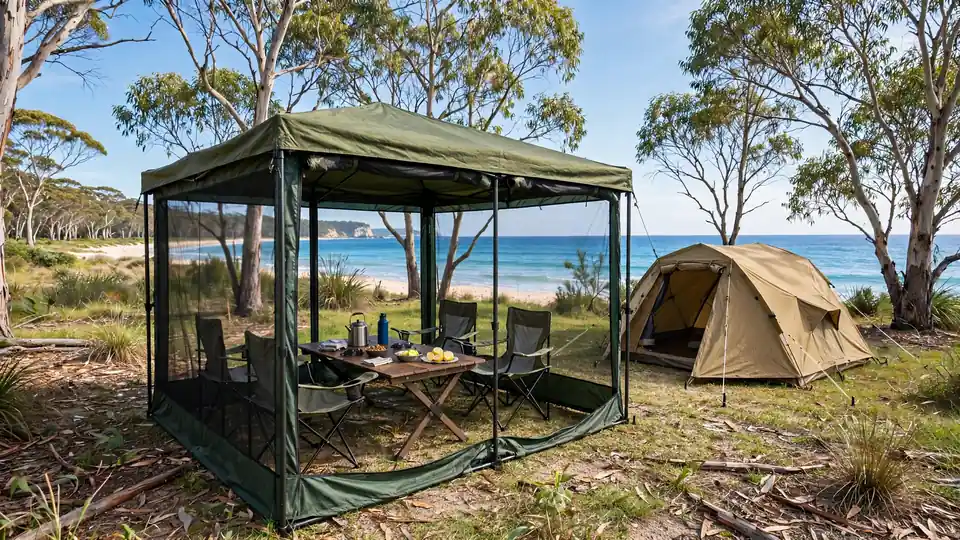
The concertina pop-up is the default for good reason: two people, a few minutes, no poles to thread. It is the right choice for car camping, markets and beach shade. Dome and pole gazebos pitch slower but pack smaller and can handle wind better once up — a fair trade for tourers short on space. Screen houses and mesh-walled gazebos are the third type, and in northern Australia they are close to essential: the tropics’ flies and midges will ruin a camp kitchen under an open gazebo, while a mesh room turns the same space into the most used room at camp. Removable walls for a pop-up give you all three behaviours in one purchase — open shade, windbreak wall on the weather side, full mesh room in bitey country.
Wind: the section that saves your gazebo
Every gazebo failure story has the same plot: a gust, an unpegged leg, a frame folded like a deckchair. Gazebos are parachutes with legs, and manufacturers’ wind claims assume correct anchoring. Do all of it, every time: peg or weight every leg (sandbags or water weights on hard ground, long sand pegs at the beach), run the guy ropes from the frame’s top corners at 45 degrees, and keep the canopy tensioned so it does not flap itself to death. When a storm is forecast, the correct move is to drop the roof or take the gazebo down entirely — canvas and polyester tear, but bent scissor arms are the usual write-off. Coastal campers should treat the afternoon sea breeze as the daily test and pitch the gazebo’s lowest, firmest setup from the start.
Setting up camp under your gazebo
Where the gazebo sits decides how camp flows. The classic layout is kitchen at one end, table in the middle, chairs in the shade line that moves least — which means thinking about where the sun will be at 4pm, not where it is at setup. Keep the stove at the downwind edge, never under the lowest point of the roof, and leave a walkway so nobody carries hot pans through the seating. At night the gazebo becomes the light trap: hang the lantern high and centre and the insects gather above head height instead of in your dinner. Pair the gazebo with your shelter choice from our guide to the best camping tents in Australia and you have the two-roof system most Australian families end up with: tent for sleeping, gazebo for living.
Care, repairs and getting a decade out of it
Gazebos die of neglect more than weather. Pack the canopy dry or dry it within a day at home — mildew in the folds is permanent. Hose sand and salt off the frame after beach trips, spray the joints occasionally, and store the bag somewhere the mice are not. Buy from a brand or retailer that sells spare canopies, struts and feet; the frame usually outlives the first canopy, and a replacement roof is a fraction of a new gazebo. If a strut bends, replace it before the next trip rather than straightening it at camp — a weakened arm transfers its load to the joints around it, and cascade failures start exactly like that. Families sizing up for group trips should also read our best family tents guide, since gazebo and tent sizing work as one decision.
Gazebo, vehicle awning or shade sail: which shelter does what
Campers often own two of these three because they solve different problems. A vehicle awning is fastest — roll it out and camp has a roof — but the shade is welded to the car’s position and orientation, useless when the sun swings or the car is away on a day trip. A shade sail or tarp is the lightest, cheapest shade and the fiddliest: brilliant in skilled hands over a known campsite, frustrating on a windy beach with no trees. The gazebo is the freestanding compromise: heavier than both, independent of the car, movable with the shade, and the only one that works at markets, sports days and backyard parties between trips. That multi-use life is the honest reason the best camping gazebo Australia families buy earns its garage space — it works fifty weekends a year, not five. If you camp from a 4WD and rarely leave the vehicle’s side, the awning wins on speed; if your camps involve kids, cooking and company, the gazebo wins on space. Many tourers carry both: awning for overnight stops, gazebo for base camps of two nights or more.
Buying the best camping gazebo Australia retailers stock: a five-minute checklist
In the shop or the product page, run this sequence. One: pick it up in its bag — that is the weight you will swear at on every trip, so honesty here beats brochure numbers. Two: check the frame warranty and whether spare canopies and struts are listed for sale; no spares listed means a disposable product. Three: read the canopy fabric spec for UV rating and seam construction rather than colour choice. Four: confirm the packed length fits your boot, roof basket or trailer — 1.6-metre packed gazebos surprise a lot of hatchback owners. Five: price the walls and mesh room you will eventually want at the same time as the gazebo, because the accessory ecosystem is where cheap gazebos get expensive. Buyers who run that checklist end up with the best camping gazebo Australia conditions allow for their budget — not the tallest claim on the box, but the frame, fabric and spares support that survive the third summer, which is when a gazebo purchase is actually decided.
Beyond camp: markets, junior sport and the beach
The gazebo’s second life is why it outsells every other shelter type in Australia. Saturday markets run on 3m × 3m gazebos because that is the standard stall footprint — buy the camp gazebo in that size and it moonlights as your market stall, school fete shelter and footy boundary base without modification. At the beach, the same frame is the base camp for boards, eskies and grandparents, with the sand-peg and bag discipline from the wind section doing the work. This double life should shape the purchase: a slightly heavier-duty frame that feels like overkill for three camping trips a year is exactly right for thirty weekends of total use, and the cost-per-use maths flips the budget decision. Buy once, buy the frame with spares, and let the calendar justify it.
A note on beach use
Beaches are where gazebos go to die, because sand defeats standard pegs and sea breezes arrive without asking. Use long sand pegs or buried sandbags on every leg, guy out toward the wind, and accept a lower roof height — dropping the legs one or two notches cuts the sail area dramatically. Rinse the frame’s joints when you get home; sand in the scissor mechanism is tomorrow’s stuck frame. Do that, and the beach is the gazebo’s happiest workplace.
Frequently asked questions
What size gazebo is best for camping?
3m × 3m is the versatile standard for a couple or small family kitchen setup. Larger groups, market stalls and full camp kitchens are better served by 3m × 4.5m or 3m × 6m models. Always weigh the packed size and weight against your vehicle space.
How do I stop my gazebo blowing away?
Peg or weight every leg, run all guy ropes at 45 degrees from the top corners, keep the canopy taut, and lower or remove the gazebo when storms are forecast. Most gazebo damage happens to unanchored gazebos in gusts well below any rated limit.
Is a steel or aluminium gazebo frame better?
Aluminium is lighter and does not rust, making it the better long-term choice for frequent campers. Steel frames are cheaper and perfectly serviceable if stored dry and maintained. At any budget, frame thickness and replaceable parts matter more than the material alone.
Can you leave a gazebo up overnight at a campsite?
Yes, if it is fully anchored and the forecast is calm — but check it before bed, tension the guys, and if strong wind is expected overnight, drop the canopy. Campgrounds in exposed coastal spots are where overnight gazebo losses happen.