Ultralight Camping Gear Guide Australia
Disclosure: We may earn a small commission if you purchase through our links, at no extra cost to you.
Ultralight is not a shopping list; it is a system. The idea behind ultralight camping gear Australia walkers are adopting is simple: weigh everything, question everything, and carry a base weight — pack, shelter, sleep system and the worn basics — light enough that multi-day walking stays fun in your fifties, not just your twenties. This guide lays out the system piece by piece for Australian conditions, with honest numbers as targets rather than product claims, because the right ultralight setup for the Overland Track is not the right one for the Larapinta. The pack itself deserves its own decision: our best hiking backpack Australia fit and volume guide covers back length, hip belts and frame types in depth.
Australian brand Sea to Summit designs much of its range in this space, alongside the international ultralight makers. Use the framework below to audit what you already own before you buy anything: most walkers find their first two kilos of savings are already in their pack, in the form of things they carry and never use.
- Aim first for a base weight under 7kg; the classic ultralight benchmark is under 4.5kg, reached gradually, not bought in one order.
- The big three — pack, shelter, sleep system — are where the kilos live. Fix them in that order of weight, not price.
- Australian conditions set the floor: water carrying, sun and scrub mean some “ultralight” imports need local adjustment.
The big three: where ultralight camping gear Australia walkers save real weight
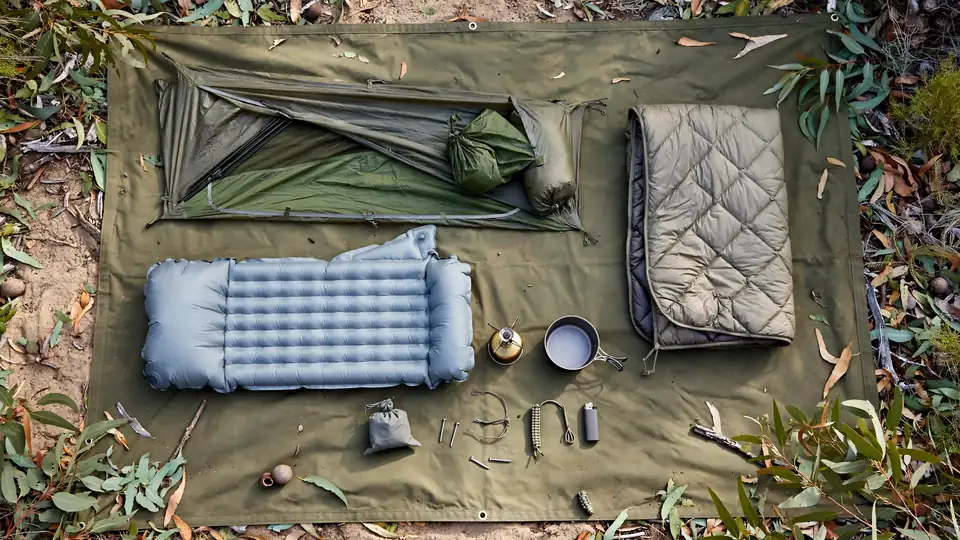
Your pack, shelter and sleep system together are typically two-thirds of base weight. A traditional trio can run past seven kilos on its own; a considered ultralight trio lands closer to two and a half to three. The pack comes last in the buying order — its size is dictated by everything else — but first in the audit: weigh your current big three and write the numbers down. Every decision after this section is arithmetic against those numbers. Our guide to the best sleeping bags in Australia covers the insulation half of the sleep system in depth, including the quilts many ultralight walkers switch to.
Shelter: tents, tarps and the Australian middle ground
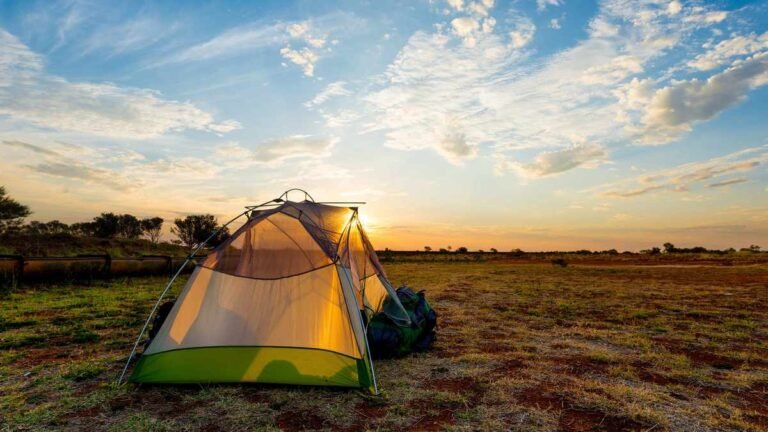
Ultralight shelters split into trekking-pole tents (using your walking poles as structure), single-wall designs that trade condensation management for grams, and tarps for the committed. In Australian conditions there is a local catch: our insects. A tarp without a bug net is a fine system in the alpine summer and a misery in the Top End or coastal Queensland; most Australian ultralight walkers land on a lightweight tent or a tarp-plus-inner combination that keeps the mesh between them and the mozzies. Weight targets: a solo shelter system between roughly 600 grams and 1.2 kilos all-in (stakes and guys included) is the realistic ultralight band; below that you are making durability and weather trade-offs that Tasmania’s west coast will examine severely.
Condensation is the other local reality: still, humid nights on the east coast punish single-wall designs. Ventilation design and site selection (a breeze, not the valley floor’s cold pool) matter more than another 100 grams of fabric technology.
Sleep systems: quilts, mats and the R-value rule
The sleep system is where ultralight walkers make their bravest change: from sleeping bag to quilt. A quilt saves weight by removing the insulation crushed uselessly beneath you — your mat provides that insulation — and for three-season Australian walking it is the rational choice for most people. The mat is non-negotiable: ground insulation is measured by R-value, and as a working rule you want at least R2–3 for summer lowlands, R3–4 for three-season mountains, and R5+ for snow and alpine winter. Those numbers, printed by reputable makers to the ASTM standard, are among the few specs in this industry you can compare across brands with confidence. Pair a quilt rated honestly for your coldest expected night (not your average one) with the right mat, and the system weighs well under a kilo and a half. Our guide to the best sleeping mats in Australia breaks down the mat options by type.
The rest of the system: kitchen, clothing and the small stuff
After the big three, the grams hide in habits. Kitchen: a tiny canister stove, one pot that is also your bowl and mug, and a spork will cover most walkers; alcohol stoves are lighter still but slower and restricted in some fire regimes. Clothing: the ultralight rule is that everything carried is either worn walking, worn sleeping, or insulation/rain protection — the “just in case” third fleece is where kilos go to hide. Water: in dry Australian country your carried water is often your heaviest item, so the ultralight skill is not gear but planning — knowing the reliable tanks, creeks and springs on your route and carrying capacity (lightweight collapsible bottles) rather than permanent weight. Safety gear is the line you do not cross: a PLB, first aid basics, navigation backup and sun protection are carried at full weight, always. Ultralight that trades away safety is not a system; it is a gamble.
Building your system without buying it twice
The expensive way to go ultralight is to replace everything this month. The smart sequence: weigh and audit your current kit (a kitchen scale and a spreadsheet), remove what you do not use, then replace the single heaviest item when it wears out or when a trip demands it — shelter usually first, then sleep system, then the pack sized to the new volume. Test each change on an overnighter close to home before committing it to a week on the Bibbulmun or the Australian Alps Walking Track. Keep a “shakedown” habit: after every trip, anything unused comes out of the next trip’s list unless it is safety gear. Within a season most walkers following this process find two to four kilos they were carrying for no reason — the cheapest ultralight camping gear Australia offers is the gear you stop carrying.
Ultralight camping gear Australia by track: three different systems
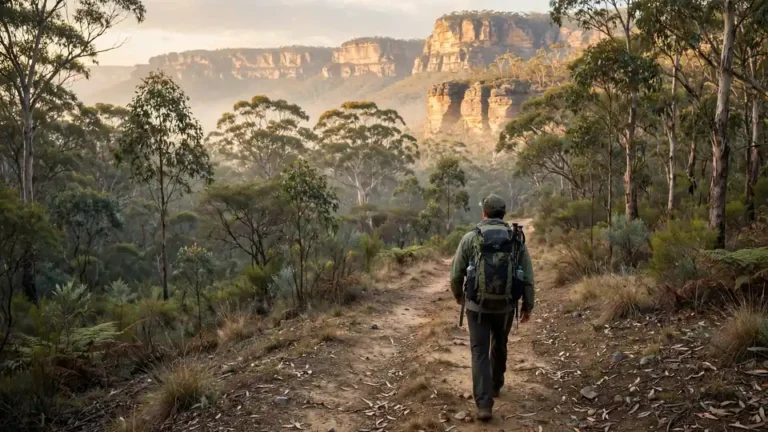
The same walker needs three different kits on Australia’s three signature long walks, which is why copying an overseas gear list fails here. On Tasmania’s Overland Track, the system is a weather system: a shelter that genuinely handles horizontal rain and the odd snow day, a sleep setup rated for below-zero nights in any month, and rain protection you can walk in all day — base weight matters less than the fact that everything works soaked. On the Larapinta Trail in the Red Centre, the system is a water system: capacity to carry four to six litres between sources outweighs every other number, sun protection is load-bearing, and the shelter can be the simplest in your cupboard because the desert sky rarely tests it. On Western Australia’s Bibbulmun Track, the system is a rhythm system: huts every day or so change the shelter maths entirely, food drops and town resupply every few days cut carried weight, and the walk rewards the lightest comfortable kit of the three. Read any ultralight advice — including the rest of this guide — through the track you are actually walking, and treat lists built for other continents as raw material, not instructions.
Where ultralight camping gear Australia walkers should never cut
Three categories sit outside the weight game. Navigation and communication: a PLB for country without coverage, a map and compass you know how to use, and a phone with the route offline — carried whole, not “optimised”. Sun protection: in Australian UV, the hat, the sunscreen and the long sleeves are medical equipment, and walkers who treat them as optional grams learn otherwise at altitude or on reflective sandstone. Water treatment: a filter or purification you trust, plus the capacity to use it, because the lightest walker in the party is the one whose water system failed. The honest framing for ultralight camping gear Australia-wide is this: cut comfort weight ruthlessly — the camp chair, the third shirt, the pillow the size of a house brick — and spend the savings on margin where the country demands it. That is not a compromise of the ultralight idea; it is the ultralight idea, applied by adults.
The spreadsheet: weighing your kit properly
None of this works on guesses or good intentions, and the ultralight community’s one genuinely universal tool is a simple list with honest weights. Kitchen scales handle everything except the pack itself (weigh that one on bathroom scales, wearing it, minus your own weight). Work through your kit in the order you pack it and record every item — the exercise takes an hour and produces the two most useful numbers in your walking life: your true base weight, and the ranked list of your heaviest items. Ranked lists end arguments: the 900-gram “lightweight” chair and the second pair of boots stop hiding in categories and stand in a column, heaviest first, waiting for a decision. Free tools like LighterPack exist for exactly this, but a notebook works. Reweigh after every purchase and every trip for the first season and the list becomes self-maintaining — new gear gets weighed at the door like a recruit. Walkers who do this once almost never go back to packing by vibes, because the spreadsheet shows them, in numbers they measured themselves, that their old “comfortable” setup was carrying the equivalent of three extra litres of water up every hill, forever, for free.
Ultralight on a budget: second-hand, sales and making do
The ultralight market’s open secret is that its devotees upgrade constantly, which makes the second-hand market unusually rich: last year’s shelter, carried twice, sells for half its ticket because its owner is chasing 90 grams. Buy used with the same audit mindset — weigh it yourself, check seam tape and zips in person where you can, and treat claimed weights as advertising. The other budget route is subtraction before purchase: most walkers’ first kilo of savings costs nothing, because it is the spare clothes, the just-in-case gadgets and the duplicate kit already in the cupboard. Then there is making do, the oldest ultralight skill of all: a cut-down closed-cell mat section that is also your sit pad and pack frame, a single pot that is genuinely enough, a rain jacket that replaces the umbrella and the windshirt. None of that photographs as well as a shopping haul, and all of it walks further. Ultralight is a practice with a budget attached, not the other way round — the spreadsheet does not care what anything cost, only what it weighs and whether it earned its place. That indifference is liberating: the walker with the audited cupboard kit and the walker with the boutique kit arrive at the same hut with the same base weight, and the track cannot tell them apart. Start where you are, weigh what you own, and let the column of numbers — not the shopping cart — lead.
Frequently asked questions
What is a good base weight for ultralight camping in Australia?
Under 7kg is a realistic first target for most walkers upgrading from traditional gear; under 4.5kg is the classic ultralight benchmark. In dry Australian country, carried water sits outside the base weight calculation and can exceed both numbers on long dry stretches.
Are quilts better than sleeping bags for ultralight hiking?
For most three-season walkers, yes: a quilt removes the insulation crushed beneath you and relies on the mat for ground insulation, saving meaningful weight. In deep winter or for very restless sleepers, a full bag can still be the wiser choice.
What R-value sleeping mat do I need?
As a working guide: R2–3 for summer lowland camping, R3–4 for three-season mountain trips, and R5 or higher for snow and alpine winter. R-values from reputable makers follow the ASTM standard and can be compared across brands.
Is ultralight gear durable enough for Australian scrub?
The lightest fabrics demand more care: keep ultralight shelters out of the worst scrub, use a groundsheet footprint where the ground is sharp, and accept shorter lifespans on the most extreme fabrics. Many Australian walkers choose mid-light gear (slightly heavier fabrics) as the durability sweet spot.