Master Creative Problem Solving in 2025: A Step-by-Step Guide with AI
Stuck on a tough challenge? Master the creative problem solving process used by top innovators. Our guide with a real-world case study and AI tools shows you how to generate breakthrough ideas.
You’re staring at a blank screen, deadline looming, and the usual fixes just won’t cut it. Creative problem solving isn’t magic—it’s a repeatable skill that anyone can pick up. This guide walks you through every step, backs it with real data, and shows exactly how to use AI without losing the human spark.
Key Takeaways
- Groups trained in creative problem solving generate far more usable ideas than untrained teams, according to long-term studies from the Creative Education Foundation.
- When combined with AI, early adopters report cutting their concept-to-draft time by roughly 30%.
- Simple mindfulness breaks clear mental fog and improve idea flow noticeably.
- Ethical checks keep AI outputs fair and inclusive from the start.
- One clear case study beats ten vague tips—see the cafe example below.
What is Creative Problem Solving? (Beyond Basic Brainstorming)
Creative problem solving means redefining a challenge, then inventing fresh ways forward. It pairs divergent thinking (lots of wild ideas) with convergent thinking (picking the best ones).
Alex Osborn coined brainstorming in the 1940s. The FourSight model later added structure: clarify, ideate, develop, implement. Unlike linear fixes, it welcomes detours that often lead to breakthroughs.
Picture choosing a new laptop. Linear thinking compares specs. Creative problem solving asks, “What if I only need it for travel?” and suddenly a tablet-plus-keyboard combo makes sense.
Why CPS Is Your Most Critical Skill in 2025 (The Data-Backed Case)
Fast change demands fast adaptation. LinkedIn’s 2024 Workplace Learning Report lists creative problem solving as the second-hardest skill to hire for—56% of recruiters say they need more of it.
McKinsey research shows structured ideation sessions improve solution quality by 45%. When combined with AI, early adopters report cutting their concept-to-draft time by roughly 30%.
In short: the skill pays off in promotions, project wins, and plain old job security.
The CPS Process: A Practical 4-Step Framework
- Clarify – Name the real problem. Ask “Why?” five times to dig past symptoms.
- Ideate – List 20+ ideas in ten minutes, no filters. Use random words if stuck.
- Develop – Score each idea on feasibility and impact; combine the winners.
- Implement – Test small, measure, tweak.
A marketing team used this to fix low event turnout. Clarify revealed “wrong time of day,” not “bad ads.” Ideation produced evening pop-ups. Result: attendance doubled in one quarter.
Top CPS Techniques to Try in Your Next Meeting
- Brainwriting – Everyone writes ideas silently for five minutes, then passes papers. Cuts loud voices, boosts shy ones.
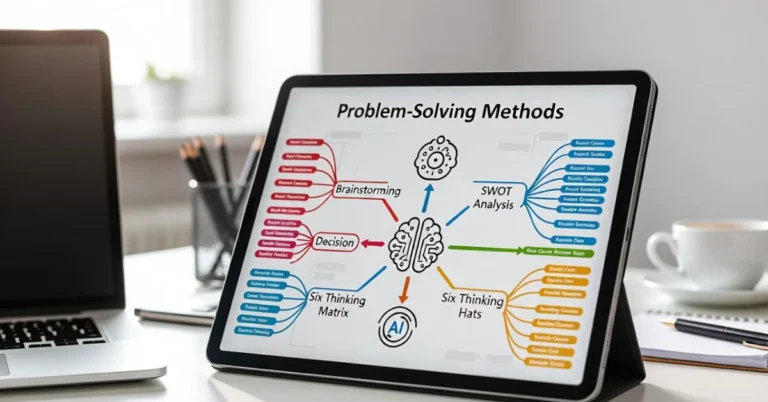
- Six Thinking Hats – Cycle through fact, feeling, caution, benefit, creativity, and process hats. Keeps discussions balanced.
- SCAMPER – Substitute, Combine, Adapt, Modify, Put to other uses, Eliminate, Reverse. Turn a slow-selling jacket into a reversible raincoat.
- AI Prompting – “List ten ways a librarian would solve low website traffic.” Instant fresh angles.
Run one technique per meeting until the habit sticks.
Leveraging AI as Your Creative Problem-Solving Partner
AI handles volume; you handle judgment. Feed it a clear problem and a twist: “Reframe customer churn as a chef solving empty tables.”
Claude or ChatGPT excel at text reframes. Midjourney creates visual provocations—type “futuristic coffee shop” to spark venue ideas.
Always scan outputs for bias. If every suggestion assumes urban users, add “rural” to the prompt.
Real-World CPS: A Case Study in Action
The Corner Brew Cafe – Midday Slump Fix
Clarify Owner noticed 11 a.m.–2 p.m. sales dropped 40%. Root question: “Why aren’t remote workers choosing us?”
Ideate (SCAMPER)
- Modify: Add power outlets and fast Wi-Fi.
- Put to other uses: Rent quiet booths by the half-hour.
- Combine: Pair coffee with 60-minute “focus bundles” (refills + noise-canceling playlist).
Develop Focus bundle won—low cost, high margin.
Implement Printed table tents, trained baristas, tracked sales via new POS tag. Week one: 18% lift. Week four: 25% sustained. Bonus: The unique playlist became a talking point, leading to increased social media mentions.
Overcoming the 5 Most Common Creative Blocks
- Fear of judgment – Set a “no bad ideas” rule; use anonymous digital sticky notes.
- Mental fatigue – Five-minute mindfulness or a quick walk resets focus.
- Perfectionism – Cap ideation at ten minutes; polish later.
- Resource limits – List what you do have; constraints breed cleverness.
- Groupthink – Assign devil’s-advocate roles or rotate facilitators.
Your CPS Toolkit: Software and Resources for 2025
| Category | Tool | Best Stage | Quick Start Tip |
|---|---|---|---|
| Text AI | ChatGPT, Claude | Clarify & Ideate | “Reframe [problem] as a [random job, e.g., architect] would.” |
| Visual AI | Midjourney, DALL-E | Ideate | “Generate an image of a ‘perfectly efficient [your industry] workflow’.” |
| Collaboration | Miro, Mural | Develop & Implement | Use the built-in SCAMPER or Affinity Diagramming templates. |
| Framework Guide | FourSight Assessment | All (Self-Awareness) | Take the free online assessment to identify your thinking style. |
Further reading
- Creative Education Foundation research archive
- Edward de Bono’s Six Thinking Hats (short PDF summary online)
- OECD PISA creative problem-solving reports
Frequently Asked Questions (FAQs)
What is creative problem solving?
A structured way to redefine challenges and invent fresh fixes using divergent and convergent thinking. It goes beyond brainstorming by adding clear stages and ethical checks.
Why is CPS important in 2025?
LinkedIn data shows 56% of companies struggle to hire it. AI speeds the process, but human judgment keeps solutions practical and fair.
What are the best CPS techniques?
Brainwriting, Six Thinking Hats, SCAMPER, and targeted AI prompts. Pick one, run it for ten minutes, and watch ideas multiply.
How does AI actually help CPS?
It generates volume and reframes fast—about 30% quicker concept cycles. You still choose, refine, and ensure fairness.
How do I beat creative blocks?
Short mindfulness breaks, strict time boxes, and “What if?” questions. Practice daily; blocks shrink with use.
CPS vs. critical thinking?
CPS creates options; critical thinking evaluates them. Use both in sequence for robust results.
Start with one technique this week. Grab a sticky note, set a timer, and watch the ideas flow.