Best Ultralight Sleeping Systems for Hiking
Disclosure: We may earn a small commission if you purchase through our links, at no extra cost to you.
Here’s the mistake most hikers make: they buy the lightest sleeping bag they can afford, then pair it with whatever mat was on sale, and wonder why they’re cold. An ultralight sleeping system isn’t a bag — it’s the bag, the mat, and the pillow working together, budgeted as one unit of weight and warmth. Get the system right and you can sleep warm at under 1.5kg total; get it wrong and you’ll carry a premium bag that underperforms because the mat lets you down. This guide shows you how to think in systems, what the best components are in Australia right now, and three complete example kits at different budgets with real weights and prices.
Think in Systems, Not Items
Your sleep system has three jobs: insulation underneath you (the mat), insulation around you (the bag or quilt), and support for your head (the pillow). They interact:
- Bag rating + mat R-value are a pair. A -5°C bag on an R-1.5 summer mat will sleep colder than a 0°C bag on an R-4.5 mat, because ground cold is the dominant heat loss. The ISO-tested bag ratings assume a mat around R-4.8 — hike with less mat and you’re hiking below the rating.
- Weight is a shared budget. Saving 200g on the bag but carrying a 700g mat is worse than a balanced 500g/400g split. Budget the system’s total, not each item’s.
- Packed volume matters as much as weight. A bag that packs to 3L and a mat that packs to 1L fit a 50L pack easily; bulky components force a bigger, heavier pack — the hidden weight penalty.
Target system weights: under 2kg is comfortable, under 1.5kg is properly ultralight, under 1kg is specialist territory with real comfort trade-offs. For most Australian three-season hiking, 1.2–1.8kg total is the sweet spot.
The Components: What’s Best in Each Slot
Sleeping bags: down rules for ultralight
For hiking, down’s warmth-to-weight ratio is unbeatable. The bags to beat in Australia:
- Sea to Summit Spark series — the Australian ultralight standard. The Women’s 7°C (around $399.90 at Snowys) weighs in the 400g region; the Women’s -1°C (around $519.90 at Snowys) is the classic three-season hiking bag; the Spark Pro range pushes further, with the -9°C Pro at $999.99 RRP for genuine winter alpine use. 850+ fill RDS-certified down, 10D fabrics, tiny packed sizes. If you buy one hiking bag in Australia, it’s probably a Spark — see the range at Sea to Summit.
- Western-style alternatives (Montbell, etc.) offer similar specs but thinner AU distribution and warranty support — factor that into the price.
Down’s weakness is moisture — on damp coastal hikes, either choose hydrophobic-treated down (standard on the Spark range) or be disciplined about airing daily. For truly wet conditions, some hikers accept synthetic’s weight penalty; for most Australian hiking, treated down wins.
Quilts: the ultralight insider’s choice
Quilts ditch the bag’s underside insulation (which your weight compresses into uselessness anyway) and the zip, saving 100–200g over an equivalent bag. They’re superb for warm sleepers and summer-to-shoulder-season hiking, and they double as camp blankets. The learning curve: draught management — you need the pad straps set right, or cold air sneaks in. Our camping quilts guide covers the best options, including Sea to Summit’s Ember range from around $300.
Sleeping mats: where warmth is won
The mat is the most underrated part of the system. For ultralight hiking:
- Therm-a-Rest NeoAir XLite NXT — the thru-hiker default worldwide: 370g (regular), R-value 4.5, packs to water-bottle size. AUD $490 RRP in Australia — expensive, but it’s the reference everything else is judged against. Warm enough for most Australian conditions including frosty shoulder seasons.
- Sea to Summit Ether Light XT / Comfort Light — the Australian alternative, slightly heavier but often comfier for side sleepers, with excellent AU warranty support.
- Closed-cell foam (Therm-a-Rest Z Lite Sol style) — ~410g, R-value 2, indestructible, doubles as a camp seat and pack frame. The budget ultralight choice; pair with realistic expectations about comfort and cold.
See our mat type comparison for the full breakdown. The key insight: in an ultralight system, the mat deserves as much budget — weight and dollars — as the bag.
Pillows: don’t skip it
A stuff sack full of clothes is free and weighs nothing extra, but a dedicated inflatable pillow (60–80g, e.g. Sea to Summit Aeros) transforms sleep quality for side sleepers. At this weight, it’s the best grams-to-comfort trade in the entire system. Bring one.
Warmth Budgeting: Matching Bag and Mat to Conditions
Use these pairings as starting points for Australian hiking:
- Summer, low altitude (nights 10°C+): 7°C bag or quilt + R-2–3 mat. System weight easily under 1kg.
- Three-season, general hiking (nights 0–10°C): -1 to -5°C bag + R-3.5–4.5 mat. The classic Australian hiking setup; 1.2–1.6kg total.
- Shoulder-season alpine (nights -5–0°C): -9°C bag + R-4.5–5+ mat. 1.5–2kg total. This is where the XLite NXT or warmer earns its keep.
- Winter alpine (below -5°C): expedition bag + R-5+ mat, often with a foam mat layered under the inflatable. Weight matters less than survival here.
Women and cold sleepers: shift everything one step warmer. A cold-sleeping woman on a “three-season” setup built for warm-sleeping men will be cold — budget the system to the sleeper, not the season. (This is also why women’s-specific bags exist: same rating, cut and filled for colder sleepers.)
Three Complete Example Kits (Verified AU Prices, Oct 2026)
Kit 1: Budget ultralight (~$450, ~1.6kg)
- Bag: A hiking-brand 0°C down bag on sale — last-season colours and Snowys/Tentworld sales regularly bring quality bags near $300
- Mat: Closed-cell foam mat (~$50–$70) — indestructible, doubles as a seat
- Pillow: Stuff sack with clothes (free)
Total: roughly $400–$450, ~1.4–1.6kg. Genuinely trail-worthy; the compromises are comfort (foam mat) and packed volume, not safety.
Kit 2: The sweet spot (~$950, ~1.2kg)
- Bag: Sea to Summit Spark -1°C Women’s/men’s equivalent (~$519.90 at Snowys)
- Mat: Mid-range insulated inflatable, R-4+ (~$300 on sale)
- Pillow: Inflatable camp pillow (~$50–$70, ~70g)
Total: roughly $900–$1,000, ~1.1–1.3kg. This is the kit most Australian thru-hikers actually carry: warm enough for the Overland Track in shoulder season, light enough for the Larapinta.
Kit 3: No-compromise (~$1,600+, under 1kg)
- Bag/quilt: Premium 850+ fill quilt or Spark Pro (~$765–$1,000)
- Mat: Therm-a-Rest NeoAir XLite NXT ($490 RRP)
- Pillow: Ultralight inflatable (~$60)
Total: ~$1,500–$1,700, under 1kg. For dedicated ultralight hikers doing big miles. The comfort trade-offs are real — thin mats and minimal bags demand good site selection and good technique.
10 Ultralight Weight-Saving Tricks (Free or Cheap)
Before spending money, harvest the free grams:
- Ditch the stuff sacks. Manufacturer stuff sacks are heavy; use one ultralight dry bag for the whole sleep system.
- Cut the mat’s straps and labels. Trivial individually, but the ultralight mindset is cumulative.
- Leave the pump sack home once you’re confident mouth-inflating — saves 50–70g (but keep it while learning; moisture from breath degrades mats over time).
- Use your pack as a pillow booster. An inflatable pillow on top of your packed clothes bag is height-adjustable and free.
- Short mats for short people. If you’re under 170cm, a short mat saves 100g+ with zero comfort loss.
- Quilt instead of bag when conditions allow — 100–200g saved.
- Wear your insulation to bed. Your puffy jacket is warmth you’re already carrying; sleeping in it extends your bag’s range.
- Share tent, share weight. Hiking as a pair? Split the tent and share a double quilt system.
- Decant repair kits. Carry patches and a tiny tube of sealant, not the whole retail kit.
- Weigh everything. Kitchen scales don’t lie; most hikers find 200g of “mystery weight” they can cut once they measure.
Common Ultralight System Mistakes
- Too much bag, too little mat. The classic. A $1,000 bag on an R-2 mat sleeps cold. Balance the budget toward the mat.
- Ignoring packed volume. A cheap bulky bag forces a bigger pack, adding 300–500g of pack weight — wiping out the “saving.”
- No margin for the sleeper. Building the system for a warm-sleeping man and handing it to a cold-sleeping woman. Budget to the actual sleeper.
- Skipping the pillow. “I’ll use my clothes” works for one night; by night four your neck disagrees. 70g is cheap.
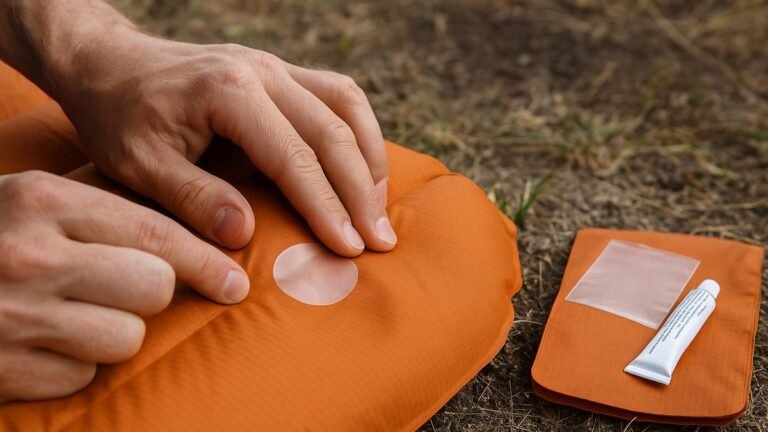
- Forgetting repair capability. Ultralight mats are thinner and more puncture-prone. Always carry patches — see how to fix a leaking mat.
- Chasing grams past comfort. There’s a line where lighter stops being enjoyable. A system you dread sleeping in is a failed system regardless of weight.
System Skills That Matter More Than Gear
The lightest kit in the world won’t save you from bad technique:
- Site selection: camp out of wind hollows and frost pockets; a sheltered site is worth degrees of warmth.
- Change into dry sleep clothes: never sleep in hiking clothes. Dry base layers, dry socks, beanie.
- Eat and hydrate before bed: your body is the furnace; fuel it.
- Vent the tent: condensation wetting your bag destroys insulation. Crack vents even in cold weather.
- Warm the bag before sleep: do star jumps or fill a bottle with warm water — climbing into a cold bag with a cold body is a long road to warm.
For the full cold-weather playbook, see how to stay warm camping in winter.
When Ultralight Goes Wrong: Real Scenarios
Ultralight isn’t automatically right. Consider these:
The Tasmanian winter hiker. A 500g quilt system at -5°C in driving rain is a survival exercise, not a holiday. Tasmania’s weather demands margin — here, a 1.2kg bag at the right rating is the smarter lightweight choice, because a bag you survive in beats a quilt you shiver in. Ultralight in Tassie means a quality 4-season tent and a properly rated bag, not the absolute minimum.
The beginner chasing grams. A first-time hiker with a 700g sleep system but no idea how to use it sleeps worse than a beginner with a 1.5kg system they understand. Skills first, grams second — the weight savings of a quilt are worthless if you can’t manage the draughts.
The cold sleeper in denial. Some people just sleep cold — physiology, not attitude. If you’re always cold, add 5°C to every rating and carry the heavier bag without guilt. The ultralight community’s warmth is calibrated to warm sleepers; adjust for yourself honestly.
The pattern: ultralight works when the gear, the skills, and the conditions align. Remove any one of those and it fails. Build the skills and know your body before you chase the grams. And remember that comfort is personal — the hiker sleeping soundly on a 900g system they trust is doing ultralight right, while the hiker shivering on a 600g system they’re afraid of is just doing light. There’s no prize for the lightest pack on the track — only for the best nights under the stars.
Frequently Asked Questions
What is an ultralight sleeping system?
Your bag (or quilt), sleeping mat, and pillow treated as one unit — budgeted together for total weight, packed volume, and warmth. The components interact: a warm bag on a cold mat sleeps cold, so they must be matched.
How light can a sleep system go while staying warm?
For three-season Australian hiking, 1.2–1.6kg total is the practical sweet spot. Under 1kg is possible with premium gear but involves real comfort trade-offs. Under 2kg is comfortable and achievable on a budget.
Quilt or sleeping bag for ultralight hiking?
Quilts save 100–200g and pack smaller, and suit warm sleepers and mild conditions. Bags are simpler, draught-free, and better for cold sleepers and cold conditions. Most hikers start with a bag and graduate to quilts.
Is the Therm-a-Rest NeoAir XLite worth $490 in Australia?
If you hike regularly in cool conditions, yes — it’s the benchmark for warmth-to-weight (R-4.5 at 370g) and lasts years. For occasional hiking, a mid-range insulated mat at half the price gets you 90% of the performance.
Can I build an ultralight system on a budget?
Yes. A sale-priced down bag, a closed-cell foam mat, and a clothes-stuff-sack pillow get you a trail-worthy system around $400–$450 and 1.5kg. Spend later on the mat first — it’s the highest-value upgrade.
← Back to our complete guide: Best Sleeping Bags Australia 2026