Solar Blankets vs Rigid Panels
Disclosure: We may earn a small commission if you purchase through our links, at no extra cost to you.
Solar blanket vs solar panel is the choice that confuses more camping solar buyers than any other — and most advice picks a side instead of explaining the trade-off. Here’s the truth: they’re genuinely different tools. Blankets win on packability and versatility; rigid panels win on efficiency, durability and price per watt. The right choice depends on your vehicle, your trips, and how much you value watts versus pack space. This guide compares them properly across every dimension that matters, with real Australian prices and a decision matrix at the end.
For the broader picture, see our best solar panels for camping roundup and the solar sizing guide (work out how many watts you need before choosing the form factor).
Solar Blanket vs Solar Panel: What Each One Actually Is
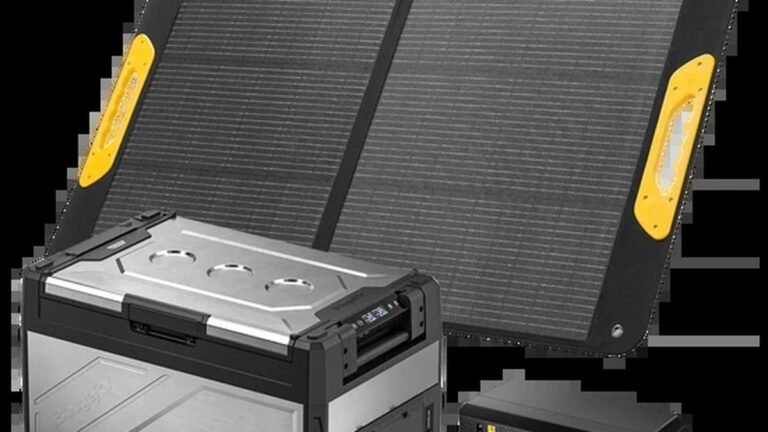
Rigid panels are the classic solar panel: aluminium frame, glass front, silicon cells in a fixed flat rectangle. They’re what you picture when someone says “solar panel” — and what sits on most house roofs. In camping, they come as fixed-mount panels (bolted to roof/canopy) or portable folding panels (hinged sections in a carry case).
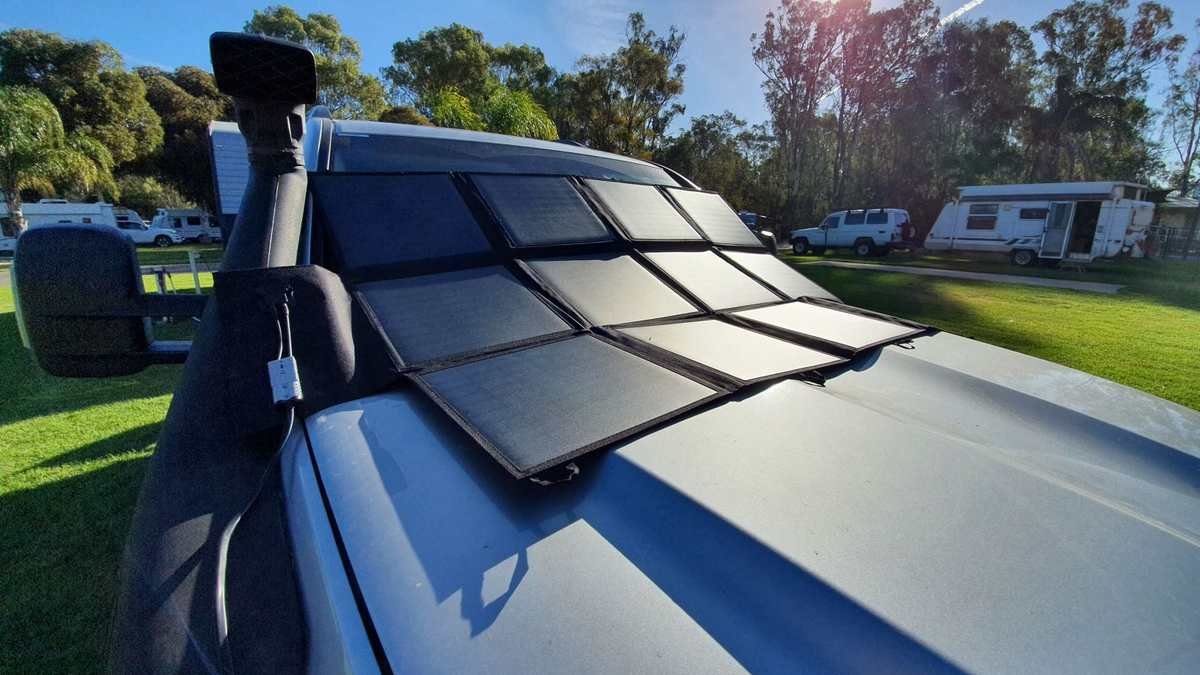
Solar blankets (flexible panels) use the same photovoltaic cells but laminated in flexible materials instead of glass and aluminium frame. They roll or fold up, drape over curved surfaces (bonnets, roofs, tents), and pack far smaller than rigid panels of equivalent wattage. The KickAss flexible ETFE panels are the best-known Australian example — and the product most campers picture when they hear “solar blanket.” Despite the name, there’s no fabric involved; it’s a fully sealed, weatherproof panel that just happens to bend.
Head-to-Head Comparison
| Solar blanket (flexible) | Rigid panel | |
|---|---|---|
| Efficiency | Good (18–22%) | Best (20–23%) |
| Price per watt (AU) | Higher (~$1.30–1.80/W) | Lower (~$1.00–1.40/W) |
| Weight (170W) | ~3–4 kg | ~12–15 kg |
| Packed size (170W) | Tiny (rolls/folds) | Large (fixed rectangle) |
| Durability | Good; vulnerable to puncture/creases | Excellent; glass + frame |
| Lifespan | 5–10 years typical | 15–25 years typical |
| Mounting | Curved surfaces, temporary | Flat surfaces, permanent or portable |
| Angling to sun | Hard (lies flat) | Easy (stands/tilts) |
| Heat performance | Worse (no airflow underneath) | Better (air gap cools) |
Efficiency and Real-World Output
On paper the efficiency gap looks small — a few percentage points. In practice it compounds: rigid panels run cooler (airflow underneath), angle optimally toward the sun (portable ones on stands), and maintain output over years with less degradation. A blanket laid flat on a hot bonnet at midday can run 20–30°C hotter than a tilted rigid panel, and heat directly cuts output — that “small” efficiency gap becomes 15–25% less harvest in harsh conditions. For weekend use the difference is academic; for full-time touring it’s the difference between comfort and rationing.
Durability: The Long-Term Story
Rigid panels are built like tanks — glass, aluminium frame, sealed junction box. They survive hail, being strapped to roof racks, and a decade of corrugations. Flexible blankets are tougher than they look (ETFE coating is remarkably resilient), but they’re vulnerable to what rigid panels shrug off: sharp creases (never fold against the crease direction), punctures from gear, and long-term UV degradation of the flexible laminate. Treat a blanket well and it’ll do 5–10 years; abuse it and it won’t. A rigid panel tolerates far more abuse for far longer. If you’re buying once for a decade of touring, rigid wins. If you need portable power for weekends and holidays, a blanket’s lifespan is plenty.
Price Per Watt: The Maths
Using real Australian prices: a KickAss 170W flexible ETFE blanket at $219.95 = $1.29/W. A KickAss 170W fixed glass panel in the MPPT bundle at $338.95 (panel + controller + cables) is harder to compare directly, but bare 170W fixed panels run ~$229–294 = $1.35–1.73/W before the regulator. Folding portable rigid panels (120W at $269.95 = $2.25/W) carry a portability premium. The honest summary: bare watts are cheapest as fixed rigid; portability costs extra in either form; blankets sit in the middle on price but win on pack size. Don’t choose on price per watt alone — choose on watts per available space, which is the real constraint in most vehicles.
The Decision Matrix
Choose a solar blanket if: you have a curved roof or no flat mounting space; pack space is your binding constraint (small car, motorbike, kayak); you want something to drape over the bonnet/tent at camp and roll away after; your trips are weekends to a few weeks.
Choose rigid panels if: you have roof/canopy space for permanent mounting; you’re touring long-term and want maximum harvest and lifespan; you want the cheapest watts; you camp in extreme heat (the cooling advantage matters).
Choose folding portable rigid if: you park in shade and want to place panels in the sun; you want tiltable, aimable panels without installation; you’re between the two — more durable than a blanket, more portable than fixed.
The combo many tourers run: fixed rigid on the roof for baseline harvest while driving and parked, plus a blanket or folding panel for deployable extra when camped in shade. Belt and braces, and each covers the other’s weakness.
Installation and Setup Realities
Blankets: gloriously simple — unroll, lay flat, connect. No mounting hardware, no drilling, no permanent commitment. The simplicity is the selling point. Downsides: they can blow away in wind (weigh down corners), they’re awkward to angle (propping one up is a DIY project), and laying them on hot surfaces costs output.
Fixed rigid: requires mounting — brackets, sealant, cable routing through the roof. A weekend DIY job or a few hundred dollars at an installer. Once done, it’s invisible and automatic: you park, it charges. The set-and-forget factor is enormous for tourers.
Folding portable: unfold, prop on the stand, connect. Two minutes. The sweet spot for renters, leased vehicles, and anyone who doesn’t want to drill holes in their roof.
Care and Maintenance
Both types need the same basic care: keep them clean (dust and bird droppings cut output), check cables and connectors for corrosion, and store dry. Blankets need one extra rule: never crease sharply or stack heavy gear on them — micro-cracks in the cells are invisible and permanent. Roll loosely or fold only along designed fold lines. Rigid panels need their mounts checked periodically — vibration loosens bolts, and a panel departing the roof at 110 km/h is everyone’s bad day. Inspect mounting hardware annually.
Real-World Scenarios: Which Wins Where?
Weekend family camping, small SUV: Blanket. Pack space is the constraint, trips are short, and a 170W blanket ($219.95) draped over the bonnet at camp covers devices and lights easily. A rigid panel wouldn’t fit the roof rails anyway.
Grey nomads, 6-month lap, 4WD + caravan: Rigid, no contest. Fixed panels on the caravan roof (400–600W) harvesting every driving and parked hour, built to survive years of corrugations. The efficiency and durability advantages compound over months.
Touring motorbike: Blanket. It’s the only thing that packs small enough and drapes over a tent or bike. Rigid isn’t an option.
Weekend warrior with roof basket: Folding portable rigid. Strap it in the basket, unfold at camp, tilt at the sun. More efficient than a blanket, nearly as convenient.
Shady campsites: Portable of either type — fixed roof panels are useless if you always park under trees. Being able to place the panel 10m away in the sun beats any efficiency spec.
Warranty Realities
Rigid panels typically carry 10–12 year product warranties and 25-year performance warranties — the industry is mature and the guarantees are real. Flexible blankets usually offer 2–5 year product warranties, reflecting their shorter expected life and the newer technology. As with all warranties, the company behind it matters more than the number: a 5-year warranty from an established Australian brand beats a 10-year warranty from a fly-by-night importer. Register your panel, keep the receipt, and photograph the serial number.
What’s Changing: The Future of Portable Solar
The gap is narrowing. Newer flexible panels using ETFE and improved cell tech are closing the efficiency and durability gap — some premium flexible panels now match rigid efficiency and offer 10-year warranties. Perovskite and tandem cells promise another leap, though they’re not in camping products yet. Prices continue to fall across both types. Our advice: buy for your needs today, not for technology that might arrive tomorrow. A panel earning its keep now beats a better panel in three years — and solar is one category where waiting rarely pays, because the savings start the day you install.
Blanket and Panel Myths
“Blankets are fragile toys.” Quality ETFE blankets are genuinely tough — they survive being driven over in demos (don’t try it). They’re less durable than rigid, not fragile.
“Rigid panels are too heavy for camping.” A 170W rigid panel is 12–15 kg — noticeable, but fine on a roof rack. The weight argument only bites for hiking and motorbikes.
“You need the same brand panel and regulator.” No — any quality MPPT regulator works with any panel, provided voltage/current specs are compatible. Mix and match freely.
“More watts always wins.” Only if you can place them in sun. A well-placed 170W blanket out-harvests a shaded 300W rigid array every time. Placement beats wattage.
The Cost of Getting It Wrong
Choose wrong and it costs real money. Buy a blanket when you needed fixed rigid for full-time touring, and you’ll replace it in 3–4 years ($220+) plus suffer years of suboptimal harvest. Buy fixed rigid when you needed portable, and you’ve drilled holes in your roof for panels that sit in shade while you wish you’d bought the blanket. The expensive mistake isn’t the price difference between types — it’s buying twice. Spend the hour with the decision matrix above and the sizing guide before spending the dollars. An hour of thinking saves hundreds of dollars and years of mild regret.
What We’d Buy: Three Setups
The weekender (small car, no roof space): KickAss 170W flexible blanket ($219.95) + existing battery. Unroll at camp, roll away after. Simple, effective, minimal investment.
The tourer (4WD + rooftop tent): 170W fixed glass panel on the roof ($229–294) + 20A MPPT, installed once. Automatic charging every driving and parked hour, zero daily effort.
The grey nomad (caravan, 6-month lap): 400W+ fixed rigid on the van roof + 200W folding portable for shady sites + 40A DC-DC. The complete system that never thinks about power.
Notice the pattern: the vehicle and trip style dictate the form factor, the sizing maths dictates the watts. Get those two right and the brand choice is secondary.
The Bottom Line
Blankets win on packability, versatility and simplicity; rigid panels win on efficiency, durability, lifespan and long-term value. Most weekend and holiday campers should choose based on their vehicle: no roof space or tiny car → blanket; roof space and long trips → rigid; shade-parking or no-drill preference → folding portable. Full-time tourers: fixed rigid for the baseline plus something portable for the shade days. And whatever you choose, size it with the sizing guide first — the right watts in the wrong form factor still disappoint, but the wrong watts in the right form factor definitely do. An hour of planning now saves years of mild regret later.
FAQs
Are solar blankets as good as rigid panels?
For portability and pack size, yes — unbeatable. For efficiency, durability, lifespan and price per watt, rigid panels win. They’re different tools; match the tool to your vehicle and trips.
How long do flexible solar panels last?
Typically 5–10 years with good care. Less than rigid panels (15–25 years) due to flexible laminate degradation and vulnerability to creasing/punctures. Fine for weekend/holiday use; tourers should weigh the replacement cycle.
Can you walk on flexible solar panels?
No — don’t. They’re flexible, not indestructible. Foot traffic causes micro-cracks that permanently reduce output. They’re designed to conform to surfaces, not to be stood on.
Do solar blankets work on cloudy days?
Yes, at reduced output like all panels (10–30% in heavy cloud). Their lower peak efficiency means they produce slightly less than rigid in poor light — another reason to oversize.
← Back to our complete guide: Best Solar Panels for Camping Australia 2026