Camping With Dogs Australia
Disclosure: We may earn a small commission if you purchase through our links, at no extra cost to you.
More Australians camp with their dog than without one, but the rules are a patchwork that catches people out every long weekend. Camping with dogs Australia-wide comes down to one big divide: national parks are closed to dogs in every state, while state forests, many council reserves, station stays and most caravan parks welcome them under conditions. This guide maps where your dog can legally sleep, the etiquette that keeps those places open, and the gear that makes a dog a good camp citizen.
The single most reliable dog-camping system in the country is NSW’s state forests: as the Forestry Corporation puts it on its camping in NSW state forests page, “even your best friend is welcome — you can bring your dog but always make sure it’s under control”, and the camping itself is free. Other states have their own forest and reserve systems with similar principles; always confirm the specific forest or reserve before you travel, because local closures and control-area rules change.
- Dogs are banned from national parks in every Australian state — no exceptions for dogs staying in the car.
- State forests (especially NSW), council reserves, station stays and many caravan parks are the dog-camping systems.
- Under control means on a lead or tethered at camp, all the time — and bring more water for the dog than you think.
Camping with dogs Australia rules, state by state
The national parks rule is absolute and national: dogs (and all pets) are prohibited in national parks across Australia to protect native wildlife, and rangers fine owners — including for dogs that never leave the vehicle. Guide and assistance dogs are the standing exception. Beyond the parks, the map opens up. NSW state forests allow dogs under control across the system. Victorian state forests and many regional parks similarly allow dogs on lead, with individual forest rules. Queensland’s genuine dog-camping is mostly council free camps and caravan parks — QPWS parks and forests are off-limits to dogs like the rest of the national estate. South Australia, Tasmania and WA repeat the pattern: parks closed, forests and council/commercial sites open with conditions. The working rule for trip planning: build the route on forests, reserves and parks that take dogs, and treat national parks as day trips where the dog stays with a non-walking partner or at home — never in a hot car.
Where dog campers actually stay
In practice, dog-camping trips assemble from four building blocks. State forests are the backbone — free or cheap, spacious, and your dog is a normal part of the scene (our guide to free camping spots in NSW is built largely on these forests and notes the dog rules site by site). Council reserves and showgrounds are the second block, and many of the travelling-dog favourites in every state are council sites. Station stays and farm stays are the third, and they often suit dogs best of all — ask about resident working dogs and livestock before you book. Caravan parks are the fourth: most take dogs on designated sites or in designated seasons, with rules about breeds, numbers and leaving dogs unattended that vary park by park. Book ahead in holiday periods; dog sites are the first to go in many parks.
Camp etiquette: the rules that keep dogs welcome
Dog camping survives on the behaviour of the worst camper present, so be the best. At camp, your dog is on a lead or a tether with enough length to reach shade and water and not enough to reach the neighbours. Waste is picked up immediately and carried out like all rubbish — “bush etiquette” does not exempt dog waste near campsites and waterways. Barking is managed, not endured by the whole campground: a dog that barks at every wallaby will be miserable in a forest full of wallabies, so work on settle training before the big trip and bring the familiar bedding and chew that help. Wildlife gets right of way in every encounter — a dog that chases is a dog that goes home early, and in snake country a recall you can trust is a safety device, covered below. Finally, never leave a dog alone in a vehicle or tied at an empty camp in heat; the temperatures that build inside a car or an unshaded tent are lethal on timescales that surprise people every summer.
Gear for the dog: what to pack
The dog’s kit list is short and mostly cheap. A flat collar with ID tags showing your mobile number (you are often out of reception, but the tag is how a found dog gets home), a sturdy lead plus a longer tether line or screw-in anchor for camp, and a harness for walking rough tracks. Their own mat or blanket — familiar-smelling bedding settles dogs faster than anything you can buy. Food in a sealed container (camp smells attract every animal in the district, including your own dog at 3am), a collapsible water bowl, and more water than your instinct says: dogs drink heavily in heat and cannot tell you early enough. A basic pet first aid addition — bandage, tweezers for ticks and grass seeds, and your vet’s number saved offline. In tick country on the east coast, keep your dog’s paralysis tick prevention current and check them daily, paws and ears included; it is the single highest-value health habit in Australian dog camping. For the humans’ side of the setup, our best camping spots in Australia guide flags which regions are forest-based and therefore dog-feasible.
Snakes, heat and the other honest risks
Two risks dominate dog camping in Australia. Snakes: dogs investigate what people avoid, and most snake bites to dogs happen around camp and on the walk to the toilet block at dusk. Keep the dog on a short lead in long grass and rock country, clear the immediate camp area, and know the nearest vet to every campsite before you arrive — write it in your trip notes, because snakebite treatment is a race. Heat: dogs overheat faster than fit humans and hide it badly. Walk early and late, carry their water on every walk, stop for shade before they ask, and treat a hot day as a rest day at the river rather than a hiking day. Neither risk is a reason to leave the dog home — they are the reason dog campers plan a little better than everyone else.
Camping with dogs Australia road trips: planning the route
A dog changes route planning from a scenery exercise into a logistics one, and camping with dogs Australia travellers do well is planned backwards from the dog’s needs. Anchor the trip on dog-legal overnight systems — forests, council reserves, station stays — and plot national parks as lookouts and short walks where one person stays with the dog, or as rest days where the dog has a booked, supervised stay locally. Check every overnight against its current rules a week out, not the night before; dog policies at caravan parks tighten in peak season and council reserves occasionally change hands. Plan driving days shorter than you would solo: a dog needs a leg-stretch and water stop every couple of hours, and the servo-and-oval stops that creates become part of the trip’s rhythm. Keep one flexibility day in hand for the inevitable discovery — the forest closed for hazard reduction, the reserve full of a campdraft crowd — because with a dog aboard, the plan B is harder to improvise. Campers who do this planning once, properly, tend to repeat the same network of trusted sites for years; camping with dogs in Australia rewards regulars, because rangers, caretakers and park managers remember the campers whose dogs were never the problem.
Training before the trip: the month that decides everything
The difference between a dog that camps well and a dog that ends trips is usually four weeks of boring training at home. Teach a solid settle on a mat — the mat becomes the dog’s place at camp, in the tent annexe and at the pub garden alike. Practise sleeping arrangements before you go: a dog that has never slept in a tent will investigate the walls at 2am the first night, so pitch the tent in the backyard for a couple of nights and let it become dull. Proof the recall around distractions that resemble camp — other dogs, food on the ground, wildlife smells if you can arrange them — because that recall is your emergency brake in snake and livestock country. Finally, run a single overnight shakedown trip close to home before any long tour: you will learn your dog’s actual water intake, bedding preference and dawn routine at the cost of one short drive, instead of discovering them three days from the nearest vet. None of this requires a professional trainer for most dogs; it requires the month, which is exactly why so few people do it — and why the dogs at well-run campgrounds are so noticeably the trained ones.
Where does the dog sleep?
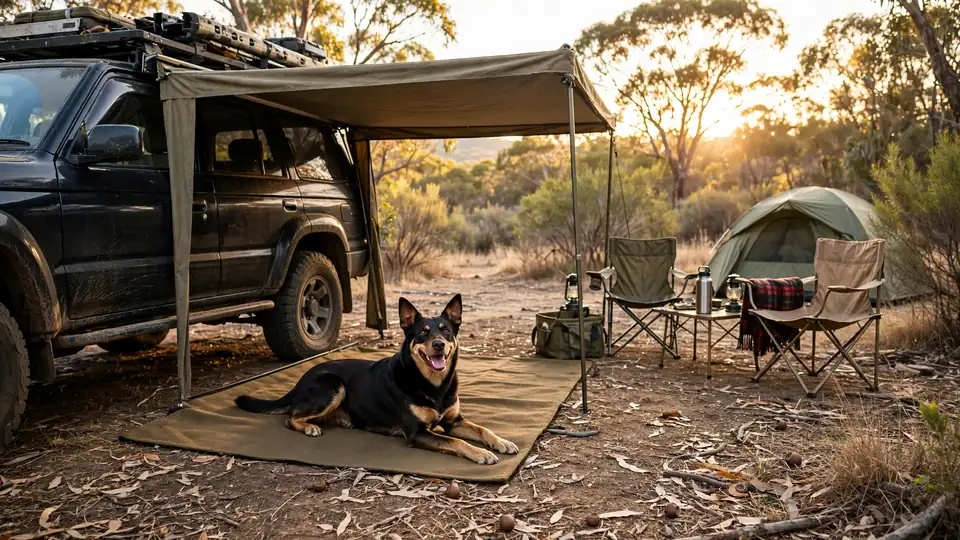
Three arrangements cover most campers, and the right one is whichever your dog has practised. In the tent or swag annexe suits most dogs best: their mat inside the door, familiar smells, and a human within reach — allow for the reality that a wet dog in a two-person tent is a team decision, and bring the towel that makes it workable. In the vehicle suits well-trained dogs in mild weather with windows managed for airflow, and is never acceptable in heat or sun regardless of the hour. Outside on a tether under the awning works for hardy dogs in safe areas, with the understanding that wildlife visits at night and a barking dog at 3am is a campground-wide event. Whichever you choose, rehearse it in the backyard first. However you arrange it, camping with dogs Australia-wide works on the same principle as everything else in this guide: the dog’s comfort and the neighbours’ peace are planned, not hoped for — and the campers who plan them are the ones still welcome back next season.
The first-trip checklist, in one paragraph
Book a dog-legal site within two hours of home. Pack the dog’s mat, food, water, lead, tether and vet details. Confirm tick prevention if you are anywhere on the east coast. Arrive in daylight, walk the boundary on the lead, set the mat up before your own chair, and keep the first evening boring. Cook, settle, sleep, and review in the morning: what the dog drank, where they slept, what they barked at. That single page of notes is the foundation of every good dog trip after it — most campers need exactly one shakedown to become competent dog campers, and the ones who skip it do their learning in front of an audience, three days from home.
Frequently asked questions
Can you take dogs camping in Australian national parks?
No. Dogs and other pets are prohibited in national parks in every Australian state and territory, including inside vehicles, with assistance dogs the standard exception. Fines apply. Use state forests, council reserves, station stays and dog-friendly caravan parks instead.
Where can I camp with my dog for free?
NSW state forests are the biggest free dog-camping system in the country: free camping, dogs welcome under control, four-week maximum stays. Many council free camps in other states also accept dogs — check the specific site’s rules before you travel.
Can my dog be off lead at a dog-friendly campsite?
Generally no: “dogs welcome” almost always means dogs under control, which in practice is on a lead or tethered at camp. Some forests and reserves allow off-lead exercise away from camping and picnic areas if the dog is under effective control — follow the signage at your specific site.
What should I pack for camping with my dog?
Collar with ID tags and your mobile number, lead plus a camp tether, harness for rough tracks, familiar bedding, sealed food storage, collapsible water bowl and extra water, tick prevention current for east-coast travel, and your vet’s details saved offline.