Best Tyre Deflators & Air Compressors Australia
Disclosure: We may earn a small commission if you purchase through our links, at no extra cost to you.
Best tyre deflators air compressors make tyre pressure changes fast and accurate. Tyre pressure is the cheapest performance modification in 4WDing — and the most neglected. Dropping from 36psi to 18psi transforms a 4WD on sand: the tyre’s footprint roughly doubles, it floats instead of digging, and tracks that were impassable become comfortable. But the system only works if you can deflate accurately and re-inflate reliably. The best tyre deflators and air compressors in Australia aren’t glamorous purchases, but they’re the tools you’ll use more than any other piece of 4WD gear.
This guide covers both halves of the workflow — getting air out precisely, and getting it back in — with real 2026 prices and the pressure charts that make it all work. For the driving technique that goes with the pressures, see our sand driving guide.
Why Tyre Pressure Matters More Than Tread
An aggressive mud tyre at 36psi will bog where a highway tyre at 16psi floats through. That’s not an exaggeration — it’s physics. Lower pressure increases the contact patch (the tyre’s footprint on the ground), which:
- Spreads the vehicle’s weight over a larger area, reducing ground pressure so the tyre rides on top of soft surfaces instead of sinking.
- Lets the tyre conform to rocks and ruts, improving grip on uneven terrain.
- Improves ride comfort dramatically on corrugations — the tyre absorbs what the suspension can’t.
The trade-off: soft tyres generate more heat, handle worse, and can roll off the rim in extreme cases. That’s why you re-inflate for bitumen — and why the compressor half of this equation is non-negotiable. Deflating without a reliable way to re-inflate is how people end up driving 80km of highway on 18psi and destroying $2,000 worth of tyres.
The Pressure Chart: What to Run Where
These are starting points for a typical 2.5–3.5 tonne touring 4WD on standard all-terrain tyres. Adjust for your vehicle’s weight — heavier rigs need slightly more pressure, lighter rigs slightly less.
| Terrain | Pressure (psi) | Notes |
|---|---|---|
| Bitumen / highway | 36–40 | Manufacturer spec; check the placard |
| Gravel roads | 28–32 | Better ride, better grip, less puncture risk |
| Corrugations | 24–28 | The single biggest comfort improvement available |
| Rocky tracks | 22–26 | Conformity over sharp edges; go slow |
| General off-road (mud, clay) | 18–22 | Standard trail pressure |
| Sand (firm beach) | 16–18 | The classic beach pressure |
| Sand (soft, Simpson-type) | 12–16 | Minimum for most; carry a compressor! |
| Emergency (deeply bogged) | 8–12 | Last resort; high debead risk; re-inflate ASAP |
Two rules: never exceed ~80km/h on soft tyres (heat buildup destroys them), and re-inflate before any sustained bitumen driving. The drive from the beach to the servo on 16psi is fine; the 200km highway leg home is not.
Tyre Deflators: The Options
Automatic deflators (Staun and similar)
Staun deflators are the Australian classic — brass valves you screw onto each tyre, preset to your desired pressure (they come set to 18psi, adjustable from 6–30psi). They bleed air automatically and stop at the preset. Screw on four, make a cuppa, come back to four tyres at exactly 18psi. Australian made, around $99.99 AUD for a set of four at Anaconda (often on sale around $89.99).
The genius is consistency: all four tyres end up identical without you crouching at each one with a gauge. The downside is they’re preset to one pressure — if you want 16psi for sand and 26psi for corrugations, you’re either adjusting them (fiddly) or owning two sets. Most tourers set them to their most-used off-road pressure and fine-tune with a gauge for the rest.
Gauge-type rapid deflators
These screw onto the valve and vent air fast while showing live pressure on a gauge — you pull them off at your target. Quicker per-tyre than Stauns for one-off adjustments, and you can hit any pressure you want. ARB’s E-Z deflator is the well-known option (~$60–$80 AUD). The trade-off: you’re crouching at each tyre, and doing all four takes longer than a set of Stauns working simultaneously.
The stick method (free, terrible)
Pushing the valve core with a stick, key, or matchstick works — and it’s how everyone starts. It’s also slow, wildly inaccurate, and keeps you bent double in the sun. Buy proper deflators. This is a $90 problem, not a lifestyle.
Air Compressors: The Options
A compressor’s job: re-inflate four tyres from ~16psi to ~36psi in reasonable time, repeatedly, in dusty hot conditions, without dying. Here’s what matters:
- Flow rate (litres/min): the honest measure of speed. 40–60 L/min is adequate; 80+ L/min is fast; 170 L/min (ARB twin) is glorious.
- Duty cycle: how long it can run before needing a rest. A 50% duty cycle means 30 minutes on, 30 off. A 100% duty cycle (ARB twin) means it just keeps going. This matters enormously when you’re doing four big 4WD tyres plus a camper trailer’s.
- Current draw: big compressors pull 40–50A. Your wiring and battery need to handle it — this is why hard-mounted compressors are wired with heavy cable direct to the battery.
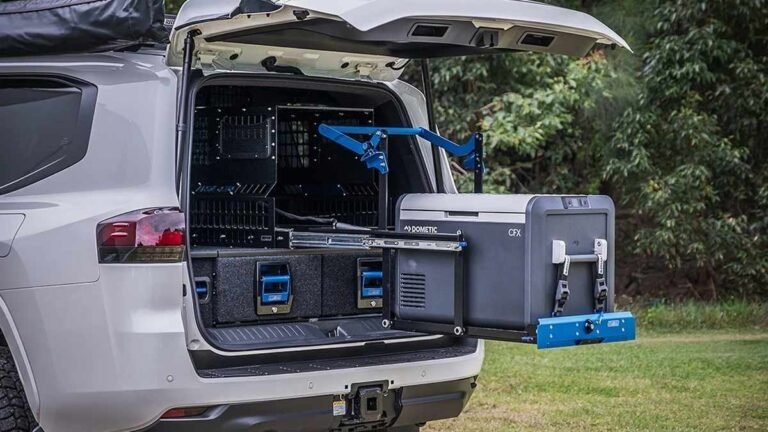
- Portable vs mounted: portable units live in a bag and clip to the battery; mounted units live under the bonnet or in the tub with a dash switch. Mounted is more convenient; portable works across multiple vehicles.
| Compressor | Type | Flow | Duty cycle | Typical AU price |
|---|---|---|---|---|
| ARB CKMA12 (single) | On-board | ~87 L/min | 50% | ~$441 |
| ARB CKMTA12 (twin) | On-board | ~174 L/min | 100% | ~$817 |
| Bushranger / TJM single | Portable | ~70–80 L/min | ~50% | ~$250–$350 |
| Kings 12V compressor | Portable | ~60 L/min | ~40% | ~$80–$120 |
1. ARB CKMA12 — The Benchmark Single
The ARB single compressor (~$441 AUD) has been the default 4WD compressor for over a decade. Australian designed and made, sealed against dust and moisture, with a flow rate that inflates a 33″ tyre from 18 to 36psi in a few minutes. The 50% duty cycle means pacing yourself on big jobs — do two tyres, let it rest, do two more.
For most tourers running standard all-terrains, the single is plenty. It’s the compressor your auto electrician will recommend, and the one you’ll still be using in ten years.
2. ARB CKMTA12 Twin — For the Impatient (and Big Tyres)
The twin (~$817 AUD) doubles the flow to ~174 L/min with a 100% duty cycle — it inflates four 35″ tyres back-to-back without breaking a sweat. If you run big muddies, tow a camper with six tyres to inflate, or just hate waiting, the twin earns its premium every single trip.
It pulls ~50A, so it needs proper heavy-gauge wiring and ideally a dual-battery system. This is a serious piece of gear for serious setups.
3. Mid-Range Portables — The Sensible Compromise
Bushranger, TJM, and similar single-cylinder portables ($250–$350) offer 70–80 L/min in a bag you can move between vehicles. Slower than the ARB single and less durable, but perfectly functional for occasional use. A good choice for the weekender who airs down a few times a year.
4. Budget Portables — Know the Limits
Sub-$120 compressors (Kings and similar) will inflate your tyres — eventually. Low flow rates, short duty cycles, and questionable longevity mean a four-tyre re-inflation becomes a 30-minute exercise with rest breaks. Fine as a backup or for very occasional use; frustrating as a primary compressor on a touring rig. If your budget only stretches here, it still beats no compressor at all.
The Workflow: Deflate, Drive, Re-inflate
The complete procedure at a beach access track:
- Before the soft stuff: stop on firm ground, screw on the Stauns (or use the gauge deflator), wait for them to finish. Check with a gauge — trust but verify.
- Drive: engage 4WD, use momentum, avoid sharp turns on soft sand (that’s how tyres debead). Keep speed moderate.
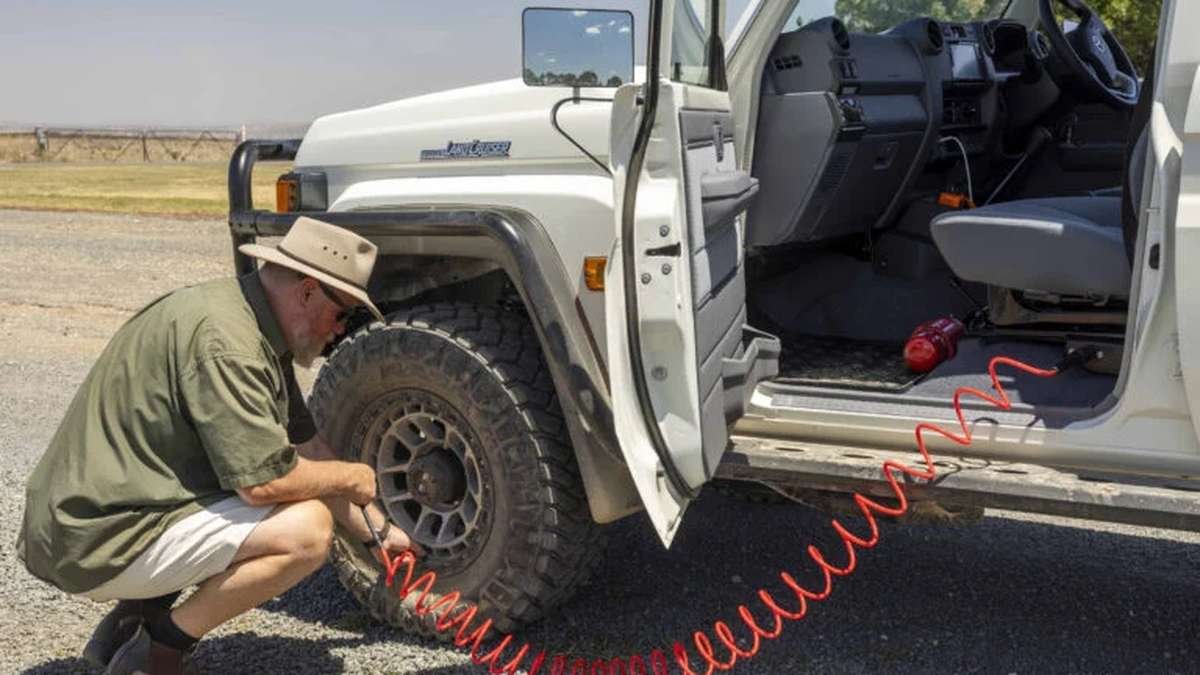
- After: before hitting bitumen, re-inflate. Connect the compressor, do all four tyres (plus trailer), checking pressure with a gauge as you go. Don’t rely on the compressor’s built-in gauge alone — they’re often optimistic.
- Inspect: soft driving stresses sidewalls. Quick visual check for damage while the compressor runs.
Total time with good gear: ~5 minutes to deflate four tyres with Stauns, ~10–15 minutes to re-inflate with a decent compressor. Total time with bad gear: long enough that you’ll start skipping it — which is when the bogging starts.
A quality tyre gauge ($15–$30 for a decent analogue one) lives in the glovebox permanently. Compressor gauges lie; Stauns are accurate but worth verifying; a standalone gauge is the referee.
Deflators and compressors are one half of the traction equation — the other half is knowing what to do when correct pressures alone aren’t enough. Our recovery gear checklist covers the full kit for when you’re properly stuck, and our touring routes guide will show you where to put all of this gear to the test.
Duty Cycle: The Spec Nobody Reads
Every compressor has a duty cycle — the ratio of run time to rest time it can sustain without overheating. It’s the spec that separates touring-grade compressors from car-park toys:
- What it means: a 50% duty cycle at 30 minutes means 15 minutes running, 15 minutes resting. A 100% duty cycle (ARB’s twin motor claims this at certain pressures) means continuous operation.
- Why it matters: re-inflating four 33-inch tyres from 16psi to 40psi takes 10–20 minutes of continuous compressor work. A cheap unit with a 15-minute thermal cutoff will shut down halfway through the job — and you’ll be waiting 20 minutes for it to cool while the sun does its worst.
- The touring test: can it do four big tyres plus a trailer’s two without stopping? If yes, it’s a touring compressor. If it needs a rest break, it’s a weekend compressor — fine for the beach, frustrating on a trip.
- Heat management: even good compressors run hot. Let the unit cool before packing it away, keep the air filter clean (dust is the enemy), and never run a compressor in a sealed box — it needs airflow.
- Current draw: serious compressors pull 30–50A. Run the engine while using them (your alternator supplies the current instead of draining the battery), use the supplied battery clamps rather than a cigarette lighter socket (which can’t handle the current), and keep the engine revs slightly up.
Maintenance: check the air filter regularly, keep the unit dry in storage, and periodically inspect the hose for cracks — a split hose at the beach end of a long day is miserable. A $15 spare hose in the recovery kit is cheap insurance.
Frequently Asked Questions
What tyre pressure should I run on sand?
Start at 16–18psi for firm beach sand, dropping to 12–16psi for soft sand. These figures suit a typical 2.5–3.5 tonne touring 4WD. Lighter vehicles can go slightly lower; heavier rigs should stay slightly higher. Always re-inflate before bitumen.
Are Staun deflators worth it?
Yes — they’re the best $90 in 4WDing. Automatic, consistent across all four tyres, Australian made, and they free you up while they work. The only limitation is the single preset pressure, which most owners set to their most-used off-road figure.
How long does it take to re-inflate four 4WD tyres?
With a good single compressor (ARB CKMA12 class): 10–15 minutes for four tyres from 16 to 36psi. With a twin compressor: under 10 minutes. With a budget portable: 25–35 minutes with rest breaks. This is why flow rate and duty cycle matter more than price.
Can I drive on the highway with low tyre pressures?
Short distances at moderate speed to reach a compressor is acceptable. Sustained highway driving on soft tyres is not — heat buildup destroys the tyre from the inside, risking a blowout. Re-inflate to placard pressures before any highway leg.
Single or twin compressor — which should I buy?
Single (ARB CKMA12 or equivalent) for standard all-terrains and occasional use. Twin (CKMTA12) for 33″+ tyres, frequent airing down, or multiple vehicles/trailers. The twin’s 100% duty cycle is the real advantage — it never needs a rest break mid-job.
How often should I check tyre pressures on a touring trip?
At the start of every driving day and every time the terrain changes — bitumen to dirt, dirt to sand, and back. Pressures drift with temperature (several psi between cold mornings and hot afternoons), so check cold for consistency.
← Back to our complete guide: Best Roof Racks for 4WD Touring Australia 2026