Best Camping Spots in Australia: State-by-State Guide
Disclosure: We may earn a small commission if you purchase through our links, at no extra cost to you.
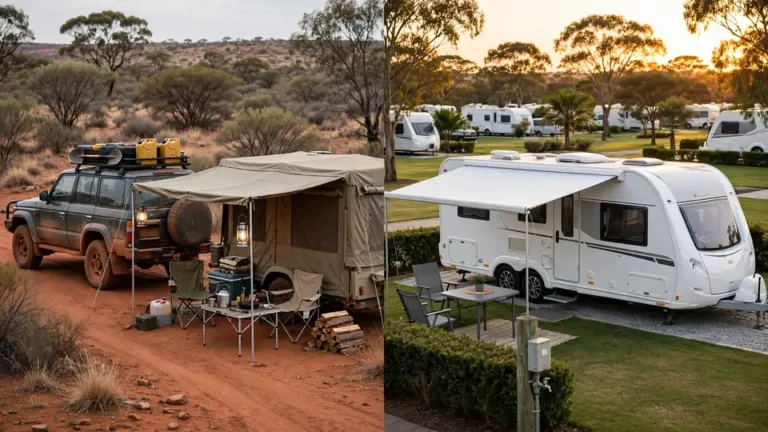
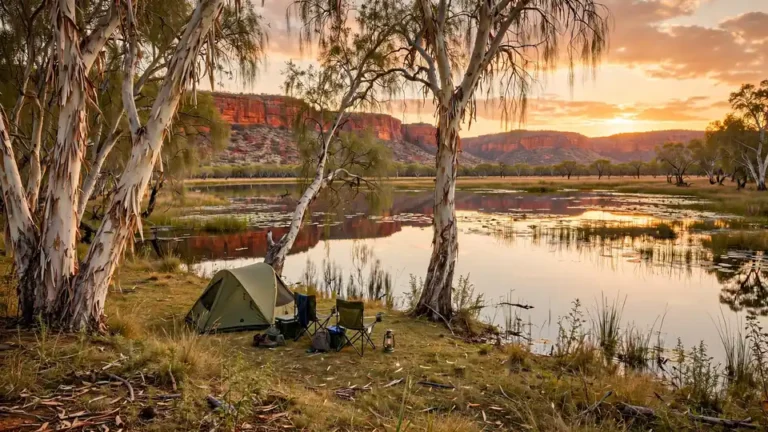
Australia is a camper’s country, but “best” depends entirely on where you point the car. The best camping spots Australia has to offer range from red-gorge country in the north to pink-granite bays in Tasmania, and the season that suits one will ruin the other. This guide is the national map: the standout camping regions in every state and territory, when to go, and how the booking systems work, with detailed state guides linked as they publish.
One rule before the list. Australia runs on two camping calendars. The tropical north (Top End, Kimberley, Far North Queensland) is a dry-season destination, roughly May to October. The south (Tasmania, Victoria, southern WA and SA) is best from late spring to autumn, and genuinely cold in winter. Plan around that split and almost every spot below will show you its best side.
- The best camping spots Australia offers split by season: north in the dry (May–Oct), south in the warmer months (Oct–Apr).
- Most national park camping is booked online through each state’s parks service, and popular sites go early for school holidays.
- State guides: South Australia, the Northern Territory and Tasmania are live below; free camping guides for NSW and Queensland are linked in this guide too.
Best camping spots Australia offers, state by state
Every state has a different camping personality, and the best camping spots Australia has are spread across all of them. Use this section to pick your region, then follow the detailed state guide for campgrounds, booking rules and the traps to avoid.
South Australia: ranges, peninsulas and island camping
South Australia is the underrated camping state. Ikara-Flinders Ranges National Park delivers ancient red ranges and creek-line campgrounds a day’s drive from Adelaide, the Yorke and Eyre Peninsulas mix surf beaches with serious seafood, and Kangaroo Island remains one of the great island camping trips in the country. The detailed guide to the best camping spots in South Australia covers the Flinders, both peninsulas, Kangaroo Island, Deep Creek and the Coorong, plus when to avoid the inland summer heat.
Northern Territory: the dry-season heavyweight
When southern campers are lighting fires in July, the Territory is in its prime. Kakadu’s escarpment country and billabongs, Litchfield’s swimmable waterfalls an easy run from Darwin, the gorges of Nitmiluk and the West MacDonnell Ranges, and desert camping under huge skies around Watarrka and Uluru-Kata Tjuta — our guide to the best camping spots in the Northern Territory walks through all of it, including the three different pass systems and the crocodile rules that shape where you can swim.
Tasmania: small island, huge variety
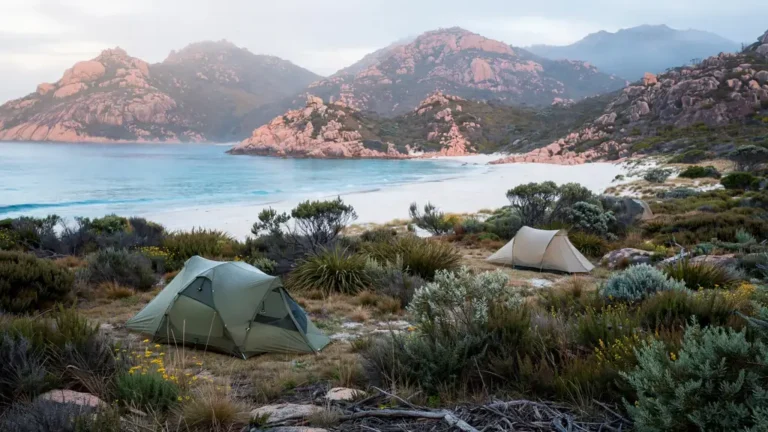
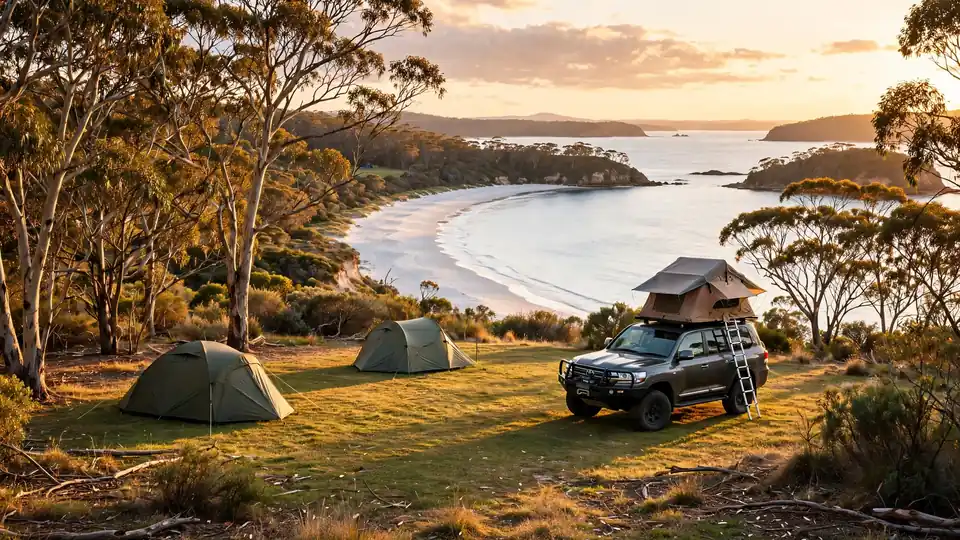
Tasmania packs a mainland’s worth of camping into a few hours of driving: Freycinet’s granite-and-white-sand bays, car-free Maria Island, the wildlife lawns of Narawntapu, alpine country at Cradle Mountain and Mount Field, and the end-of-the-road camp at Cockle Creek. One Parks Pass covers entry to all Tasmanian national parks. Our guide to the best camping spots in Tasmania has the campgrounds, the pass system and the honest weather warnings.
New South Wales: the most campgrounds of any state
NSW runs the full range: Blue Mountains and Kosciuszko alpine camping, a long coastline of surf-side national park campgrounds from Royal to Yuraygir, and outback parks around Broken Hill and Mungo. Our NSW national parks guide is on its way through the publishing queue; in the meantime the free camping guide below covers the state forests and free campgrounds that locals actually use.
Queensland: tropics, reef coast and big-sky inland
Queensland camping splits three ways: rainforest and reef coast in the north (best in the dry), the long beach-camping coast from the Gold Coast to Fraser Island (K’gari), and red inland country around Carnarvon Gorge and the Channel Country. Queensland Parks camping is permit-based everywhere, which makes the state’s genuine free camps — mostly council and community sites inland — worth knowing about; they are covered in the Queensland free camping guide linked below.
Victoria: compact, green and close to Melbourne
Victoria is the weekend camper’s state: the Grampians’ sandstone ranges, Wilsons Promontory’s granite headlands and squeaky sand, high country camping along the rivers near Bright and Mount Buffalo, and the Great Ocean Road hinterland. Distances are short, campgrounds are plentiful, and winter is cold and wet rather than impossible. Parks Victoria has been moving many campgrounds to online booking, so check before you roll up.
Western Australia: the big one
WA is a lap destination in its own right: Ningaloo’s beachfront camps where the reef starts at the shoreline, Karijini’s gorge campgrounds in the Pilbara, the Kimberley’s Gibb River Road station stays and national parks in the dry, and the tall-timber south-west around Margaret River and Walpole. WA national park camping is booked through Parks WA, and the most popular Ningaloo and Karijini sites are snapped up months ahead in season.
Free camping: where it is legal and where it is not
Free camping in Australia is real, but it is patchwork: state forests in NSW are free to camp in, many council reserves and rest areas across Queensland allow free overnight stays with time limits, and every state bans sleeping in random roadside spots and town streets. Two guides cover the states where free camping works best as a system: the best free camping spots in NSW (state forests, WaterNSW recreation areas and free national park campgrounds) and free camping spots in Queensland (council camps and community sites, and why Queensland national parks are never free). Read the rules sections before you rely on either — the fines for illegal camping are not theoretical.
How booking and passes work
There is no national camping pass. Each state runs its own system: NSW National Parks, Queensland Parks, Parks Victoria, Parks WA, SA’s National Parks and Wildlife Service, Tasmania’s Parks and Wildlife Service and the NT Parks system all take bookings through their own sites, and the two big Commonwealth parks (Kakadu and Uluru-Kata Tjuta) run through Parks Australia. Vehicle entry fees, per-person camping fees and the booking windows all differ. The state guides in this series spell out the system for each destination so you are not decoding it at a booking page the night before.
Gear that suits Australian camping
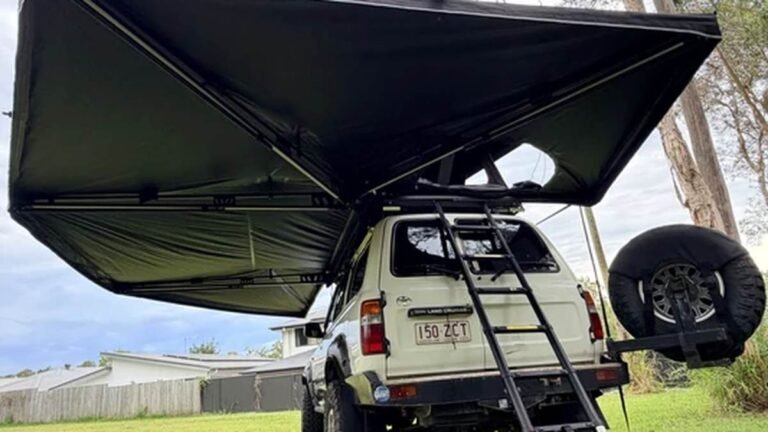
Two things decide comfort at most Australian campgrounds: your shelter and your sleep system. Distances are long and ground is hard, so a tent with a proper floor and a mat with real insulation earn their keep. Start with our guide to the best camping tents in Australia and the camping checklist for Australia if you are building a kit from scratch, then match your sleeping setup to the season of the state you are heading to — a bag that is perfect for a Top End dry-season night will leave you cold at Cradle Mountain in any month.
Best camping spots Australia by season
Because the country spans the tropics to the cool temperate zone, “when” matters as much as “where”. In the dry season (May to October), the north is unbeatable: Kakadu’s waterfalls are still flowing but its roads are open, Litchfield’s pools are swimmable, and the Kimberley and Cape York tracks are passable. The Red Centre is also at its best then — warm days, cold nights, no flies worth mentioning. The same months are Tasmania’s and Victoria’s off-season: campgrounds are empty and cheap to book, but you are camping in genuine cold, and alpine areas sit under snow.
From November the balance flips. The southern coastlines — the NSW South Coast, Victoria’s east, SA’s peninsulas, Tasmania’s east coast and WA’s south-west — come into their own through summer, while the Top End builds into the wet: spectacular storms and waterfalls, but road closures, extreme humidity and campgrounds that shut entirely. Easter is the national sweet spot, mild almost everywhere, which is why it is also the hardest fortnight of the year to book. School holidays work the same way: if your trip touches them, book the headline parks the day bookings open.
What camping costs in Australia
There is no single price of a campsite night, because every state prices differently. Some systems charge per person per night (Queensland Parks is the main one), some charge per vehicle or per site, and several states layer a park entry fee under the camping fee — Tasmania’s Parks Pass, the NT Parks Pass and WA’s park entry are all separate from the camping charge itself. At the other end, a large amount of camping is free: NSW state forests, many council reserves and rest areas, and designated free campgrounds in several states, covered in the free camping guides in this series. The practical takeaway is to budget by system, not by night: a fortnight in Queensland parks costs a family differently to a fortnight split between NSW forests and council camps, even in identical tents.
Staying safe and leaving no trace
Australian camping has three non-negotiable safety rules. First, fire: every state runs total fire ban days in the warmer months when no fire of any kind is permitted, and most park campgrounds only allow fires in provided fireplaces in season — check the rating daily, not once per trip. Second, water: in the tropical north, saltwater crocodiles mean swimming only where signs explicitly allow it, and in the arid interior the rule is the opposite problem — carry far more drinking water than you think you need, because campgrounds with potable water are the exception inland. Third, distance: outside the capitals, fuel, food and phone coverage thin out quickly, and a “nearby” town can be 200 kilometres away. Leave no trace applies everywhere — if a campground has no bins, everything you carried in rides out with you, including food scraps. The campers who come after you, and the wildlife, are the reason the good spots stay good.
How these spots were chosen
Every region in this guide had to pass the same tests. It must be a place you can legally camp, in a designated campground or reserve — no “secret spots” that are actually trespass. It must be managed by a parks service, council or recognised operator with published information, so prices, bookings and closures can be checked before you drive there. And it must be the best version of its landscape: the Flinders over a generic roadside stop, Freycinet over a random beach car park. Where a famous name failed those tests — a handful of much-photographed places have no legal camping at all — it was left out, and the state guides say why. The result is deliberately not the longest list of the best camping spots Australia can offer; it is the list we would hand a friend driving out of our own driveway.
A note on dogs, generators and the other campground questions
Two questions decide more Australian camping trips than any scenery debate. Dogs: they are banned from national parks in every state, full stop — but welcome in most state forests (NSW’s are the standouts), many council free camps and commercial parks. If the dog is non-negotiable, build the trip on those systems, as our NSW free camping guide does. Generators: most parks restrict them to set hours or ban them outright (Queensland Parks prohibits them in most parks), many campgrounds are quiet-hours by 10pm, and solar has made the noisy option unnecessary for most setups anyway. Sort those two policies for your shortlist before you book, and most Australian campground friction disappears.
Frequently asked questions
What are the best camping spots in Australia overall?
The names that come up again and again are Kakadu and Litchfield in the NT, Ikara-Flinders Ranges in SA, Freycinet in Tasmania, Karijini and Ningaloo in WA, Wilsons Promontory in Victoria and the Blue Mountains and Kosciuszko in NSW. Which is “best” depends on season: the northern parks are winter destinations, the southern ones summer ones.
Do I need to book campsites in Australia?
Usually, yes. Most national park campgrounds in every state are booked online in advance, and popular sites fill for school holidays and long weekends. Some state forest camping (notably in NSW) and many council free camps are first-come, first-served with no bookings.
Is free camping legal in Australia?
In designated places, yes: NSW state forests, many council reserves and rest areas, and some national park campgrounds. Camping outside designated areas — road reserves, town streets, undesignated bush — is restricted or banned in most jurisdictions, and rangers do fine people. Our NSW and Queensland free camping guides cover the legal options in detail.
When is the best time of year to go camping in Australia?
There is always somewhere in season. Aim for the tropical north between May and October (the dry season), and the southern states between October and April. Easter and the summer school holidays are the busiest periods nationwide.