Campfire Safety Australia: Rules, Fire Bans and Safe Fires
Disclosure: We may earn a small commission if you purchase through our links, at no extra cost to you.
Campfire Safety Australia: Rules, Fire Bans and Safe Fires
A campfire is the heart of an Australian camping trip — dinner, warmth, light and conversation all happen around it. It is also the most dangerous thing most campers do, and the one most likely to cause real harm to other people. Campfire safety Australia is not complicated, but it is strict: check whether a fire is allowed today, in this place, before you light anything; build the fire small and contained; never leave it alone; and put it out properly with water before you sleep. This guide covers each of them.
Check the Fire Ban Before You Check Anything Else
Before you pack the firewood, check the fire danger for the day you travel and every day you will be at camp. Each state and territory runs its own fire authority and declares total fire bans on hot, dry, windy days — and a ban can be declared at short notice when the forecast changes. In Victoria, check the Country Fire Authority’s daily listings on the CFA total fire bans page; in Western Australia, the DFES total fire bans page carries the same information. Other states publish theirs through their own fire services — New South Wales through the Rural Fire Service, Queensland through Queensland Fire and Emergency Services, South Australia through the Country Fire Service, Tasmania through the Tasmania Fire Service and the Northern Territory through Bushfires NT.
On a total fire ban day, you cannot light a campfire, a solid-fuel barbecue or a fire pit — full stop. Gas and electric barbecues and camp stoves are usually still allowed, but check the conditions for the day, because the rules change with the fire danger rating. If you are already camping when a ban is declared, put your fire out immediately and do not relight it, even if the evening cools down. The ban is about the conditions, not the temperature at your campsite. Keep a gas stove as your backup cooking method on every trip — our best camping stoves guide covers models that pack small and cook properly.
Fire danger ratings run from Moderate up to Catastrophic, and the rating tells you what the day could do, not just what it feels like at your campsite. On an Extreme or Catastrophic day, the safest choice is often to leave the bush altogether. Check the rating each morning of your trip, the way you check the weather, and have a leave-early plan before you need one.
Check the Park Rules, Not Just the State Rules
A fire can be legal under state rules and still banned at your campsite. Many national parks allow fires only in provided fireplaces, some allow them only in certain campgrounds, and some ban them entirely — year-round, not just on ban days. Some parks ban firewood collection, so you must bring your own wood or buy it locally. Read the park’s page before you go and the signs at the campground when you arrive. If the sign says no fires, there are no fires, whatever the fire danger rating says.
Where fires are allowed, use the fireplace or fire pit provided. Do not build a new fire ring out of rocks, do not light a fire on bare ground under trees, and never light a fire inside a tent, a swag or an awning — tents burn fast, and people die in tent fires every year. Keep the fire clear of overhanging branches, dry grass and your gear, and keep a clear space of at least a few metres around it. If the campground has no provided fireplace and the park rules do not clearly allow a fire, do not light one: cook on the gas stove instead.
Bring your own firewood or buy it near the campground. Collecting firewood in national parks is banned in most states, and in any case dead wood on the ground is habitat — hollow logs are homes for wildlife. Buy firewood from a local supplier or service station and keep it dry. Never burn treated timber, painted wood, plywood or rubbish — treated timber releases toxic smoke, and rubbish leaves a mess for the next camper.
How to Build a Safe Campfire
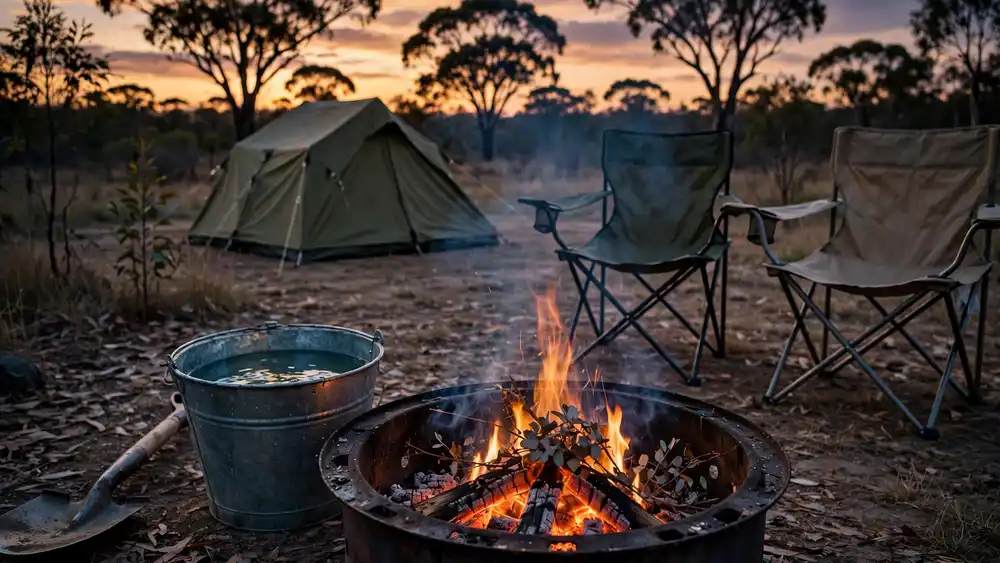
Build small. Campfire safety Australia starts with size: a campfire for cooking and warmth needs to be no bigger than a dinner plate at its base — anything larger is harder to control, uses more wood and throws more sparks. Clear the ground around the fireplace, lay a small teepee or log-cabin stack of kindling and dry wood, and light it with a match or a lighter. Keep a bucket of water and a shovel beside the fire before you light it, not after.
Once the fire is going, feed it slowly, a stick at a time. A fire that is fed gradually burns steadily and predictably; a fire loaded with wood all at once flares, throws embers and collapses into a spread of coals that is hard to manage. Keep children and pets well back from the fire — a clear ring around the fireplace, and a rule that nobody steps inside it. Keep chairs a sensible distance away, keep your tent upwind of the smoke, and never wear loose clothing or a synthetic jacket near an open flame: synthetic fabric melts onto skin, which is far worse than a simple burn.
Cook over the fire only with gear made for it. A cast-iron camp oven and a grill plate are the right tools; a household pot with a plastic handle is not. Our best camp cookware guide and the camp kitchen checklist cover fire-safe cooking gear. Store all food in sealed containers or the car overnight — a fire that smells of dinner attracts animals after dark, and you do not want them in camp.
Managing the Fire Through the Evening
A campfire needs an adult watching it for its whole life. Never leave a fire unattended — not to walk to the toilets, not to fetch water, not while you are asleep in the tent. If everyone is going to bed, the fire goes out first. If one person stays up, that person is the fire watcher, and they keep it small. This is the rule most often broken and the one that causes most campfire damage: a fire left alone while everyone sleeps can spread to dry grass, to a tent or to a tree, and by the time anyone notices, it is too late.
Watch the wind. A change in wind direction can push sparks and smoke onto tents, cars and dry grass in seconds. If the wind picks up, reduce the fire or put it out. If embers are landing on your tent or your gear, the fire is too big for the conditions. Keep the fire low and the flames below the rim of the fireplace. If you are using a portable fire pit, keep it on bare ground or gravel, never on dry grass or a wooden deck, and make sure it cannot be knocked over.
Putting the Fire Out Properly
Putting a campfire out is not a quick job. Start early: stop adding wood an hour before bed, let the fire burn down to coals, then drown it with water, stir the ashes, and drown it again. The test is simple — if it is too hot to touch, it is not out. A fire that looks dead can hold enough heat to reignite hours later, especially in wind, and a reignited campfire in a dry campground is how bushfires start.
Use water, not dirt. Dirt smothers the flames but insulates the coals, and the heat stays underneath. Water cools them. Pour water over the whole fire area, stir the ash and embers with a shovel or a stick, and pour more water until nothing hisses and nothing is warm to the touch. If the campground has no water tap, carry a dedicated bucket of water for the fire — do not rely on your drinking water, and do not assume there will be a tap. In the morning, check the fire site again before you leave: cold ash, no warmth, no smoke. If you are leaving the campsite for the day, the fire must be fully out first — an unattended fire is never acceptable, even for a short walk.
When you leave, the fireplace should look as if you were never there: cold ash, no rubbish, no half-burnt logs sticking out of the pit. Pack out everything you brought in. The next camper should be able to light their own fire in a clean fireplace, not deal with yours.
When Fire Is Not an Option
Some of the best camping trips have no fire at all. On total fire ban days, in parks that ban fires, and on hot windy evenings, cook on a gas stove and get your warmth from clothing, a good sleeping bag and a hot drink — our guide to staying warm while camping covers the layers that make a fireless night comfortable. A lantern gives you the light of a campfire without the risk, and a shared meal cooked on a stove is still a shared meal.
Before your next trip, read our camping for beginners guide for the full setup routine, and check the fire rules for your destination the same week you book. Campfire safety Australia is simple to practise and worth it every time: a campfire is one of the best parts of camping in Australia — and it stays that way when every camper treats it with the respect it deserves.
Campfire Safety Australia: FAQs
Can I have a campfire on a total fire ban day in Australia?
No. On a total fire ban day you cannot light a campfire, a solid-fuel barbecue or a fire pit anywhere in the ban area. Gas and electric barbecues and camp stoves are usually still allowed, but check the conditions for the day on your state fire authority’s website. If a ban is declared while you are camping, put your fire out immediately and do not relight it.
How do I put a campfire out properly?
Stop adding wood an hour before bed, let the fire burn down to coals, then drown it with water, stir the ashes, and drown it again. Use water, not dirt — dirt insulates the coals and the heat stays underneath. The fire is only out when nothing hisses and nothing is warm to the touch. Check the site again in the morning before you leave.
Can I collect firewood in an Australian national park?
In most states, no — collecting firewood in national parks is banned, and dead wood on the ground is wildlife habitat. Bring your own firewood or buy it from a local supplier or service station near the campground. Never burn treated timber, painted wood, plywood or rubbish, which releases toxic smoke.
How big should a campfire be?
Small — no bigger than a dinner plate at the base. A small fire is easier to control, uses less wood, throws fewer sparks and is easier to put out. Feed it slowly, a stick at a time, keep the flames below the rim of the fireplace, and keep children, pets and tents well back from it.
What should I do if a campfire gets out of control?
Call 000 immediately if a fire escapes and you cannot put it out safely with water. Do not try to fight a spreading fire yourself — move yourself and others upwind and away from the flames, to a road, a cleared area or a body of water if it is safe to reach one. Your safety comes before your gear or your car.