Best Camping Cookware Sets Australia
Disclosure: We may earn a small commission if you purchase through our links, at no extra cost to you.
Open any camping store’s cookware aisle and you’ll face a wall of nested pots in shiny boxes, all promising the complete camp kitchen. Most of them contain pieces you’ll never use and miss the ones you need. Choosing camping cookware sets Australia wide comes down to three decisions — material, contents, and how it packs — and getting them right means the difference between a kitchen you love and a heavy box of regret. This guide explains the materials honestly, what a set should actually include, the best options at each budget, and the pieces worth buying separately.
Cookware Materials: The Honest Trade-offs
Aluminium (anodised)
The hiking standard. Pros: light, heats fast and evenly, cheap, hard-anodised versions resist scratching. Cons: less durable than steel (dents), acidic foods can react with uncoated aluminium (anodising solves this), not as non-stick as coated options. Best for: hikers, weight-conscious campers, and anyone boiling water and cooking simple meals.
Stainless steel
The car-camping workhorse. Pros: nearly indestructible, no coatings to damage, handles campfire heat, easy to clean, no reactivity with food. Cons: heavy, heats unevenly (hot spots) unless it has a clad/aluminium base, food sticks more than non-stick. Best for: family camping, campfire cooking, and buyers who want to buy once.
Titanium
The ultralight luxury. Pros: incredibly light and strong, no coatings, lasts forever. Cons: expensive, terrible heat distribution (notorious hot spots — fine for boiling, poor for cooking), thin walls dent. Best for: ultralight hikers who mainly boil water. Not for campfire cooking or real cooking.
Non-stick coated
Pros: easiest cooking and cleaning — eggs slide off, washing up is trivial. Cons: coatings scratch (no metal utensils), degrade with high heat and campfire use, and eventually wear out. Best for: car campers who prioritise easy cooking and cleaning over longevity.
The practical summary: hikers buy aluminium or titanium; car campers buy stainless or non-stick. Campfire cooks buy stainless or cast iron — never non-stick over open flame (the coating degrades) and never titanium for real cooking.
What a Cookware Set Should Actually Contain
The essential camp kitchen, nothing more:
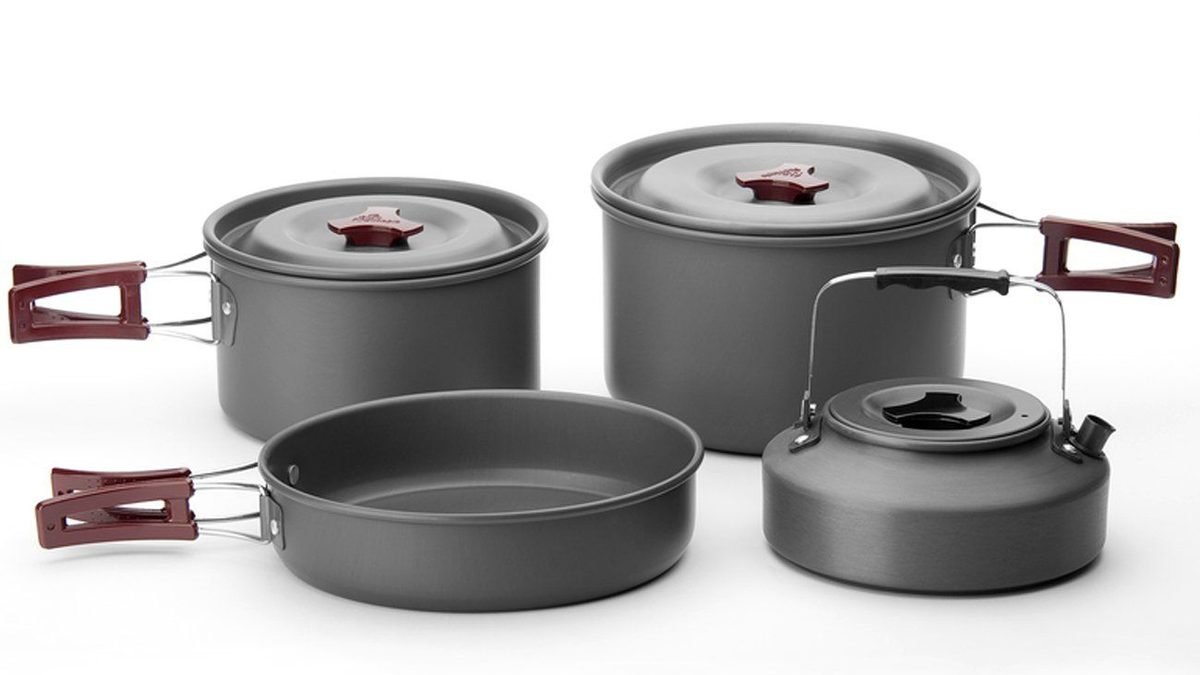
- A pot, 1.5–3L: the workhorse — boiling water, pasta, stew, soup. One good pot covers 80% of camp cooking. Lid essential (halves boil time and fuel use).
- A frypan, 20–25cm: eggs, bacon, stir-fry, toast. The second most-used piece. A lid that fits both pot and pan is a bonus.
- A kettle or second small pot: for the constant cups of tea and coffee. A dedicated kettle pours better; a second pot is more versatile.
- Utensils: spatula, spoon, tongs — silicone or wood for coated cookware, anything for steel.
- Plates/bowls/cups: per person. Nesting sets save space; personal preference rules.
- Cutting board and knife: a small board and a sharp knife transform camp cooking more than any pot.
What you don’t need in the set: novelty gadgets, tiny saucepans you’ll never use, flimsy “multi-tools” that do nothing well. Buy the core pieces well; add specialists later. And beware the 20-piece sets — half the pieces are usually tableware of dubious quality that you’ll replace within a year anyway.
Nesting and Packing: The Space Logic
Camp cookware lives or dies on packing. Good sets nest — smaller pieces fit inside larger ones, utensils tuck into gaps, and the whole lot packs into the space of the largest pot. Before buying, check: does it nest with your stove? (A pot that doesn’t fit over your burner is useless.) Does the packed set fit your camp box or pack? Are the handles folding or removable (fixed handles waste space)?
The Sea to Summit X-Series takes this furthest — collapsible silicone walls that pack flat — brilliant for hikers where space is the constraint. For car campers, conventional nesting stainless or aluminium is simpler, tougher, and cheaper.
Camping Cookware Sets Australia: Best Picks
Campfire Stainless Cookset Large — best value family set
Around $119.95 MSRP, the Campfire stainless set is the default family-camping recommendation: stainless durability, campfire-safe, nests together, and priced for real families. It won’t win design awards, but it’ll still be cooking in a decade. Check BCF, Anaconda, and Tentworld for current pricing — Campfire gear goes on sale regularly.
Sea to Summit X-Series — best for hikers
Collapsible silicone-walled pots and kettles with aluminium bases — the X-Pot packs to a fraction of its cooking size. Premium pricing, but nothing packs smaller. For bushwalkers where every litre of pack space matters, it’s transformative. Pair with the X-Bowl and X-Mug for a complete nested system. Available at hiking specialists and major retailers.
Sea to Summit Camp Kitchen Tool Kit (10pc) — best utensil kit
Around $60 at Sherpa and other Sea to Summit stockists, this 10-piece kit covers the utensil side: the tools that turn pots into a kitchen. Well-designed, compact, and from a brand with proper Australian warranty support.
Sea to Summit Camp Kitchen Clean Up Kit (6pc) — best wash kit
Around $69.99, the clean-up kit (10L sink, scrubber, washcloth, Wilderness Wash, towel, storage sack) solves the camp dishes problem properly — including Leave No Trace compliance with the 100m-from-water rule built into the design.
Stanley-style stainless sets — best bombproof
The Stanley approach (exemplified by sets like the Wildfare 26-piece, ~US$90) — 18/8 stainless pots and pans with serving gear for four — is the “buy it for life” option. Heavy, indestructible, campfire-proof. If your camping is all car-based and you never want to think about cookware again, this is the philosophy.
Browse current options at Anaconda’s cookware sale section, where major brands rotate through discounts.
Camping Cookware Sets Compared
| Set / Piece | Material | Best for | Price (AU) | Notes |
|---|---|---|---|---|
| Campfire S/S Cookset Large | Stainless | Family car camping | ~$119.95 | Campfire-safe, nests |
| Sea to Summit X-Pot range | Silicone/alu | Hiking | Check retailers | Collapsible, ultra-packable |
| S2S Camp Kitchen Tool Kit 10pc | Various | Utensils | ~$60 | Complete tool set |
| S2S Clean Up Kit 6pc | Various | Washing up | ~$69.99 | Leave No Trace design |
| Stanley-style 18/8 sets | Stainless | Buy-once | Check retailers | Heavy, indestructible |
Campfire Compatibility: What Goes Near Flames
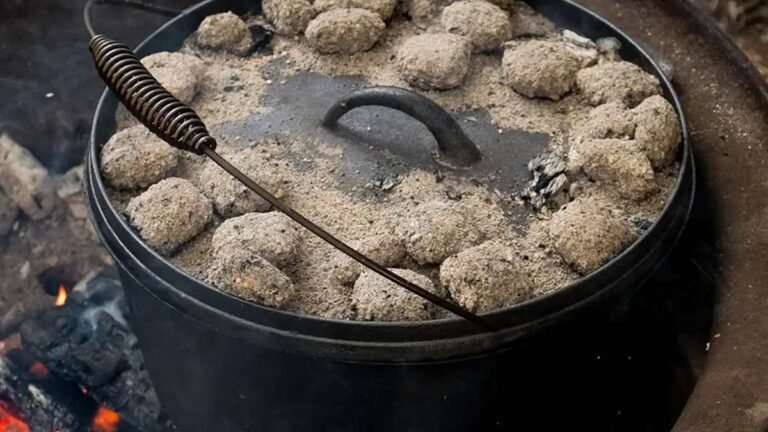
- Safe on campfire: stainless steel, cast iron, uncoated aluminium (it’ll soot up but survives).
- Never on campfire: non-stick coatings (toxic fumes, destroyed coating), silicone components, plastic handles.
- Use with care: hard-anodised aluminium (survives but discolours), titanium (survives, cooks badly).
Soot is the price of campfire cooking — carry a dedicated “fire pot” if you mix fire and stove cooking, or accept blackened bases. A rub of dish soap on the outside of pots before fire use makes soot wash off dramatically easier — an old camp-cook trick.
Care and Cleaning: Making It Last
- Clean promptly: food welded on overnight is ten times harder to remove. A soak while you eat solves most problems.
- Non-stick: soft sponge only, no metal utensils, no high heat, no dishwasher.
- Stainless: Bar Keeper’s Friend or bicarb paste removes discolouration; steel wool is fine on uncoated steel.
- Aluminium: avoid harsh abrasives on anodised surfaces; hand wash.
- Dry completely before nesting — trapped moisture corrodes and stinks.
- Protect non-stick in nesting: a cloth or paper towel between pieces prevents scratches.
- Leave No Trace: wash dishes 100m+ from waterways, scatter strained dishwater widely, pack out food scraps.
Building Beyond the Set: Pieces Worth Buying Separately
No set is complete. The upgrades that matter: a good knife (the set knife is always rubbish); a proper cutting board (bigger than the token one); a camp oven for baking and roasting (see our camp oven guide); a jaffle iron for the essential Australian camp food; and a kettle if your set lacks one — the most-used vessel in any camp kitchen. Buy these once, buy them well.
The Camp Kitchen Audit: What Do You Actually Cook?
Before buying any set, audit your camp menu honestly. The family that cooks pasta, stir-fry, and bacon-and-eggs needs: a 3L pot, a big frypan, a kettle, and utensils. The hiking couple living on dehydrated meals needs: a 1L pot and a spoon each. The camp-oven baker needs: the oven, a trivet, and a lid lifter — and barely needs a “cookware set” at all.
The mismatch to avoid: buying a 10-piece hiking set for car camping (tiny pots, endless batch cooking) or a massive stainless family set for backpacking (you’ll leave half of it in the car by trip two). Write down five actual camp meals, list the vessels each needs, and buy to that list. The set that matches your menu is the right set; the set with the most pieces is just the heaviest.
And a word on plates and bowls: the set’s included tableware is often the weakest part — flimsy plastic that warps and stains. Many experienced campers buy the cooking vessels as a set and choose tableware separately: enamel (classic, durable, heavy), bamboo fibre (light, decent), or stainless (indestructible, noisy). Personal preference, but don’t let bad plates ruin good pots.
Cookware for Special Diets and Camp Realities
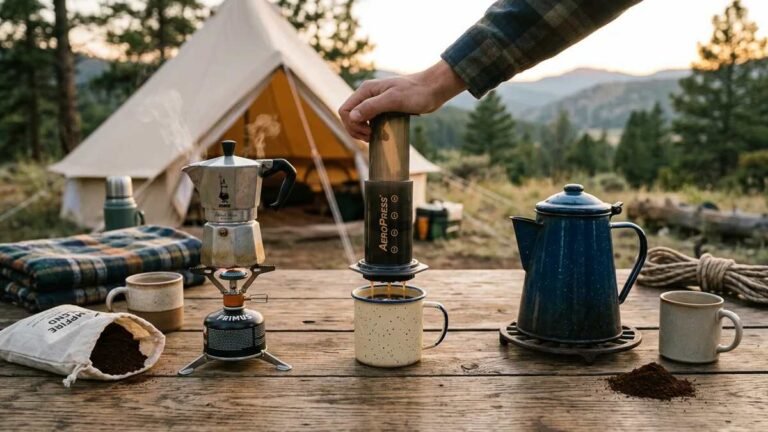
Two camp realities shape cookware choice. First, allergen separation: if someone has coeliac disease or a nut allergy, a second small pot and dedicated utensils prevent cross-contamination — a $20 insurance policy. Second, coffee: the camp kitchen revolves around it, and a dedicated kettle (rather than boiling in the pasta pot) is worth the space — see our coffee maker guide for the full ritual.
For 2-burner stove users, check pot diameter against burner spacing — two large pots side by side may not fit. Measure your stove’s usable width before buying the big frypan. And if you cook for big groups regularly, consider a dedicated camp oven alongside the cookware set — the oven handles the bulk cooking (stews, roasts, damper) while the pots handle sides and boiling, a division of labour that scales to feeding a crowd.
Cookware Mistakes That Ruin Trips
Bringing the wrong size: a 1L hiking pot for family car camping means cooking pasta in four batches while everyone waits. Match pot volume to group size — 1L per person is a rough guide for one-pot meals.
Forgetting the lid: a pot without a lid uses roughly twice the fuel and time to boil. If your set’s lid is missing, improvise with a plate or buy a universal lid — never cook lidless by choice.
Metal utensils on non-stick: one careless scrape with a fork and the coating is compromised. Pack silicone or wooden tools and keep the metal ones for the campfire.
Nesting wet: packing damp cookware breeds the funk that taints the next trip’s first meal. Dry everything — dish towel, air dry, then pack.
No kettle: the most regretted omission in camp kitchens. Boiling water in the pasta pot works, but a kettle pours safely and everyone’s happier. It’s the cheapest upgrade with the highest daily impact. A whistling kettle is also the camp’s alarm clock — nobody sleeps through it, which is either a feature or a bug depending on your family.
Frequently Asked Questions
Stainless steel or aluminium camping cookware: which is better?
Stainless for car camping (durable, campfire-safe, buy-once); aluminium for hiking (light, heats fast). Non-stick suits car campers who prioritise easy cleaning. Match the material to how you camp, not to marketing.
Can you use camping cookware on a campfire?
Stainless steel, cast iron, and uncoated aluminium are campfire-safe. Never put non-stick coatings, silicone parts, or plastic handles over open flame. Rub dish soap on pot exteriors before fire use for easy soot removal.
What size pot do I need for camping?
1.5–2L for solo/couple hiking; 2–3L for family car camping. One versatile pot plus a frypan covers most camp cooking — more pieces add weight, not capability.
How do you clean camping cookware without damaging it?
Clean promptly, use soft sponges on non-stick and anodised surfaces, and dry completely before nesting. Protect non-stick with cloth between nested pieces. Wash 100m+ from waterways.
Is titanium cookware worth it?
For ultralight hikers who mainly boil water — yes, the weight saving is real. For actual cooking, no — titanium’s hot spots make it frustrating, and aluminium cooks better for less money. It’s a specialist material, not an upgrade.
← Back to our complete guide: Best Camping Stoves Australia 2026