Best Hammocks for Camping Australia 2026
Disclosure: We may earn a small commission if you purchase through our links, at no extra cost to you.
Ask a hammock convert about their sleep and you’ll get a sermon: no rocks in the back, no sloping tent floor, gentle sway, best sleep of their life. Ask a failed hammock camper and you’ll hear the opposite: back pain, freezing at 2am, feeling like a banana. The difference between those two experiences usually isn’t the hammock — it’s the hang. Get the setup right and hammocks for camping Australia-style are genuinely superb, especially in the tropical north where airflow beats a stuffy tent. This guide covers the best hammocks you can buy here, how to hang them properly, and the insulation and weather protection that make or break the experience.
Is Hammock Camping Right for You?
Hammocks shine when: you camp where trees are plentiful (east coast, tropics, Tasmania), you value light weight (a full hammock system can be under 1.5kg), you hate uneven ground, and you camp in warm weather where airflow is a blessing. They’re less ideal when: you’re above the treeline (alpine zones), in treeless outback, in national parks that restrict hammock use, or in cold conditions without proper insulation — more on that critical point below.
Check park rules before you go. Some Australian national parks restrict hammocks to protect trees, and almost all require tree-friendly straps rather than rope. Queensland’s parks in particular have specific guidance; when in doubt, check the park’s website before you arrive.
The 30-Degree Hang: Why Most Beginners Get It Wrong
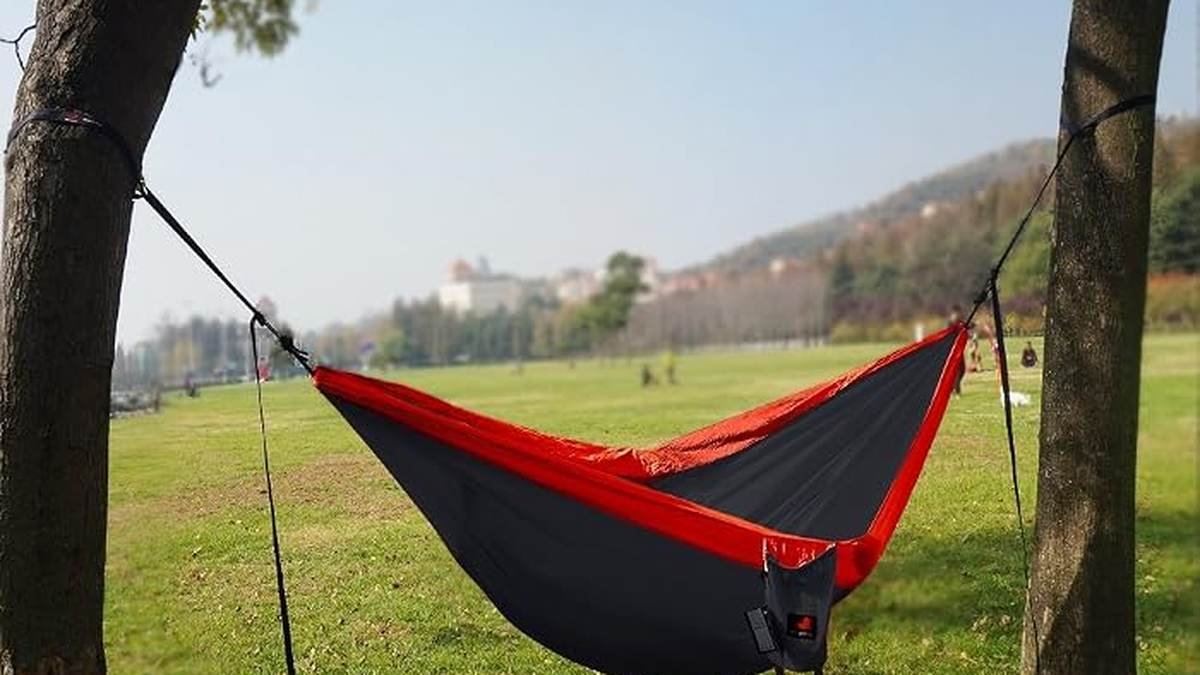
The number one beginner mistake is hanging the hammock too tight — pulled taut like a trampoline between two trees. This creates a cocoon that squeezes your shoulders, hyperextends your knees, and guarantees a bad night. The correct hang:
- Suspension straps at roughly 30 degrees from horizontal. A handy check: make a finger-gun with thumb and index finger — that angle is about 30 degrees.
- Sit height around chair height (45–50cm) at the lowest point when occupied.
- Lie diagonally, not straight down the middle. An asymmetric diagonal lay is what makes a gathered-end hammock flat enough to sleep in — your head near one edge, feet near the opposite edge.
- Trees 4–5 metres apart for a standard hammock; healthy, living trees at least 15cm in diameter.
- Tree-friendly straps at least 2.5cm wide — never thin rope or cord, which cuts into bark. This is both ethics and, in many parks, the rules.
A structural ridgeline — a cord running from end to end above the hammock — locks in the sag so your hang is consistent every time. Many premium hammocks include one; it’s one of the best upgrades for consistent comfort.
The Cold Problem: Why Hammocks Freeze You (and the Fix)
This is the thing that ends most hammock experiments: cold butt syndrome. Your sleeping bag’s underside insulation compresses beneath you and does nothing; cold air circulates under the hammock and strips heat from below. On a 15°C night you can be shivering in a bag rated far lower. The fixes:
- An underquilt — insulation that hangs beneath the hammock’s outside, staying lofted because your weight isn’t on it. This is the proper solution and what serious hammock campers use. Dedicated hammock underquilts (like Ticket to the Moon’s Moonquilt range) are cut to fit.
- A sleeping mat inside the hammock — a closed-cell foam mat works best (it doesn’t slide as much as an inflatable). Some hammocks have a double-layer sleeve to hold the mat in place. Our mat comparison guide covers which types behave in a hammock.
- A sleeping bag used as a quilt — unzip your bag and drape it over you like a doona rather than climbing inside; less compressed insulation underneath. See our camping quilts guide for bags designed to work this way.
Rule of thumb: your under-insulation needs to match the night-time temperature just like your top insulation does. In winter, hammock camping without an underquilt is a recipe for misery.
What to Look For in a Camping Hammock
Gathered-end vs bridge
Gathered-end hammocks (fabric bunched at each end) are the classic: light, simple, affordable. Bridge hammocks use spreader bars for a flatter lay but are heavier and fussier. Beginners should start gathered-end.
Single vs double width
“Double” means wider fabric, not two people — one person sleeps in a double hammock, more comfortably, with room to lie properly diagonal. Unless you’re ultralight-focused, buy the double width. Solo sleeping two-to-a-hammock is uncomfortable for actual sleep.
Weight capacity and fabric
Parachute nylon (typically 70D) is the standard: strong, light, quick-drying. Check the rated capacity and give yourself margin — dynamic loads from plopping down exceed static weight. 150–200kg ratings are common on quality doubles.
Bug protection
In much of Australia, a hammock without insect protection is a mosquito feeder. Options: hammocks with integrated bug nets (best for serious use), separate net socks that enclose the hammock, or a treated head net for casual hangs. If you camp in the tropics or near water, integrated is worth it.
What’s included vs sold separately
Read the fine print: many hammocks sell the hammock, tree straps, bug net, and tarp all separately, and a $90 hammock becomes a $250 system. Complete kits or bundles are often better value for beginners.
The Best Hammocks for Camping in Australia
Best overall: Ticket to the Moon Original
Ticket to the Moon has been making parachute-nylon hammocks since 1996, and the Original remains the benchmark: 320 x 200cm of fabric, 200kg capacity, just 600g, packing into its own attached stuff sack that doubles as a pillow pocket. The 70D parachute silk is noticeably tougher than bargain hammocks, the triple-stitched seams inspire confidence, and the colour range means you can spot your camp from across the valley. Tree straps are sold separately (get the wide tree-friendly ones), as are the tarp and bug net — budget for the system, not just the hammock. For relaxed camping hangs through to overnight sleep-outs, it’s the safe recommendation. Sea to Summit’s hammock range and the major camping retailers stock the hammocks, straps, tarps, and bug nets mentioned here — buy the straps and suspension at the same time as the hammock so you’re not improvising with rope on night one.
Best ultralight: Ticket to the Moon Lightest
At around 240g, the Lightest is for hikers who count grams: the same clever design in a featherweight 34g/m² fabric. The trade-off is durability and comfort — the thin fabric is less forgiving, has minimal stretch, and demands careful site selection (no sharp twigs). Pair it with the Lightest straps (95g for the pair) and Lightest tarp for a complete shelter system around 1kg. Not a beginner’s hammock, but superb for experienced ultralight hikers.
Best with bug net: Ticket to the Moon Original Pro
The Pro adds an integrated bug net with an adjustable structural ridgeline to the Original platform — the ridgeline keeps the net off your face and guarantees the same comfortable sag every hang. At 950g it’s heavier, but for tropical camping, lakeside sites, or anywhere the mozzies own the night, integrated protection beats fiddling with a separate net in the dark. External loops accept an underquilt for cold weather.
Best premium system: Sea to Summit hammock range
Sea to Summit’s Australian-designed hammock system is the technical option: the Ultralight hammock packs to roughly the size of a drink can, and the modular system (hammock, suspension straps, bug net, gear sling, and the excellent Hammock Tarp at $269.99 RRP) is beautifully engineered to work together. The tarp in particular earns its price — 350g, purpose-built coverage, all guy ropes included. This is the system for hikers who want every component optimised and are willing to pay for it.
Best budget complete kit: DD Hammocks SuperLight
DD Hammocks’ SuperLight is remarkable value: a full-size 2.7 x 1.4m hammock at 270g including whoopie slings, tree huggers, and carabiners — the complete suspension, not just the hammock. Around $77 through Australian stockists, it’s the cheapest way to get a genuinely trail-worthy setup rather than a backyard toy. The included suspension means no hidden extras. A great first proper hammock.
Tarp and Weather Protection
A hammock without a tarp is a fair-weather toy. For overnighting, you need coverage:
- Size: the tarp’s ridgeline should exceed the hammock’s length by at least 30cm each end. An 11-foot (3.3m) tarp over a standard hammock is the sweet spot.
- Pitch: hang the tarp’s ridgeline above and independent of the hammock suspension, so the hammock can move without dragging the tarp. In bad weather, pitch the sides low and steep; in fair weather, high and airy.
- Drip lines: tie short cords on your suspension straps just outside the tarp’s coverage — rainwater wicks down straps and into your hammock without them. This tiny detail saves trips.
Hammocks for Camping Compared
| Hammock | Size | Capacity | Weight | Price (AU) | Best for |
|---|---|---|---|---|---|
| Ticket to the Moon Original | 320 x 200cm | 200kg | 600g | Check AU stockists | Best overall |
| Ticket to the Moon Lightest | 320 x 155cm | 100kg | ~240g | Check AU stockists | Ultralight hiking |
| Ticket to the Moon Original Pro | 320 x 200cm | 150kg | 950g | Check AU stockists | Bug protection included |
| Sea to Summit Ultralight | Single / Double | 180kg | ~150g | Check AU stockists | Premium minimal weight |
| DD SuperLight | 270 x 140cm | 125kg | 270g incl. suspension | ~$77 | Budget complete kit |
| S2S Hammock Tarp | 3.6m ridgeline | — | 350g | $269.99 RRP | Weather protection |
Note: Ticket to the Moon and Sea to Summit hammock prices vary between Australian stockists — check current pricing at Snowys, Tentworld, and hiking specialists before buying. Straps, bug nets, and tarps are usually sold separately; budget for the full system.
Hammock vs Tent: The Honest Trade-off
Neither is universally better. Hammocks win on comfort (for most people, once dialled in), weight, setup speed, and site flexibility on uneven ground — and in warm, humid conditions the airflow is glorious. Tents win on weather protection, privacy, gear storage, bug protection simplicity, and treeless terrain. Tents are also more socially straightforward for couples and families. Many experienced campers own both and choose per trip: hammock for solo forested hikes in mild weather, tent for everything else. If you’re hammock-curious, a budget gathered-end hammock plus straps is a cheap experiment — just commit to learning the 30-degree hang before judging it.
Hammock Camping Checklist
- Hammock with adequate weight rating
- Wide tree-friendly straps (never rope on bark)
- Tarp with guy ropes and pegs
- Bug net (integrated or separate) for most of Australia
- Under-insulation: underquilt or foam mat
- Top insulation: sleeping bag used as quilt, or a dedicated camping quilt
- Drip lines for wet weather
- Check park rules on hammocks before you go
Hammock Camping in Australia: Where You Can and Can’t Hang
The dream is hanging between two gum trees anywhere. The reality has rules. In national parks, hammock use varies by state and park: some parks prohibit attaching anything to trees (to protect bark), others allow it with wide tree-friendly straps (never rope or cord, which cuts into bark). State forests are generally more relaxed. Private campgrounds set their own rules — ask first.
The Leave No Trace approach works everywhere: use wide (2.5cm+) tree straps, never screw or nail anything into trees, don’t hang from young or damaged trees, and take the straps down when you’re done. Beyond regulations, there’s practicality: much of outback Australia simply lacks suitable trees — hammocks are a east-coast, Tasmanian, and tropical proposition, not a Nullarbor one. Always carry a ground backup plan (a foam mat doubles as your hammock insulation anyway) for the treeless night.
Frequently Asked Questions
Can you sleep in a hammock every night while camping?
Yes — many long-distance hikers do. The keys are a proper diagonal lay (never straight down the middle), adequate under-insulation, and a hammock wide enough for your body. Most converts report better sleep than in a tent once dialled in.
Are hammocks bad for your back?
A correctly hung hammock (30-degree sag, diagonal lay) supports the back evenly and many people with back pain prefer them. A hammock hung too tight, forcing a banana position, is bad for your back. The hang matters more than the hammock.
What do you sleep on under you in a hammock?
An underquilt hung beneath the hammock is the best solution. Alternatively, a closed-cell foam sleeping mat inside the hammock (double-layer hammocks hold it in place). Never rely on just your sleeping bag underneath you — compressed insulation doesn’t insulate.
Can I hang a hammock from any tree?
Use healthy living trees at least 15cm in diameter, with wide tree-friendly straps — never thin rope, which damages bark. Check park regulations; some Australian national parks restrict or prohibit hammocks.
Do I need a tarp with my hammock?
For day hangs in fine weather, no. For overnight camping, yes — dew alone will soak an unprotected hammock by morning, let alone rain. A proper hammock tarp with independent ridgeline is essential kit.
← Back to our complete guide: Best Sleeping Bags Australia 2026