Power Station vs Generator
Disclosure: We may earn a small commission if you purchase through our links, at no extra cost to you.
The power station vs generator debate is the biggest either/or decision in camp power, and most of the advice online is really just people justifying what they already bought. Here’s the honest version: they’re different tools for different jobs, most serious tourers eventually own some version of both (or wish they did), and the right choice depends entirely on how you camp. This guide compares them properly — cost, noise, runtime, weight, maintenance, and real-world scenarios — with Australian prices, so you can decide with numbers instead of vibes.
If you’re new to the category, start with our best portable power stations and best portable generators roundups for the specific models, and the solar sizing guide for the maths that underpins both.
The 30-Second Summary
Buy a power station if: you camp mostly weekends to a week, your loads are devices/lights/fridge/fans (not heating or aircon), you value silence, you hate maintenance, and you have or will get solar panels. This describes most modern campers.
Buy a generator if: you need high sustained wattage (aircon, power tools, fast battery charging), you camp for weeks in poor solar conditions, or you need to refuel in minutes rather than recharge in hours. This describes tourers, tradies, and off-grid workers. And be honest about which category you’re really in — plenty of people buy generator capability “just in case” and then never use more than a power station would provide, carrying 20 kg of unused potential on every trip.
Consider both if: you’re a long-term tourer — power station + solar for daily silent use, small generator as the cloudy-week backup and fast charger. This is the setup most full-time travellers converge on.
Power Station vs Generator: Head-to-Head Comparison
Noise
This is the power station’s knockout punch. Power stations are silent — literally zero decibels from the unit itself (the inverter fan may whisper under heavy load). Generators, even the quiet inverter models, produce 52–65 dB at 7 metres — roughly conversation level at best, and noticeably intrusive in a quiet bush camp at worst. In a crowded caravan park, nobody cares. In a remote national park at 9pm, a generator makes you that campsite. Many parks now restrict generator hours (typically 9am–5pm or similar) — a power station has no hours.
Running costs
Power stations cost nothing to run — solar is free, and charging from mains costs cents. Generators burn fuel: a 2.2kVA inverter generator uses roughly 0.5–1 litre per hour depending on load, so a week of evening use is $30–60 in petrol plus oil changes, spark plugs, air filters and eventual servicing. Over five years of regular use, a generator’s running costs can exceed its purchase price. The power station’s five-year cost is essentially the purchase price plus panels.
Purchase price (real AU numbers)
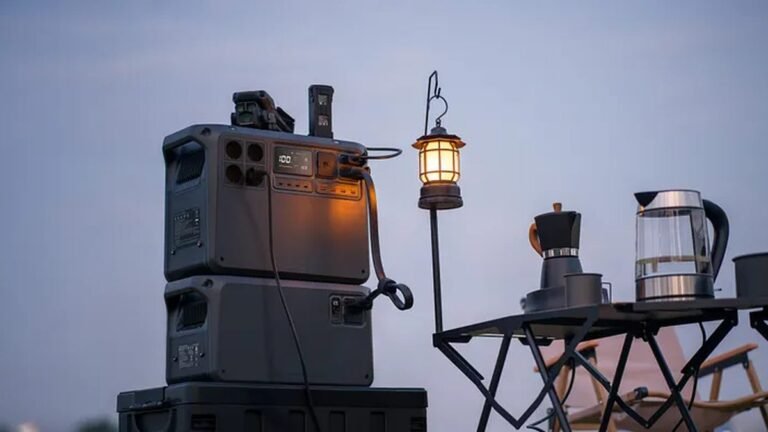
A capable power station (1,024Wh LiFePO4, e.g. EcoFlow DELTA 2) runs ~$1,259 plus $270–430 for panels — call it $1,600–1,700 all-in. A quality inverter generator runs ~$929–949
for a budget Cromtech 2400W, ~$2,049–2,095 for a Honda EU22i, or ~$2,299–2,499 for a Yamaha EF2200iS. So the power station sits between budget and premium generators on purchase price — but remember the generator keeps costing you fuel forever.
For the latest DELTA 2 specifications, see EcoFlow.
Runtime and refuelling
This is the generator’s knockout punch. A generator runs as long as you feed it fuel — refill in two minutes, run indefinitely. A power station is finite: when the battery’s empty, you’re waiting hours for solar (or finding mains power). On a grey winter week with no sun, a power station without backup is a brick; a generator doesn’t care about the weather. For indefinite off-grid runtime, nothing beats liquid fuel.
Power output
Generators deliver high sustained wattage easily — 1,800–2,200W continuous from the models above, enough for aircon, microwaves, power tools, and fast-charging big batteries. Power stations top out around 1,800–2,400W on large models (with surge/X-Boost tricks), but sustaining high loads drains the battery fast — a 2kW kettle empties a 1kWh station in 30 minutes. For resistive heating and cooling loads, generators win decisively.
Maintenance
Power stations: essentially zero. No oil, no filters, no spark plugs, no fuel going stale. Wipe it down, keep it charged, done. Generators: oil changes, air filters, spark plugs, fuel stabiliser if stored, carburettor issues if neglected. A generator that’s sat for a year with old fuel is a well-known source of campsite profanity. If you’re not mechanically inclined, this matters.
Weight and portability
Roughly comparable at similar capability: a 1,024Wh station is ~12 kg; a Honda EU22i is 21 kg; a Cromtech 2400W is ~20 kg. The station is lighter and has no fuel to carry, but the generator’s weight includes its “fuel tank” — the station needs separate panels (~5–8 kg) for off-grid use. Call it even, with the station slightly easier to live with day to day.
Safety and fumes
Power stations produce no exhaust, no carbon monoxide, no fuel spills — safe to use inside an annexe, near kids, anywhere. Generators produce CO and must run outdoors, away from tents and sleeping areas, with the same respect you’d give any combustion engine. They also need fuel stored and transported safely. The power station is the lower-risk device by a wide margin.
Scenario Guide: Which for Your Trips?
Weekend warrior, powered sites sometimes: Power station, no contest. A 512–1,024Wh station covers everything, charges at home between trips, silent, zero fuss.
Family, week-long school holiday trips: Power station + 200–400W solar. The solar covers daily use, the battery covers nights. Quiet for the neighbours, no fuel runs.
Grey nomads, months on the road: Both, ideally. Power station + solar for daily silent living; a small inverter generator for cloudy stretches and fast battery top-ups. If forced to one: the generator, for weather independence.
Tradie / off-grid worker: Generator. Power tools, all-day runtime, refuel in minutes. A power station is a nice supplement for quiet tasks, not the primary tool.
CPAP user: Power station, absolutely. Silent all-night power with no fumes — this is the use case power stations were born for.
Budget-constrained: A $929 Cromtech generator buys more raw capability per dollar than any power station — but factor in fuel. If you’ll use it a lot, the power station’s zero running costs close the gap within a couple of years.
The Hybrid Setup: What Experienced Tourers Actually Do
Talk to full-time travellers and a pattern emerges: a 1–2kWh power station with 300–400W of solar handles 90% of days silently. A small inverter generator (2–2.4kVA) lives in the toolbox for the other 10% — multi-day storms, aircon needs, or fast-charging the station’s battery in an hour instead of waiting on weak sun. The generator also serves as home backup during blackouts. It’s more money up front, but it’s the “never worry about power again” setup — and each device covers the other’s weakness perfectly.
Noise Etiquette and Park Rules
Generator noise is one of the most complained-about issues in Australian campgrounds, and the rules reflect it. Many national parks ban generators outright or restrict them to specific hours (commonly 9am–5pm, sometimes narrower). Caravan parks vary — some allow them in unpowered areas during the day, others prohibit them entirely. The social contract matters too: even where legal, running a generator at 7am to make coffee while fifty other campers sleep will not make you popular. If you must run one, position it as far from neighbours as your lead allows, point the exhaust away from everyone, and keep runtimes short and purposeful — charge the batteries, then switch it off. Power stations sidestep all of this: silent, no hours, no complaints. For many campers, this alone settles the debate.
The Environmental Angle
A generator burns fossil fuel and emits CO2, CO, and noise pollution directly into the place you came to enjoy. A power station charged from solar is genuinely zero-emission in use. Even charged from the grid, it’s cleaner per unit of energy than a small petrol engine (which is far less efficient than a power station’s supply chain). If environmental impact factors into your decision — and for people who love wild places, it probably should — the power station + solar combo is the clear winner. The manufacturing footprint of the lithium battery is real, but amortised over 3,000+ cycles and a decade of use, it’s modest per trip.
Resale Value: What Holds Its Worth
Quality generators — especially Honda and Yamaha — hold resale value remarkably well in Australia. A five-year-old EU22i in good condition still fetches strong money on the secondhand market, because the brand reputation is bulletproof and parts are available. Power stations are newer to the resale market, but the big brands (EcoFlow, Bluetti) are holding value reasonably as buyers recognise the names. No-name power stations, like no-name generators, depreciate to near zero. The lesson: buy recognisable brands if resale matters to you, maintain the service history on generators, and keep the box and receipts for power stations.
Your Decision Checklist
Answer these honestly:
- What’s my single biggest power draw? (If it’s aircon or electric heating → generator. If it’s a fridge → either. If it’s devices → power station.)
- How many consecutive grey days might I face? (More than 2–3 without solar → generator or hybrid.)
- How much do I hate noise and maintenance? (A lot → power station.)
- What’s my budget including running costs over 3 years? (Do the fuel maths — it often flips the answer.)
- Where do I camp? (Noise-restricted parks → power station. Remote stations with no rules → either.)
Most campers who work through this honestly land on a power station + solar as the primary, with a small generator as backup if they tour long-term. It’s not the cheapest answer, but it’s the most liveable one.
Worked Example: 5-Year Costs Side by Side
Let’s make it concrete. Camper A buys an EcoFlow DELTA 2 ($1,259) + 240W folding panel ($432) + cables ($70) = $1,761 all-in. Running costs over five years: ~$0. Total: ~$1,761.
Camper B buys a Cromtech 2400W generator ($949). Fuel for 40 nights/year of evening use (~3 hrs/night at ~0.7L/hr = ~84L/year, ~$150/year at current prices) = $750 over five years. Oil, filters, plugs, one service: ~$300. Total: ~$1,999 — and that’s the budget generator. With a Honda EU22i ($2,095), the five-year total pushes past $3,100.
The power station wins on cost for typical use, wins on silence and convenience, and only loses where the generator’s unique strengths (sustained high output, weather independence) actually matter. Run your own numbers with your own trip frequency — but do run them, because the fuel bill surprises everyone.
The Bottom Line
There is no universal winner — only the right tool for your trips. The camper doing weekends with a fridge and a phone needs a power station and never needs to think about fuel again. The tourer running aircon through a Top End build-up needs a generator and the weather-independence it brings. And the growing majority in the middle — the family doing school-holiday trips, the couple touring for a month — are best served by a power station plus solar handling the daily load, with the generator question answered by how often they face grey weeks. Start with the power station; add the generator only when your trips prove you need it. That’s the path most experienced campers wish they’d taken from the beginning, instead of buying the generator first and the power station three years later.
FAQs
Is a power station better than a generator for camping?
For most campers, yes — silent, no fumes, no maintenance, no running costs. Generators win for high sustained loads (aircon, power tools), indefinite runtime, and bad-weather independence. Match the tool to your actual use.
Can a power station replace a generator?
For devices, lights, fridges and fans — yes, completely, especially with solar. For air conditioning, electric heating, or multi-day grey-weather touring without solar input — no. Be honest about your loads.
How much does it cost to run a generator camping?
A 2.2kVA inverter generator uses roughly 0.5–1L of petrol per hour depending on load. A week of evening use costs roughly $30–60 in fuel, plus oil, filters and servicing over time.
Can you use a power station and generator together?
Yes — it’s the ideal hybrid setup. Use the generator to fast-charge the power station (many charge 0–100% in about an hour from AC), then run silent from the station. Best of both worlds for long-term tourers.
← Back to our complete guide: Best Solar Panels for Camping Australia 2026
Station Or Generator? Start With Your Numbers
The right answer depends on your daily draw and how long you stay put. Run your loads through the calculator first — the verdict usually makes this choice for you.