Best Rechargeable Camping Fans Australia 2026
Disclosure: We may earn a small commission if you purchase through our links, at no extra cost to you.
A rechargeable camping fan is the difference between a sleepless, sweaty night staring at the tent ceiling and actually resting on a hot Australian summer trip. Tents are heat traps — even with the fly off, still air inside a tent on a 30°C night is miserable. A fan doesn’t lower the temperature, but moving air transforms how heat feels, and the white noise helps half the campsite sleep. This guide covers the best rechargeable camping fans in Australia for 2026, with real prices, what the battery specs actually mean, and how to cool a tent properly.
Fans are part of the broader camp comfort system: lanterns for light, power stations for energy. Get the trio right and summer camping becomes genuinely pleasant instead of merely survivable.
What Matters in a Camping Fan
Battery runtime on usable speeds. Ignore the “up to 20 hours” headline — that’s always on the lowest whisper setting. What matters is runtime on medium, the speed you’ll actually sleep with: look for 5–8+ hours. Check whether the runtime claim is with oscillation on (it drains faster).
Noise. A fan that sounds like a drone will keep you awake worse than the heat. Look for brushless motors and noise ratings under 50 dB on medium. In practice: if reviewers mention sleeping with it, it’s quiet enough.
Airflow vs size. Bigger blades move more air at lower RPM (quieter). A 30cm fan on low outperforms a 20cm fan on high, quieter. For tents, 25–30cm is the sweet spot; smaller fans suit personal desk use.
Charging. USB-C is the modern standard — charge from any power bank. Proprietary chargers are a pain; 12V-only fans limit you to vehicle power. The best fans charge via USB-C and run while charging (pass-through).
Mounting options. Tent life needs versatility: a fan that sits on a table, hangs from a lantern hook, and clips to a pole covers every scenario. Check for hanging hooks, clamp options, and stable bases.
The Tent-Cooling Playbook
A fan alone helps; a fan with strategy transforms the night:
- Ventilate first. Open every vent, door and window the tent has. A fan recirculating trapped hot air is half as effective as one moving fresh air through.
- Position for cross-flow. Place the fan to pull cooler outside air in through one opening and push hot air out another. Blowing directly on faces feels best for sleeping.
- Elevate it. Hot air rises — a fan on the tent floor pushes the hottest air around. Hang it high or place it on a table for better circulation.
- Pre-cool the tent. Run the fan for 30 minutes before bed with everything open to flush the day’s accumulated heat.
- Wet towel trick. Drape a damp towel where the fan blows across it — evaporative cooling drops the felt temperature several degrees. Re-wet before sleep.
- Choose the site wisely. Shade in the afternoon matters more than any fan. A tent pitched in shade from 3pm is 10°C cooler at bedtime than one baked all day.
The Best Rechargeable Camping Fans in Australia for 2026
Companion Aerobreeze 30cm Lithium Rechargeable Fan — Our Pick
The Aerobreeze is the benchmark camping fan in Australia: 30cm blades (real airflow), lithium rechargeable with 12V and 240V charging, 5 hours on low / 4 hours on high, multiple speeds, and oscillation. At 2 kg it’s substantial — this is a proper fan, not a toy. The 30cm size moves serious air quietly enough to sleep with, and Companion’s build quality means it’ll survive years of touring.
At ~$85 from Snowys, it’s the sweet spot of performance per dollar. If you buy one fan for the tent, buy this one. The Aerobreeze has been a mainstay of Australian camp setups for years precisely because it gets the fundamentals right — real airflow, honest battery specs, and a build that survives being knocked off the camp table more times than you’d care to admit.
Coleman Rechargeable Lithium-Ion Fan 8″ — Best Compact
Coleman’s 8-inch (20cm) rechargeable fan trades some airflow for portability: 6 hours on low, 5 on high, 1.55 kg, and a smaller footprint that suits smaller tents and tables. The lithium battery charges via 12V or 240V. It’s the right choice when the Aerobreeze is overkill — solo campers, small tents, or as a second fan for the kids’ tent.
At ~$80 from Snowys, it’s priced close to the Aerobreeze — choose on size needs, not price. Bigger tent or hotter sleeper: Aerobreeze. Smaller tent or weight-conscious: Coleman.
Outdoor Connection Breezeway 12V Fan — Best Budget
The Breezeway is a 12V-only fan (no internal battery) at ~$63 from Snowys — it runs from your vehicle’s 12V socket or a power station. Less convenient than rechargeable (you’re tethered to power), but cheaper, lighter (1 kg), and one less battery to remember to charge. A solid choice if you already run a power station every night — the fan just becomes another 12V accessory.
Coleman Lighted Tent Fan — Best for Kids’ Tents
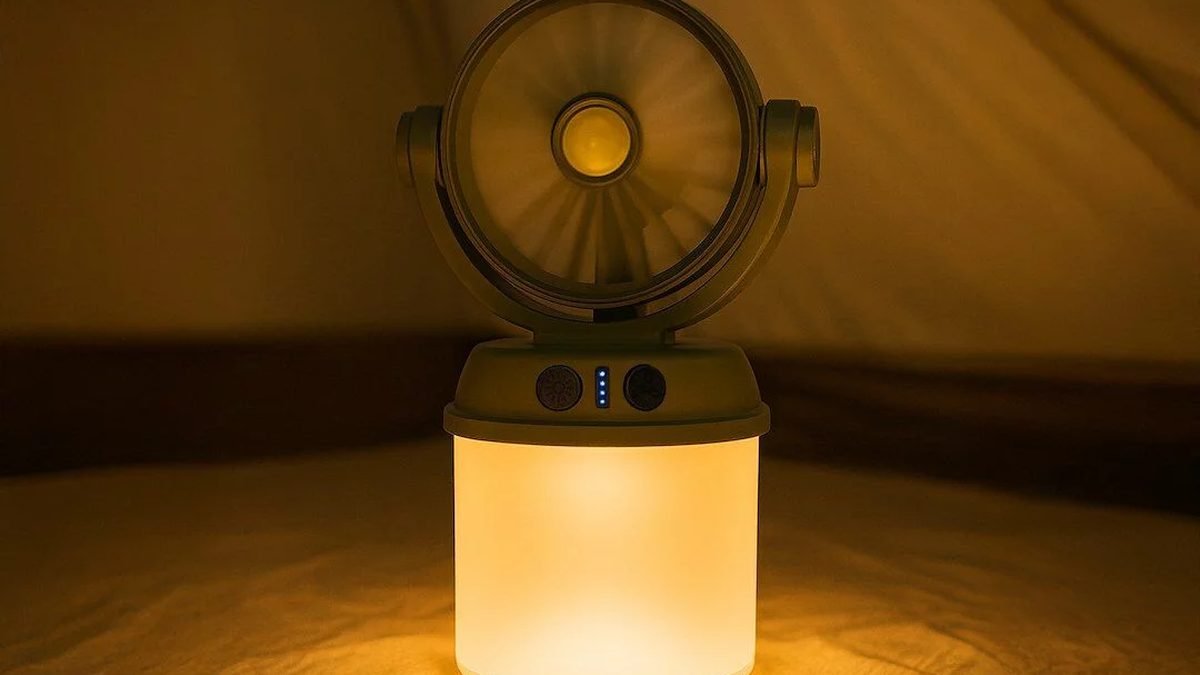
A clever combo: a fan with a built-in light, running on 12V or D-cell batteries, with 10 hours on high and 30 on low. The light means one less lantern in the kids’ tent, and the long battery runtime means it survives the night even on D-cells. Not as powerful as the lithium models, but as a set-and-forget kids’ tent solution it’s excellent.
Powering Fans Off-Grid
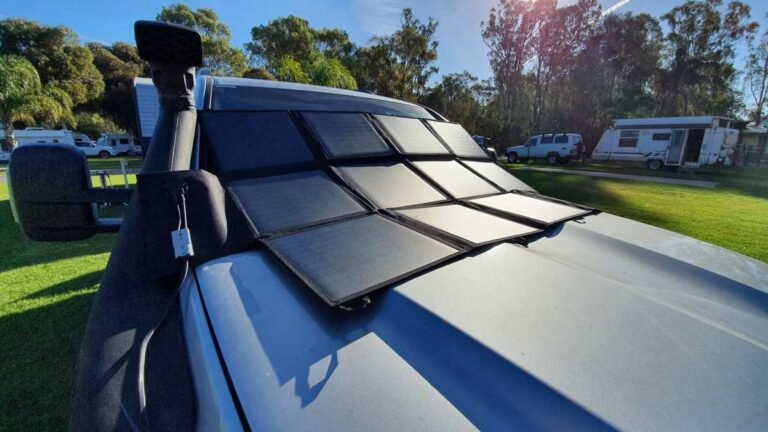
A fan’s nightly consumption is modest: a 15W fan for 8 hours = 120Wh — easily covered by any power station or a decent power bank with 12V output. For multi-night trips without recharging, budget 120Wh/night/fan. Solar top-up during the day (even a small 60–120W panel) covers a fan indefinitely. The 12V fans (Breezeway) can run straight from the car while driving — arrive at camp with a pre-cooled vehicle and a full fan battery.
Fan Maintenance
Keep blades clean — dust buildup causes vibration and noise. Charge the lithium battery every few months in storage (don’t leave it flat). Store with the oscillation lock engaged so the head doesn’t flop in transit. And keep the charging cable with the fan — a proprietary cable left at home turns a $85 fan into a paperweight. (USB-C models win here again.)
Fan Types Compared: Rechargeable vs 12V vs USB
Rechargeable (internal lithium): The most versatile — use anywhere, no cables, no vehicle needed. The downside is one more battery to remember to charge, and when it’s flat you’re done until you recharge. Best for: tents, hiking base camps, anywhere away from the car.
12V (vehicle-powered): Runs from the car’s 12V socket or a power station’s 12V output. No battery to charge, runs indefinitely while powered — but you’re tethered by a cable and it only works where 12V exists. Best for: car campers who run a power station nightly, caravan setups.
USB-powered (5V): Small personal fans running from any USB port or power bank. Weak airflow for tent cooling — these are desk fans, not tent fans. Fine for personal use in a swag, inadequate for cooling a family tent. Don’t confuse them with proper rechargeable camping fans.
The verdict: Rechargeable wins for most campers because the use case (tent, away from the car) is exactly where 12V isn’t available. 12V makes sense only if your power station runs every night anyway.
Noise Ratings: What to Actually Expect
Manufacturers quote noise in decibels, but testing conditions vary wildly — treat specs as relative, not absolute. As a guide: under 40 dB is whisper-quiet (you’ll sleep through it easily), 40–50 dB is a soft hum (most people sleep fine, light sleepers may notice), 50–60 dB is clearly audible (fine for evening use, marginal for sleeping), over 60 dB is intrusive (don’t buy it for a tent). Brushless motors are quieter and more efficient than brushed — worth seeking out. And remember: a bigger fan on low is always quieter than a small fan on high moving the same air. Size up, slow down.
Beyond the Tent: Other Uses
A good camping fan earns its place beyond hot nights: cooking smoke — position it to blow campfire or stove smoke away from the seating area; drying gear — airflow dries damp clothes and tents far faster than still air; flies — a decent breeze disrupts flies around the food prep area (they’re weak flyers); car pre-cooling — run it in the car while packing up to flush hot air; power outages at home — the same fan that cools your tent keeps you sane during summer blackouts. The more uses, the easier the purchase justifies itself.
Kids and Pets: Extra Considerations
For kids’ tents, prioritise finger-safe grilles (small gaps little fingers can’t reach through), stable bases that won’t tip onto sleeping kids, and simple controls they can operate themselves. The Coleman lighted tent fan mentioned above is ideal — light plus fan, long battery life, no small parts. For dogs in tents or caravans, a fan is almost essential in summer — dogs overheat far faster than humans, and a 12V fan running from the vehicle while you eat dinner nearby can be a genuine safety measure. Never leave pets in a closed vehicle relying solely on a fan — it helps, but it’s not air conditioning.
What We’d Buy
The one-fan solution: Companion Aerobreeze 30cm (~$85, Snowys). Proper airflow, quiet enough to sleep with, proven durability. Tight on space: Coleman 8″ rechargeable (~$80, Snowys). Already running a power station nightly: Outdoor Connection Breezeway 12V (~$63, Snowys) — cheaper, lighter, one less battery. Kids’ tent: Coleman lighted tent fan. Buy once, sleep well — and check the current range at Snowys, which stocks the full Companion and Coleman fan lineups with real-world reviews from Australian campers.
Buying Checklist
Before you buy, run through this: Runtime on medium — 5+ hours? Noise — brushless motor, under 50 dB claimed? Size — 25–30cm for tents, smaller only for personal use? Charging — USB-C (preferred) or 12V/240V with cables included? Mounting — stable base plus hanging hook or clamp? Weight — under 2.5kg for the big ones? Warranty — 12 months minimum from an Australian-sold brand? If a fan ticks all seven, buy with confidence. If it fails two or more, keep looking — a fan is a multi-year purchase and the good ones aren’t expensive.
The Bottom Line
A rechargeable camping fan is one of the highest comfort-per-dollar purchases in all of camping gear — under $90 transforms every hot night for years. Buy the Companion Aerobreeze 30cm if you want the proven benchmark, the Coleman 8″ if space is tight, or the 12V Breezeway if your power station runs nightly anyway. Then use the tent-cooling playbook — ventilate, elevate, pre-cool, wet towel — because the fan is only half the system. Sleep well; the heat doesn’t have to win. And when autumn arrives and the fan goes back in the shed, give the battery a storage charge — it’ll be ready when the first hot night of next summer rolls around. A well-maintained fan lasts many seasons — neglect the battery and you’ll be buying a new one.
FAQs
How long do rechargeable camping fans last?
Typically 4–8 hours on medium/low speeds — enough for a full night’s sleep. High speed drains most fans in 3–5 hours. Size your expectations to medium speed, which is what you’ll actually sleep with.
Can I run a camping fan all night?
Yes — that’s what they’re designed for. A 15W fan uses ~120Wh over 8 hours, easily handled by a power station or power bank. Use medium speed for the best noise-to-runtime balance.
Do camping fans really cool a tent?
Fans don’t lower air temperature, but moving air dramatically improves comfort through evaporative cooling of sweat. Combined with ventilation and the wet-towel trick, a fan makes hot nights genuinely sleepable.
What’s better: rechargeable or 12V camping fan?
Rechargeable for versatility (use anywhere, no cables). 12V for simplicity if you always have vehicle/station power — cheaper, lighter, one less battery to manage.
← Back to our complete guide: Best Solar Panels for Camping Australia 2026