Best 12V Batteries for Camping
Disclosure: We may earn a small commission if you purchase through our links, at no extra cost to you.
Your 12V battery camping setup is the heart of your off-grid power system — every light, every phone charge, every fridge cycle flows through it. And the market has fundamentally changed in the last few years: lithium (LiFePO4) batteries that once cost a fortune have fallen to the point where the old default, AGM, is now the questionable choice for most buyers. This guide compares AGM vs lithium honestly — not just the sticker price, but the five-year maths, the weight, the lifespan, and the situations where each still makes sense — with real Australian prices for 2026.
For the full system context, see our solar sizing guide (how big a battery you need), 12V setup basics (wiring it all together), and best solar panels (keeping it charged).
AGM vs Lithium: The Core Differences
| AGM (lead-acid) | LiFePO4 (lithium) | |
|---|---|---|
| Usable capacity (100Ah) | ~50Ah (50% discharge limit) | ~100Ah (100% usable) |
| Weight (100Ah) | ~28–32 kg | ~12–14 kg |
| Cycle life | 300–500 cycles | 3,000–4,000+ cycles |
| Charge speed | Slow (tapering) | Fast (to ~95%) |
| Self-discharge | ~3–5%/month | ~1–3%/month |
| Price (100–120Ah, AU) | ~$250–400 | ~$600–800 |
| Lifespan (weekend use) | 2–4 years | 8–12+ years |
The headline: a 120Ah lithium battery gives you roughly the usable energy of a 200Ah+ AGM bank, at less than half the weight, and lasts 3–5x longer. The only thing AGM wins on is upfront price — and even that advantage is shrinking.
The 5-Year Maths (This Settles It)
Let’s price usable amp-hours over five years of weekend camping (~100 cycles/year = 500 cycles):
AGM: 120Ah AGM at ~$300 gives 60Ah usable. At 500 cycles you’re at or past its rated life — budget a replacement around year 3–4. Five-year cost: ~$600 for 60Ah usable. That’s $10 per usable Ah, plus you’ve lugged 30 kg around and dealt with declining performance.
Lithium: KickAss 120Ah LiFePO4 at $799.95 gives ~120Ah usable — double the AGM — and at 500 cycles it’s barely broken in (rated 4,000 cycles at 80% DoD). Five-year cost: $799.95 for 120Ah usable = $6.66 per usable Ah, at 13 kg, with years of life remaining.
Lithium wins on cost per usable amp-hour already, before counting the weight saving (17 kg!), the faster charging, or the fact that the lithium battery still has most of its life left at year five while the AGM is on its second unit. The “lithium is expensive” narrative is outdated — it’s now the value choice for anyone who camps regularly. The only campers who should still default to AGM are those with a hard upfront budget ceiling or a specific technical reason (like an ancient charging system) — and even then, it’s worth pricing the lithium option, because the gap is smaller than most people assume.
When AGM Still Makes Sense
Lithium wins most comparisons, but AGM isn’t dead:
- Tight upfront budget: If $800 isn’t available and $300 is, an AGM gets you camping now. It’s a legitimate stepping stone — just know you’ll replace it sooner.
- Simple existing setups: Very old vehicles and basic setups with lead-acid-only chargers work fine with AGM. (Though most modern DC-DC chargers handle both.)
- Extreme cold charging: Lithium shouldn’t be charged below 0°C (discharging is fine to -20°C). If you camp in alpine winter and can’t keep the battery warm, AGM avoids the issue. (Many lithium batteries now include low-temperature charge protection or heating.)
- Starter battery replacement: For cranking engines, AGM still rules — lithium cranking batteries exist but are a different product.
What Size Battery Do You Need?
From the sizing guide: add up daily watt-hours, divide by 12 for amp-hours, add margin. Quick reference:
- No fridge, weekends: 50–75Ah lithium (or 100Ah AGM)
- Week-long, no fridge: 100Ah lithium
- With 12V fridge: 100–120Ah lithium minimum; 170–200Ah for week+ trips
- Full-time touring: 200–300Ah+ lithium
Remember the usable-capacity rule: halve AGM ratings when comparing. A “100Ah AGM” and “100Ah lithium” are not the same battery in practice — the lithium delivers twice the usable energy.
The Best 12V Battery Camping Picks in Australia for 2026
KickAss 120Ah LiFePO4 — Best All-Rounder
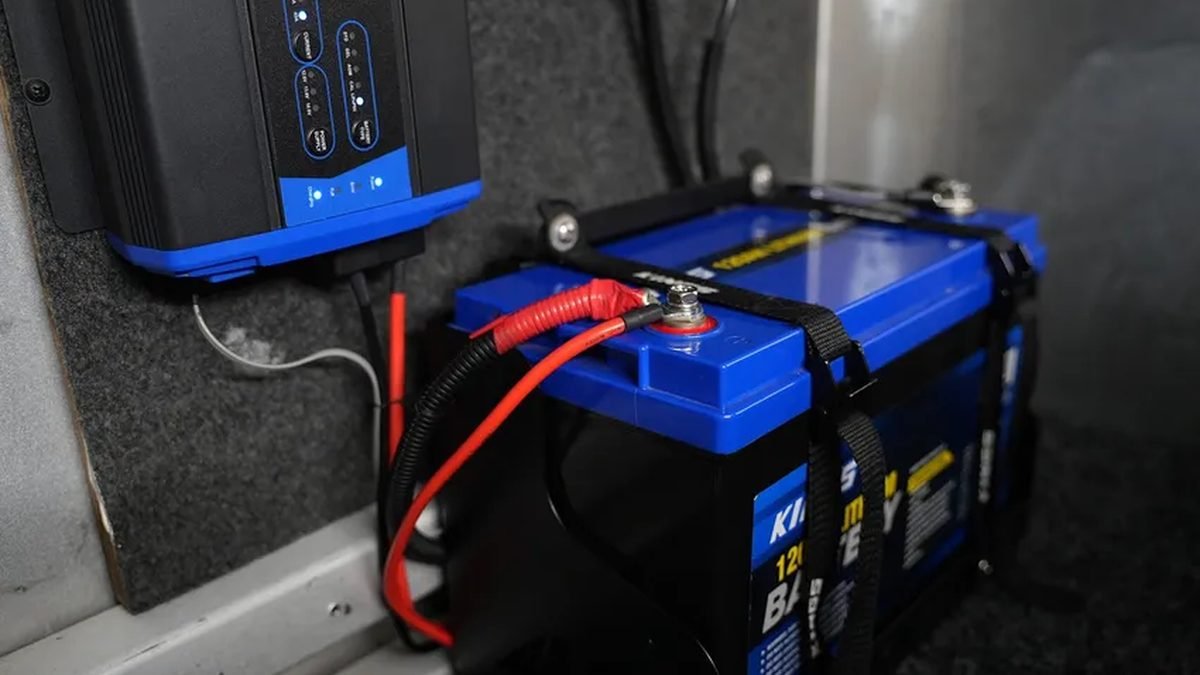
KickAss’s 120Ah Smart Lithium is the benchmark Australian camping battery: 4,000-cycle rated LiFePO4, built-in smart BMS with low-temperature cut-off, 120A continuous discharge (enough for inverters and high-draw gear), Bluetooth monitoring on smart models, and genuine local support. At $799.95, it’s the price-to-performance king — the battery we’d buy with our own money for most setups. The slimline version (same price) fits where standard batteries won’t.
KickAss 170Ah AGM + DC-DC Bundle — Best AGM Option
If you’re going AGM (budget or specific needs), don’t buy a bare battery — buy the system. KickAss’s 170Ah slimline AGM bundled with a 25A DC-DC charger, tray, wiring kit and LVD runs $935.95. It’s everything needed for a proper dual-battery install in one box, with components designed to work together. As AGM setups go, this is the smart way to do it.
Enerdrive / Baintech — Best Premium
At the top end, Enerdrive and Baintech (Baintech is the Australian-made option) make superb lithium batteries with exceptional BMS sophistication, Australian engineering and support. You’ll pay more — often $1,000+ for 100–125Ah — but for mission-critical touring where failure isn’t an option, the premium buys peace of mind. These are the batteries in serious expedition builds.
Budget Lithium — The Value Frontier
Generic LiFePO4 batteries from online marketplaces now dip well below the name brands. The cells are often fine; the BMS quality and after-sales support are the gamble. If you go this route: verify the BMS has low-temperature charge cut-off, over-current and short-circuit protection; check the actual continuous discharge rating (not just peak); and accept that warranty claims may be an adventure. For a second battery or low-stakes use, acceptable. For your primary touring battery, buy the brand.
Battery Monitors: Know Your State of Charge
A battery without a monitor is a guess. Voltage alone is a poor state-of-charge indicator (especially for lithium, whose voltage stays flat across most of the discharge curve). A proper shunt-based monitor (Victron SmartShunt, Enerdrive ePRO, or the Bluetooth in smart batteries) tracks amp-hours in and out and tells you the real percentage. It’s a $100–200 addition that prevents both the anxiety of not knowing and the damage of over-discharging. If your battery has built-in Bluetooth monitoring, use it — check it the way you check your fuel gauge.
Safety: Lithium Is Safe If You Respect It
LiFePO4 is the safest lithium chemistry — thermally stable, no thermal-runaway fire risk like phone/laptop cells. But “safe chemistry” isn’t “no rules”: use a quality BMS (built into all reputable batteries), fuse appropriately (within 20cm of the battery positive terminal), use proper gauge cable, secure the battery so it can’t move in a crash, and never charge a frozen lithium battery (below 0°C) unless it has low-temp protection. AGM has its own risks — hydrogen venting when charging (ventilate!), acid spills, and much heavier lifting injuries. Both are safe with proper installation; both punish sloppy work.
Battery Boxes: The Plug-and-Play Shortcut
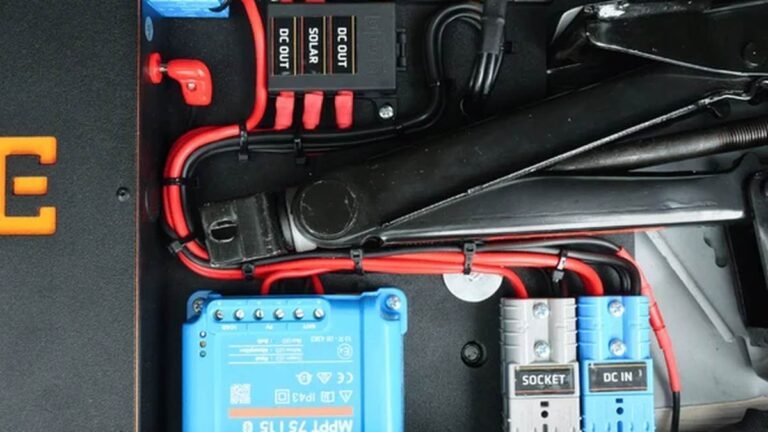
Not keen on wiring? A battery box is a battery in a portable case with built-in outlets — 12V sockets, USB ports, sometimes an inverter and solar regulator. Drop in a battery (or buy pre-fitted), connect solar, done. No crimping, no fuses to wire, no holes drilled. They’re the middle ground between a loose battery and a full power station: cheaper than a power station, more flexible (you choose the battery size and can replace it), but bulkier and less polished. Brands like KickAss, Baintech and iTechworld all do them. For renters, leased vehicles, or anyone who wants 12V power without modifying the car, battery boxes are brilliant. The trade-off is efficiency — every connection and adapter loses a little, and a wired dual-battery install is ultimately tidier.
Expanding Later: Adding a Second Battery
Start with one battery; add a second when your trips prove you need it. Rules for paralleling: same chemistry, same capacity, same age — ideally bought together. Mixing an old battery with a new one drags the new one down to the old one’s level. With lithium, the BMS in each battery manages the pairing, but the same-age rule still applies for best results. Wire them with equal-length cables to a common point (not daisy-chained) so they share load evenly, and fuse each battery. When in doubt, buy the bigger single battery now rather than planning to parallel later — one 200Ah is simpler and more reliable than two 100Ah.
Winter Battery Care
Cold affects both chemistries: AGM loses capacity (a battery at 0°C delivers ~85% of its rated capacity), and lithium must not be charged below 0°C. Practical steps: insulate the battery box (even a blanket helps), keep the battery in the vehicle’s cabin or canopy rather than an exposed tray where possible, and never leave a lithium battery charging from solar on a frosty morning without low-temp cut-off — quality BMS units handle this automatically, which is another reason to buy reputable brands. In alpine conditions, some tourers run a small 12V heating pad on a thermostat. Discharging in the cold is fine for both; it’s charging frozen lithium that kills cells.
Disposal and Recycling
Don’t bin old batteries — it’s illegal in most Australian states and terrible environmentally. Lead-acid/AGM batteries are ~95% recyclable; most auto stores, battery retailers and council transfer stations take them free (some even pay scrap value). Lithium batteries go to dedicated e-waste recyclers — check your council’s website or retailers like Battery World. A lithium battery at end of life still has value as a stationary storage battery (solar shed, anyone?) — the “second life” market is growing. Recycle properly; the lead and lithium in your old battery become someone’s new one.
Charging Profiles: What Your Charger Is Actually Doing
A proper multi-stage charger runs through bulk (maximum current until ~80% full), absorption (tapering current to 100%), and float (maintenance trickle). Lithium charges differently from AGM: it takes full current almost to 100% (which is why it charges so much faster), then stops — no float needed, and float can actually harm lithium over time. This is why the charger’s chemistry setting matters: an AGM profile on a lithium battery undercharges it and wastes its capacity; a lithium profile on an AGM overcharges and boils it dry. Set it once, correctly, and never think about it again. If your charger has no lithium mode, it’s time for a new charger, not a compromise.
Battery Myths Worth Burying
“Lithium batteries explode.” You’re thinking of phone/laptop cells (NMC chemistry). LiFePO4 camping batteries are thermally stable and don’t go into thermal runaway. They’re safer than the petrol jerry can next to them.
“AGM is maintenance-free.” Lower-maintenance than flooded lead-acid, yes — but AGMs still sulfate if left flat, still lose capacity in heat, and still need proper charging voltages. “Sealed” doesn’t mean “invincible.”
“Bigger is always better.” An oversized battery that’s never properly charged sulfates (AGM) or just wastes money and weight. Size to your actual use — the sizing guide exists for this.
“You can’t mix old and new.” Actually true — keep this one. A new battery paralleled with a tired one inherits the tired one’s characteristics. Replace banks together.
FAQs
Is lithium worth it for camping?
Yes for regular campers. A 120Ah lithium (~$800) delivers double the usable energy of a 120Ah AGM (~$300), weighs half as much, charges faster, and lasts 3–5x longer. The 5-year cost per usable amp-hour already favours lithium.
Can I replace my AGM with lithium directly?
Usually yes, but check your charger: lithium needs a lithium charging profile (14.2–14.6V). Old lead-acid-only chargers will undercharge it. Most modern DC-DC chargers and solar regulators have a lithium mode — just switch it over.
How long does a 120Ah lithium battery last camping?
With a 12V fridge (~800Wh/day), a 120Ah lithium (1,440Wh) lasts ~1.5 days solo, indefinitely with 200W+ solar. Without a fridge, 3–5 days of typical device/lighting use.
Can lithium batteries be charged below freezing?
No — charging LiFePO4 below 0°C damages the cells. Discharging is fine to -20°C. Quality batteries include low-temperature charge cut-off; keep the battery insulated or warmed in alpine conditions.
← Back to our complete guide: Best Solar Panels for Camping Australia 2026