Best 4WD Awnings Australia 2026
Disclosure: We may earn a small commission if you purchase through our links, at no extra cost to you.
An awning is the difference between a campsite you enjoy and a campsite you endure. In the Australian sun, shade isn’t a luxury — it’s the thing that makes lunch edible, the fridge efficient, and the afternoon bearable. But walk into the best 4WD awnings Australia has to offer and you’re confronted with the big question: 270 or 180? Freestanding or poled? And why does one cost $1,000 while another costs $3,000?
This guide answers the type question first — because buying the wrong type of awning is a far more expensive mistake than buying the wrong brand — then compares the leading options with real 2026 Australian prices. Once you’ve chosen, our camp setup routine shows you how to get it deployed in minutes as part of a proper arrival drill.
270 vs 180: The Decision That Matters Most
The numbers refer to degrees of coverage around your vehicle:
- 180° (straight) awnings: extend straight out from one side of the vehicle in a rectangle — typically 2m × 2.5m or 2.5m × 2.5m, giving 5–6m² of shade. Lighter (10–15kg), cheaper ($250–$750), simpler to mount. One person can set one up in a couple of minutes.
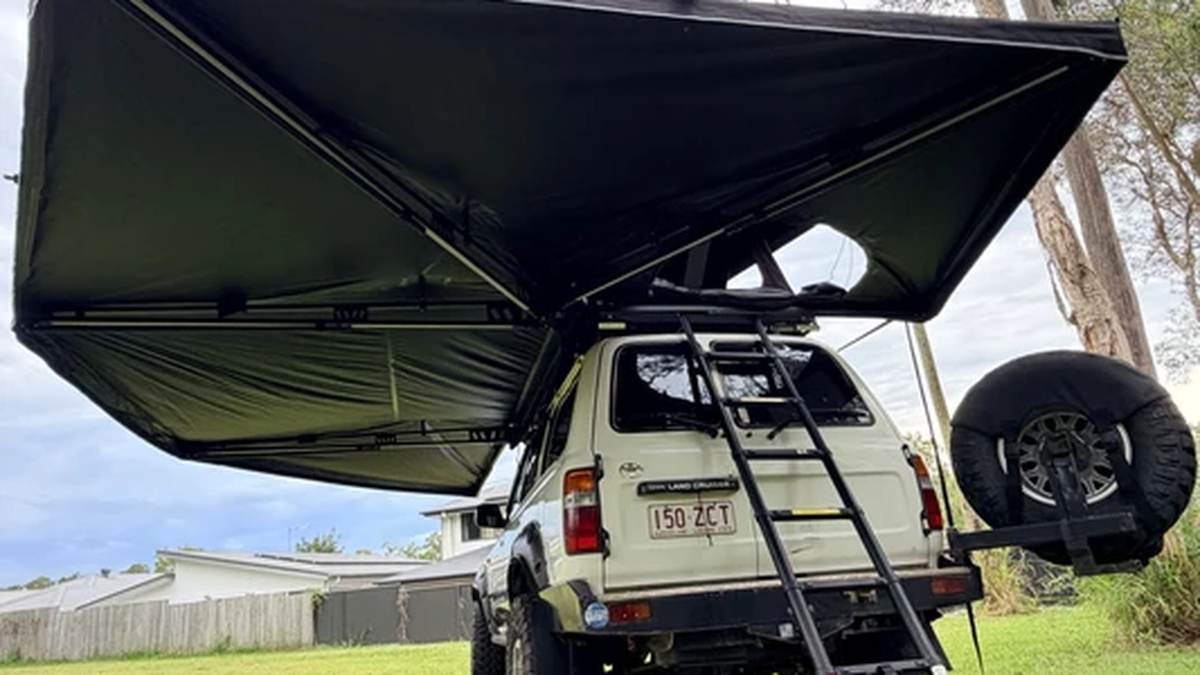
- 270° (wraparound) awnings: swing out from the side and wrap around the rear of the vehicle, covering the side and the back — typically 10–12m² of shade. Heavier (20–30kg), pricier ($1,000–$3,000), more complex. The rear coverage is the killer feature: it shades your rear kitchen, tailgate fridge, or canopy setup.
The coverage maths: a 270° awning gives roughly double the shade of a 180° for roughly double the money and double the weight. But the useful difference is bigger than the numbers suggest, because the rear coverage of a 270° protects exactly where touring 4WDs live — the back of the vehicle where the fridge, kitchen, and drawers are.
Choose 180° if: you’re a weekend camper, you run a simple setup without a rear kitchen, weight and budget matter more than coverage, or your vehicle is smaller (a 270° overwhelms a short-wheelbase wagon).
Choose 270° if: you tour for weeks at a time, you cook at the rear of the vehicle, you camp with family (kids need shade to exist in), or you want the option of adding walls later for a full enclosed room.
Freestanding vs Poled: Understanding Wind Ratings
Within 270° awnings there’s a second crucial distinction:
- Freestanding (no-pole) designs: the arms lock rigid and the awning stands up with no legs. Setup is genuinely fast — swing it out and you’re done. But freestanding has a wind limit: most are rated to only ~30km/h freestanding. Above that, you must drop the legs and guy-rope it.
- Poled designs: require legs from the start. Slower to set up, but inherently more stable in wind once guyed out (typically rated to 50–60km/h with legs and ropes).
Here’s what the marketing doesn’t emphasise: a freestanding awning in wind is a sail attached to your roof rack. The leverage on your rack mounts in a gust is enormous. The correct technique with any 270° awning is to drop the legs every time you set up properly — treat “freestanding” as a convenience for quick lunch stops, not a camping mode. Tie it down, or watch the weather.
The Best 4WD Awnings in Australia for 2026
| Awning | Type | Coverage | Weight | Typical AU price |
|---|---|---|---|---|
| Darche Eclipse 270 Freestanding LED G3 | 270° freestanding | 11.5m² | ~26kg | ~$1,879 |
| 23Zero Onyx 270 | 270° freestanding | ~11m² | ~24kg | ~$1,090 |
| 23Zero Falcon Pro 270 | 270° freestanding | ~10m² | ~23kg | ~$1,300 |
| The Bush Company 270 XT MAX Mk2 | 270° freestanding | 12.2m² | ~30kg | ~$2,950 |
| 23Zero Peregrine 180 | 180° | ~6m² | ~12kg | ~$749 |
| OpenRoad 270 Freestanding | 270° freestanding | ~10.5m² | ~29kg | ~$1,000 |
Prices AUD from Australian retailers, late 2026. Wall kits (which enclose the awning into a room) are sold separately, typically $300–$750 depending on brand.
1. Darche Eclipse 270 Freestanding LED G3 — The All-Rounder
The Darche Eclipse 270 is arguably the most popular 270° awning in Australia, and the G3 generation refines a proven formula: 11.5m² of coverage, freestanding setup, and integrated dimmable LED lighting in the arms — which sounds like a gimmick until you’re cooking under it at night.
At around $1,879 AUD at BCF, it’s firmly mid-premium. The build quality is proven over years of Australian touring, spare parts are available, and the dealer network is everywhere. The LED lighting alone saves you rigging a separate camp light. If you want the safe, popular, well-supported choice, this is it.
2. 23Zero Onyx 270 — The Value Standout
23Zero’s Onyx 270 undercuts the Darche by nearly $800 at around $1,090 AUD direct — while offering a 6-arm TIG-welded aluminium truss system, freestanding setup, and even sound-reactive RGB LED lighting in the rafters. It’s the new-generation value play: proper engineering at a price that embarrasses the established players.
The brand has built a strong reputation in rooftop tents and camping accessories, and the Onyx brings that same value philosophy to awnings. If budget matters but you still want 270° coverage, this is currently the price-to-performance leader.
3. 23Zero Falcon Pro 270 — The Step Up
The Falcon Pro 270 (around $1,300 AUD) sits between the Onyx and the Darche: 5 aluminium truss rafters, 280gsm polycotton canvas with light-suppression coating, integrated LED lighting, and a wraparound design with dual RTT access points for rooftop tent users.
The polycotton canvas is the differentiator — cooler underneath than polyester in harsh sun, at the cost of slightly more weight and slower drying. For hot-climate touring, that cooler shade is genuinely noticeable.
4. The Bush Company 270 XT MAX Mk2 — The Premium
At $2,950 AUD, the Bush Company’s 270 XT MAX Mk2 is the most expensive awning on this list — and the most capable. 12.2m² of coverage (the largest here), premium canvas construction, and a reputation among serious tourers that’s borderline cult-like. This is the awning for people doing the Canning Stock Route, not the caravan park.
Is it worth 2.7× the 23Zero Onyx? For most campers, no — the mid-range options cover 95% of needs. For remote-area tourers who’ll deploy it daily for months and need it to survive conditions that destroy lesser awnings, the premium buys peace of mind. It’s a specialist tool at a specialist price.
5. 23Zero Peregrine 180 — The Simple Choice
For the 180° camp: the Peregrine 180 at around $749 AUD gives you quality straight-side shade without the weight, cost, or complexity of a 270°. It’s the right answer for weekenders, smaller vehicles, and anyone who looks at a 270° and thinks “that’s overkill for us”.
6. OpenRoad 270 — The Budget Entry
OpenRoad’s 270° freestanding awning at around $1,000 AUD is the cheapest way into wraparound coverage from a brand with Australian distribution. The specs are honest (10.5m², 30km/h freestanding wind rating, 60km/h with legs and guys), and it includes the mounting hardware.
As with all budget touring gear, go in with realistic expectations about longevity and support versus the premium brands. For the price of entry to 270° shade, it’s compelling.
Mounting: Getting It On the Vehicle
Awnings mount to your roof rack or directly to roof bars via L-brackets. The key considerations:
- Mount it on the passenger side (left in Australia) — this keeps your camp setup away from road traffic when you pull over.
- Check tailgate clearance: a 270° awning wraps around the rear, and on some vehicles the rear door or tailgate can foul the awning arms. Check before you buy, not after.
- Rack strength matters: a 25–30kg awning plus wind leverage is a serious load. Your rack’s mounting system needs to handle it — this is another reason to buy a proper platform rack rather than basic cross bars.
- Height: the awning should mount at 1.9–2.2m so you can walk under it comfortably but it doesn’t catch every branch. Adjustable legs handle the rest.
Walls: Turning Shade Into Shelter
Most 270° awnings accept zip-on wall kits that enclose the covered area into a full room — typically $300–$750 depending on brand. With walls up, a 270° awning becomes a 10–20m² enclosed shelter: a bug-free dining room, a kids’ play space, or emergency accommodation.
Walls are the most underrated awning accessory. They block low sun and wind-driven rain — the two things an open awning can’t handle — and they transform a fair-weather shade into genuine all-weather camp infrastructure. If you’re buying a 270° awning for extended touring, budget for the walls from the start.
Awning Care and Maintenance
A quality awning lasts a decade; a neglected one lasts two seasons. The maintenance is simple but non-negotiable:
- Dry before storing. The golden rule. Packing a damp awning breeds mildew that stains the canvas and weakens the fabric. If you must pack wet (rain departure), deploy it at the next stop — even for an hour — to dry. This single habit determines awning lifespan more than any other factor.
- Clean the fabric annually. Mild soap, soft brush, thorough rinse. Never use harsh detergents or pressure washers — they strip the waterproofing. Re-treat with canvas reproofer every couple of years if water stops beading.
- Check the hinges and arms. The folding mechanisms on 270 awnings take enormous loads. Annually: check bolts for tightness, lubricate pivot points with dry lubricant (not oil — it attracts dust), and inspect for cracks in brackets.
- Peg and guy in wind — always. Even “freestanding” 270 awnings need pegging in any breeze. The number one cause of awning death is an unpegged awning catching a gust. Carry spare pegs and guy ropes permanently.
- LED strips: if your awning has integrated lighting, check the wiring where it flexes at the hinges — that’s where breaks happen. Carry a standalone strip light as backup regardless.
- Storm protocol: in serious wind, pack the awning away. No awning is worth the risk — a 270-degree sail in a 60km/h gust can damage the vehicle, the awning, and anyone nearby. Ten minutes of packdown beats a $2,000 replacement.
Frequently Asked Questions
Is a 270 awning worth it over a 180?
If you tour for weeks, cook at the rear of your vehicle, or camp with kids — yes. The rear coverage protects exactly where touring 4WDs live (fridge, kitchen, drawers), and the coverage roughly doubles for roughly double the money. For weekenders with simple setups, a 180° is lighter, cheaper, and entirely adequate.
Can I leave my 270 awning freestanding overnight?
Not safely in anything above a light breeze. Most freestanding awnings are rated to only ~30km/h without legs. Always drop the legs and guy-rope it for overnight or unattended setups — “freestanding” is for quick stops, not camping mode.
How much does a good 4WD awning cost in Australia?
Quality 180° awnings run $500–$800; quality 270° awnings run $1,000–$1,900, with premium options to $3,000. Budget $300–$750 extra for wall kits if you want an enclosed room.
Will a 270 awning fit my vehicle?
Most 270° awnings suit medium to large wagons and dual-cab utes with a roof rack. Check two things: tailgate/rear door clearance (the awning wraps around the back), and that your rack can handle 25–30kg plus wind leverage. Short-wheelbase vehicles are usually better with a 180°.
Do awnings come with LED lights?
Many modern 270° awnings do — the Darche Eclipse G3 has dimmable LEDs and the 23Zero Onyx has RGB lighting built into the rafters. It’s genuinely useful for cooking and camp life after dark, and saves rigging separate lights.
Can I leave my awning on the car permanently?
Yes — most tourers do. It costs a small fuel penalty and adds weight up high, but the convenience of instant shade outweighs it. Maintain it: dry before long storage, check bolts annually, and peg it in any wind.
How do I stop my awning flapping in wind?
Peg every corner and use guy ropes — most flapping comes from unpegged edges catching the breeze. Lower the awning’s front edge slightly so wind flows over rather than under, and in strong gusts, pack it away: no awning is worth the damage.
← Back to our complete guide: Best Roof Racks for 4WD Touring Australia 2026