Best Camping Near Hobart: 10 Top Spots Within 3 Hours
Disclosure: We may earn a small commission if you purchase through our links, at no extra cost to you.
Best Camping Near Hobart: 10 Top Spots Within 3 Hours
Hobart is one of the easiest Australian cities to escape from with a tent. Within an hour you can be camped beside a river in tall forest at Mount Field; within two hours, at the end of the road at Cockle Creek or on an island camp on Bruny; within three hours, on the white sand of Freycinet. The best camping near Hobart is a ring of Parks and Wildlife Service campgrounds — forest, beach, island and far-south wilderness — with a couple of free camps in the mix.
Fees were checked 22 November 2026 against Parks Tasmania pages. From 3 November 2026 the fee-charging campgrounds here book online through one portal, at a flat rate per site for up to six people: $18 standard, $24 premium unpowered, $35 premium powered. A parks pass is a separate charge, required in every national park. Seasonal campfire bans started across southern Tasmania on 26 October 2026 — check the fire rules before you travel.
Best camping near Hobart within 90 minutes
The closest forest, peninsula and beach camps.
Mount Field Campground, Mount Field National Park
Mount Field is the closest national park campground to Hobart — just over an hour’s drive via New Norfolk and Westerway. It sits in the forest beside the Tyenna River. There are 14 powered sites as well as a range of unpowered sites. Camping costs $24 per site per night unpowered or $35 powered, for up to six people. Facilities are hot showers (token-operated), laundry, a cooking shelter and free electric barbecues. The campground is a fuel-stove-only area — no fires are permitted in it. Check the Parks Tasmania page before you go.
Fortescue Bay Campground, Tasman National Park
Fortescue Bay is the Tasman Peninsula’s big beach camp, about 90 minutes from Hobart via Eaglehawk Neck and Port Arthur, then 12 kilometres of unsealed road that is suitable for 2WD vehicles. There are two campgrounds, Banksia and Mill Creek, behind a wide arc of white sand. Camping costs $24 per site per night. Mill Creek has the larger sites, for boats, campervans and motorhomes; generators are permitted there but must be switched off by 9pm. Boil the tank water for three minutes before drinking. Campfires are permitted only in the designated fireplaces, and not during seasonal campfire restrictions.
Lime Bay Campground, Lime Bay State Reserve
Lime Bay is the quiet Tasman Peninsula alternative to Fortescue Bay, about an hour and a half from Hobart via Sorell, Taranna and Nubeena, with the last 6.5 kilometres on an unpaved road. Camping costs $18 per site per night. Facilities are four pump-flush toilets and camp fireplaces; generators are permitted but must be switched off by 9pm. Bring your own drinking water and firewood. Campfires are only permitted in the designated fireplaces and are prohibited during seasonal fire bans, so carry a fuel stove. Pets are prohibited.
Bruny Island: three camps across the ferry
Kettering is about 40 minutes from Hobart via Kingston, and the SeaLink ferry takes 15 minutes to Roberts Point. The Bruny camps are $18 per site per night for up to six people, except The Pines, which is free.
The Neck Campground, Bruny Island
The Neck is the famous one — the narrow isthmus joining north and south Bruny. The campground sits in The Neck Reserve about three kilometres past the lookout, sheltered behind the sand dunes at the south of the isthmus, with easy access to the beach. Camping costs $18 per site per night, and bookings are required. It sits outside the national park boundaries, so you do not need a parks pass here, though the camping fee still applies. Campfires are permitted unless seasonal fire restrictions are in force.
Jetty Beach Campground, South Bruny National Park
Jetty Beach is the family pick on Bruny — a campsite set among the trees facing a gently curving sandy beach. It is just over an hour south of the ferry terminal, via Alonnah and Lunawanna. Camping costs $18 per site per night for up to six people, and bookings are required. Facilities are pit toilets and non-treated tank water, and campfires are permitted unless seasonal fire restrictions apply.
Cloudy Bay Campgrounds, South Bruny National Park
Cloudy Bay has two separate camps, a 50-minute drive south of the ferry terminal. The Pines, on Cloudy Bay Road, is a small site for surfers and walkers — and there is no charge to camp there. Cloudy Corner, at the far end of the bay, is the larger site at $18 per site per night, but it is only accessible to 4WD vehicles and needs a three-kilometre drive along the beach at low tide. Cloudy Corner is a fuel-stove-only area. Campfires are permitted at The Pines unless seasonal restrictions apply.
Two to three hours: the far south and the east coast
The longer drives buy the wildest camps.
Cockle Creek Campground (Boltons Green), Southwest National Park
Cockle Creek is as far south as you can drive in Australia, two hours south of Hobart on the Huon Highway through Geeveston. Boltons Green, across the bridge, is the campground inside the national park, with about ten sites for tents and caravans. Camping is free, first come, first served — no bookings are taken — with a maximum stay of four weeks. Facilities are pit toilets and a water tank; boil the water before drinking. The Southwest National Park is a fuel-stove-only area, so no fires are permitted at any time of year. Dogs are not permitted once you cross the bridge into the national park. North of the bridge, in the Recherche Bay Nature Recreation Area, dogs are allowed on a lead where signed.
Maria Island Camping, Darlington
Maria Island is the car-free island escape, about 80 minutes’ drive from Hobart to Triabunna, then a passenger ferry to Darlington. Bookings on the ferry are essential — book through Encounter Maria Island. There are no shops or cafes on the island, so bring all food and supplies from Triabunna. Darlington campground sits close to the heart of the island. Camping is from $18 per site per night — confirm the live price at booking. All water on the island is non-potable and must be treated with purification tablets or boiled for at least one minute.
Richardsons Beach Campground, Freycinet National Park
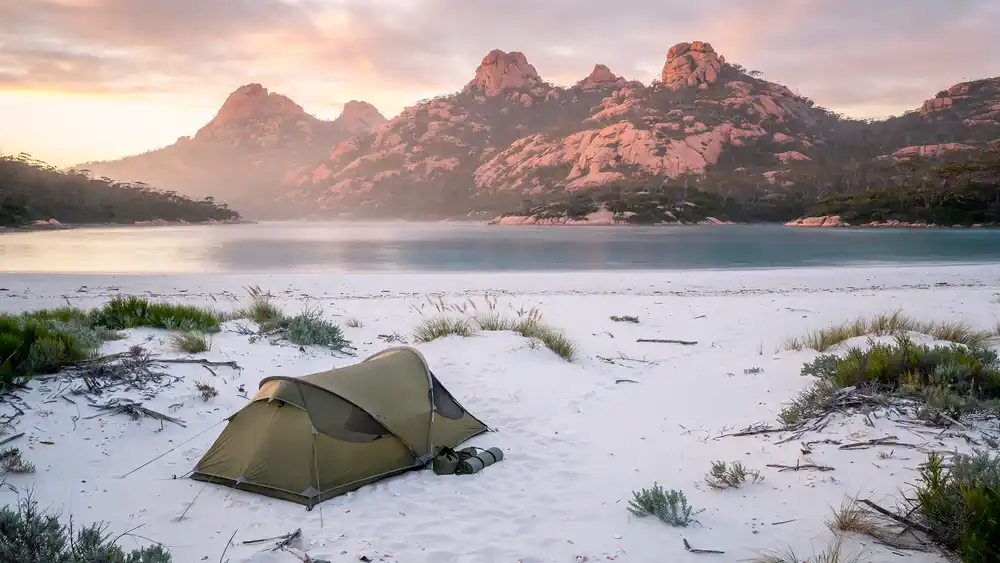
Richardsons Beach is the east coast headline: beachfront camping beside the Freycinet Visitor Centre at Coles Bay, about two and a half hours from Hobart. There are 52 sites: 18 powered for vehicles up to 18 feet, the rest tent-only in the dunes and at Honeymoon Bay. Camping costs $35 per site per night for a powered site or $24 for an unpowered tent site, for up to six people. Honeymoon Bay tent sites are $18. The powered sites have potable water, grey water disposal and coin-operated hot showers. Freycinet is a fuel-stove-only area year-round, so bring a gas stove and refill water at the visitor centre.
Friendly Beaches Camping (Isaacs Point), Freycinet National Park
Friendly Beaches is the quieter Freycinet camp, about 25 kilometres south of the visitor centre on a gravel road off Coles Bay Road. Isaacs Point offers low-key tent and campervan sites among coastal scrub, a short walk from miles of unspoiled white sand. No bookings are taken, and no camping fee is listed on the Parks page — confirm the current fee at the visitor centre. Facilities are pit toilets only, with no water. Freycinet is a fuel-stove-only area.
How to book camping near Hobart
Book through the Parks Online Booking System at book.parks.tas.gov.au, launched 3 November 2026. Fees are a flat rate per site per night for up to six people: $18 for a standard site, $24 for a premium unpowered site and $35 for a premium powered site. The parks pass is separate: a daily vehicle pass is $49.15, a holiday pass is $98.35 and an annual pass is $104.75. The free camps take no bookings and work first come, first served. Book early for school holidays.
Campfires, dogs and park rules
Seasonal campfire bans started on reserved land across southern Tasmania at 2:00 am on Monday 26 October 2026. Mount Field, Cockle Creek, Freycinet and Cloudy Corner are fuel-stove-only all year. Where fires are allowed, they are only permitted in the designated fireplaces, never left unattended, and never during a seasonal ban or on a total fire ban day. Dogs are not permitted in Tasmanian national parks, which covers eight of the ten camps here. Lime Bay, a state reserve rather than a national park, also prohibits pets. The exceptions are the free camping areas north of the Cockle Creek bridge, where dogs are allowed on a lead where signed, and The Neck, which sits outside the national park boundary.
When is the best time to camp near Hobart?
Late spring to autumn is the best season for the best camping near Hobart: mild days, cool nights, campfires allowed where the rules permit them. Summer is the warmest and the busiest, and fire bans can shut the bush camps at short notice. Winter is quiet, but nights are cold and rain makes the unsealed roads slippery.
What to pack for a weekend near Hobart
Bring all drinking water — most of these campgrounds have no potable water, and the tank water at Fortescue Bay, Lime Bay, Cockle Creek and the Bruny camps must be boiled. Pack warm layers and a waterproof jacket: Hobart’s weather changes in an afternoon. Screenshot your booking confirmation — phone reception is patchy at Cockle Creek, Lime Bay and Friendly Beaches. Check the Tasmania Fire Service for total fire ban days on the morning you leave.
Best camping near Hobart: FAQs
How much does camping near Hobart cost?
National park camping near Hobart is charged per site per night, under the new flat rates from 3 November 2026: $18 for a standard site, $24 for a premium unpowered site and $35 for a premium powered site. Mount Field and Richardsons Beach are $24 unpowered or $35 powered; Fortescue Bay is $24; Lime Bay and the Bruny camps are $18; Honeymoon Bay tent sites are $18.
Do I need to book campgrounds near Hobart in advance?
Yes, for the paid campgrounds. Mount Field, Fortescue Bay, Lime Bay, the South Bruny campgrounds, Maria Island’s Darlington campground and Richardsons Beach at Freycinet all book through the Parks Online Booking System. The free camps — Cockle Creek and The Pines at Cloudy Bay — take no bookings and work first come, first served, so arrive early on weekends and through summer. Friendly Beaches also takes no bookings and lists no camping fee — confirm the current fee at the visitor centre.
Can I camp for free near Hobart?
Yes, at two of the ten camps here. Cockle Creek (Boltons Green) at the far south is free, first come, first served, with about ten sites. The Pines at Cloudy Bay on Bruny Island is free. Friendly Beaches (Isaacs Point) at Freycinet also takes no bookings and lists no camping fee on the Parks page — confirm the current fee at the visitor centre.
Are dogs allowed when camping near Hobart?
Not in the national parks — dogs are not permitted in Tasmanian national parks, which covers eight of the ten camps on this list. The exceptions are the free camping areas north of the Cockle Creek bridge, where dogs are allowed on a lead where signed, and The Neck, which sits outside the national park boundary.
What is the closest camping to Hobart?
Mount Field Campground in Mount Field National Park is the closest national park campground — just over an hour’s drive from the city via New Norfolk and Westerway.
Start with the closest sites and the whole ring opens up. Our guide to the best camping spots in Australia picks up where this one leaves off; our city guides cover Adelaide, Brisbane, Melbourne and Perth.