Best Portable Generators for Camping Australia
Disclosure: We may earn a small commission if you purchase through our links, at no extra cost to you.
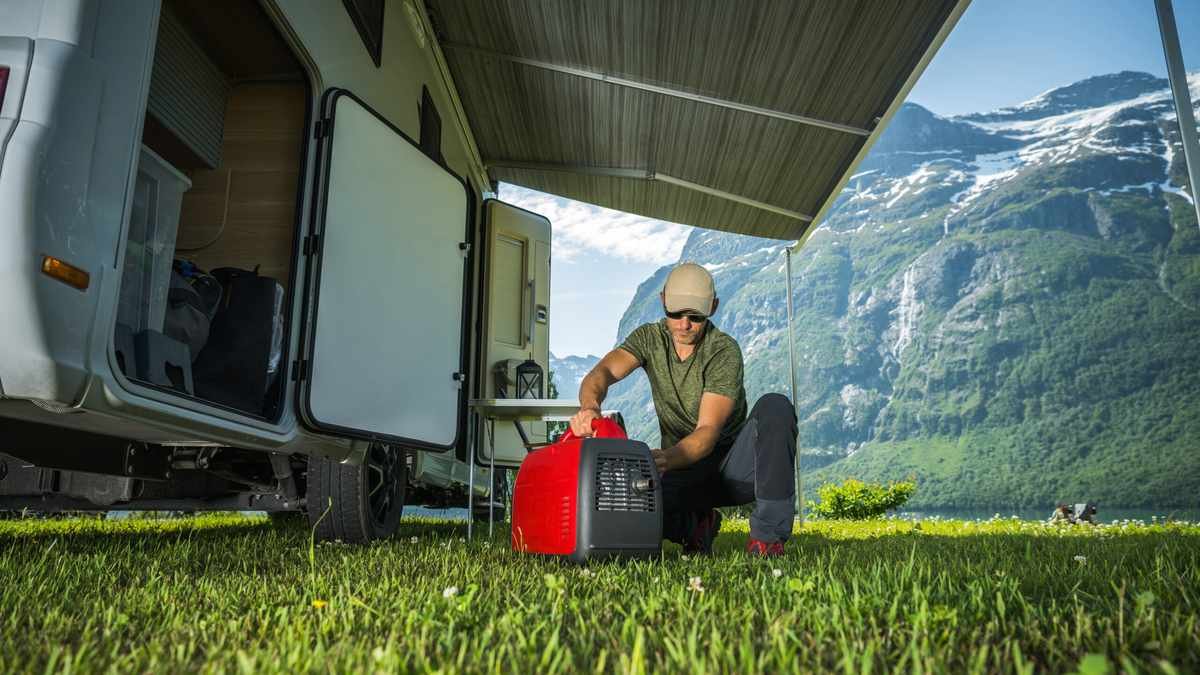
A portable generator camping setup is the heavy artillery of camp power: unmatched for sustained high output, indefinite runtime, and bad-weather independence. It’s also noisy, thirsty, maintenance-hungry, and increasingly restricted in where and when you can run it. This guide covers the best quiet inverter generators for camping in Australia for 2026 — because for camping, “quiet inverter” is the only category worth discussing — with real prices, honest noise context, and the etiquette that keeps you welcome at campgrounds.
Before you commit, read our power station vs generator comparison — many campers discover a power station suits them better. But when you need a generator, you need a generator, and buying the right one matters.
Why Inverter, Why Quiet: The Non-Negotiables
Inverter technology produces clean, stable sine-wave power safe for sensitive electronics (laptops, cameras, CPAP machines, battery chargers). Old-style conventional generators produce “dirty” power with voltage fluctuations that can damage modern electronics — never run sensitive gear from one. Every generator in this guide is an inverter model.
Quiet isn’t a luxury at camp — it’s the difference between usable and antisocial. Quality inverter generators run 52–65 dB at 7 metres (conversation level), with eco-throttle modes that drop revs (and noise) under light loads. Cheap noisy generators (70+ dB) are banned or restricted in most campgrounds and will make enemies fast. If a generator’s noise spec isn’t published, that’s your answer.
What Size Generator Do You Need?
Generators are rated in kVA (roughly kW for our purposes). Match to your loads:
- 1–1.2 kVA: Battery charging, devices, lights, small fridge top-up. Lightest and quietest, but limited.
- 2–2.4 kVA: The camping sweet spot. Runs a 12V battery charger at full tilt, power tools, a small aircon (with soft-start), plus everything smaller simultaneously. This is the size most campers should buy.
- 3.5 kVA+: Serious aircon, workshop tools, whole-van power. Heavy (35–50 kg+), thirstier, louder — overkill for most camping.
The 2–2.4 kVA class is where 90% of camping buyers land. It handles the realistic maximum (fast battery charging + a few extras) without the weight and fuel penalty of bigger units.
The Best Portable Generator Camping Picks in Australia
Honda EU22i — The Benchmark
The EU22i is the generator all others are measured against: 2.2 kVA max (1.8 kVA rated), 53 dB at 7m on eco-throttle, 21 kg, 8 hours runtime on a 3.6L tank, and Honda’s legendary reliability backed by a 4-year domestic warranty and Australia’s best service network. It’ll run a soft-start caravan aircon, charge batteries fast, and sip fuel doing it. The downsides are the price and the weight — 21 kg is a two-person lift for many.
At ~$2,049–2,095 street price (from dealers like Elliott Bros and KMPE), it’s the premium buy. Expensive, but the resale value is exceptional — five-year-old EU22is still command strong money because everyone knows what they’re getting.
Yamaha EF2200iS — The Refined Alternative
Yamaha’s answer to the Honda: 2.2 kVA max (1.8 kVA rated), 57–65 dB, 25 kg, 10.5 hours runtime on a 4.7L tank, Smart Throttle, and a clever overload reset button (no restart needed). The bigger tank means longer runtimes between refuels — meaningful on long touring days. Four-year warranty, excellent dealer network.
RRP is $2,499 with street prices from ~$2,299. Slightly dearer than the Honda, slightly heavier, but the runtime and features make it arguably the better touring generator. You won’t go wrong with either Japanese unit — it’s Ford vs Holden territory.
Cromtech Outback 2400W — Best Budget Buy
The Cromtech Outback 2400W (2.4 kVA max, 2.1 kVA continuous) is the value champion: 52–59 dB at 7m (genuinely quiet), 19.8 kg (lighter than the Honda!), 5L tank, eco mode, and two 15A outlets plus USB. Australian-designed for local conditions with local service agents. The trade-offs: 1-year warranty (vs 4 for Honda/Yamaha) and less certain long-term parts availability.
At ~$929–949, it’s less than half the Honda’s price for comparable capability. For campers who use a generator occasionally rather than daily, the value equation is compelling — just go in knowing the warranty and support aren’t Japanese-grade.
MaxWatt / Briggs & Stratton — Worth a Look
MaxWatt (Brisbane-based, 2-year warranty) and Briggs & Stratton’s inverter range sit between Cromtech and the Japanese brands on price — typically $1,200–1,600 for 2–2.4 kVA. Both offer decent specs and better support than the cheapest imports. Worth comparing if the Cromtech feels too budget and the Honda too dear — the middle ground is well served in Australia.
Noise in Context: What the Numbers Mean
Decibels are logarithmic — every 10 dB sounds roughly twice as loud. So 52 dB (Cromtech/Honda eco mode) vs 65 dB (full load) is a dramatic difference, not a small one. For reference: 50 dB is quiet conversation, 60 dB is normal conversation, 70 dB is a vacuum cleaner. A generator at 53 dB, 30 metres from camp on eco-throttle, fades into background bush noise. The same generator at full chat 10 metres away dominates everything. Distance and eco-mode are your friends — always run the smallest load you can, as far away as practical.
Generator Etiquette: Don’t Be That Campsite
- Know the hours: Most parks restrict generators to daytime (often 9am–5pm). Some ban them entirely. Check on arrival — ignorance isn’t an excuse.
- Position for minimum impact: As far from neighbours as possible, exhaust pointing away from everyone, ideally behind your vehicle as a sound barrier.
- Run with purpose: Charge the batteries, run the aircon for the hot afternoon, then switch off. A generator idling “just because” is pure noise pollution.
- Eco-throttle always: If your generator has eco mode, use it. Lower revs = less noise + less fuel.
- Morning restraint: Nobody wants a generator at 6:30am. Wait for a civilised hour — your coffee can wait until 8.
- Consider the alternative: If you’re running a generator just to charge phones, a power station charged during the day’s generator run would do it silently. Hybrid thinking reduces everyone’s noise.
Fuel, Maintenance and Running Costs
Budget ~0.5–1L/hour depending on load — a 2.2 kVA unit at moderate load sips about 0.6L/hr, so the Honda’s 3.6L tank gives ~6 hours of real use. Always use fresh fuel (stale fuel is the #1 cause of “my generator won’t start”), and add fuel stabiliser if it’ll sit more than a month. Maintenance: oil change after the first 20 hours then every 100 hours or annually, air filter check, spark plug annually. It’s 30 minutes a year — neglect it and you’ll learn why the manual insists.
Five-year running costs for moderate use: ~$750 in fuel + ~$300 in maintenance on top of purchase. Factor it in — the “cheap” generator isn’t cheap if you run it constantly.
Safety: The Serious Bit
Generators produce carbon monoxide — odourless, colourless, lethal. Never run one in or near enclosed spaces: not in a tent, not in an annexe with the sides down, not under the caravan, not in the back of a ute with the canopy closed. Position it outdoors, downwind of living areas, with exhaust pointing away. Refuel only when stopped and cool — petrol on a hot exhaust is a fireball. And carry a fire extinguisher; it’s cheap and you should have one anyway.
Parallel Operation: Doubling Up
Need more power occasionally? Most inverter generators (Honda, Yamaha, Cromtech) support parallel operation — linking two identical units with a parallel cable or kit to double output. Two EU22is in parallel give you 4.4 kVA: enough for serious aircon plus everything else. It’s a clever alternative to buying one big heavy generator: run a single light unit most of the time, parallel the second only when needed. The catch is cost (two generators + kit) and the fact that both need fuel and maintenance. For most campers it’s a “nice to know” rather than a plan — but for caravaners with big aircon who tour in summer, it’s the standard solution.
Storing Your Generator Between Trips
Generators hate sitting. The golden rules: run it dry or stabilise the fuel — either drain the carburettor (most have a drain screw) or add fuel stabiliser and run it for five minutes to circulate. Stale fuel gums up carburettor jets, and “it ran fine last year” is the most common generator complaint in spring. Store under cover, upright, with the fuel cap vent closed. Every 2–3 months in storage, start it and run for 15 minutes under light load — this keeps seals supple and the battery (if electric start) charged. Change the oil annually even if unused. A generator that’s stored properly starts second pull after a year; one that isn’t becomes a carburettor rebuild.
Buying Secondhand: What to Check
Used generators — especially Hondas — are excellent buys if you check carefully. Service history: ask for receipts; regular oil changes matter enormously. Hours: many modern units have hour meters; under 500 hours is lightly used, over 2,000 is well worked (though Hondas do 5,000+ with care). Start it cold: should start within 2–3 pulls; hard starting suggests carburettor or compression issues. Run it under load: plug in something substantial (a kettle via the inverter… no — a heater or power tool) and listen for hunting, surging or smoking. Check the oil: milky oil means water contamination; very black oil means neglected changes. Inspect: cracked panels, damaged outlets, frayed cords. Price guide: expect 50–70% of new for a good used Honda/Yamaha; less for budget brands. And verify it’s not stolen — check serial numbers against online registries if buying privately.
Accessories Worth Having
- Generator tent/cover: A ventilated rain cover lets you run in wet weather safely (never enclose the exhaust — covers are designed with airflow).
- Extended fuel tank / fuel cap: Aftermarket extended-run tanks stretch runtime to 12+ hours for overnight aircon use.
- Security cable: Generators walk away. A hardened chain through the frame to the vehicle, plus parking it out of sight, deters opportunists.
- Magnetic dipstick / hour meter: Cheap additions that make maintenance tracking effortless.
- Spark arrestor: Required in many fire-prone areas — check yours is fitted and clean.
The Generator-Free Challenge
Before buying, try this: do your next three trips with a power station + solar instead, hired or borrowed if needed. Many campers discover their actual generator need was far smaller than imagined — a week of real data beats showroom speculation. If you find yourself constantly wishing for the generator’s fast refuel or high output, buy with confidence. If the power station covered everything, you’ve just saved $1,000–2,000 and a lifetime of fuel runs. Either way, you decide from experience, not marketing. The campers happiest with their generators are the ones who proved they needed them first.
The Bottom Line
For most campers, the answer is a 2–2.4 kVA quiet inverter generator: the Honda EU22i if budget allows and you value the best reliability and resale, the Yamaha EF2200iS if you want longer runtimes, or the Cromtech 2400W if you want 90% of the capability at 45% of the price. Buy inverter, buy quiet (sub-65 dB), respect the etiquette and the safety rules, and maintain it properly. And before you buy at all, prove you need it — the generator-free challenge has saved many campers a couple of thousand dollars. The right generator, bought for the right reasons, is a decade of dependable power; the wrong one is an expensive noise maker.
FAQs
What size generator do I need for camping?
2–2.4 kVA suits 90% of campers — fast battery charging, power tools, small aircon with soft-start. 1 kVA is enough for charging only; 3.5 kVA+ is overkill unless running big aircon.
How loud is a camping generator?
Quality inverter generators run 52–65 dB at 7m — conversation level on eco-throttle. Cheap generators hit 70+ dB (vacuum cleaner level) and are unsuitable for campgrounds.
Can I run my caravan air conditioner on a 2.2kVA generator?
Usually yes with a soft-start fitted — the Honda EU22i and Yamaha EF2200iS both handle typical caravan aircons. Without soft-start, the compressor’s startup surge can trip the overload. Check your aircon’s startup draw.
How much fuel does a camping generator use?
Roughly 0.5–1L/hour depending on load. A 2.2kVA unit at moderate load uses ~0.6L/hr — about $30–60 in fuel for a week of evening use, plus oil and servicing.
← Back to our complete guide: Best Solar Panels for Camping Australia 2026