Best Rooftop Cargo Bags & Boxes Australia
Disclosure: We may earn a small commission if you purchase through our links, at no extra cost to you.
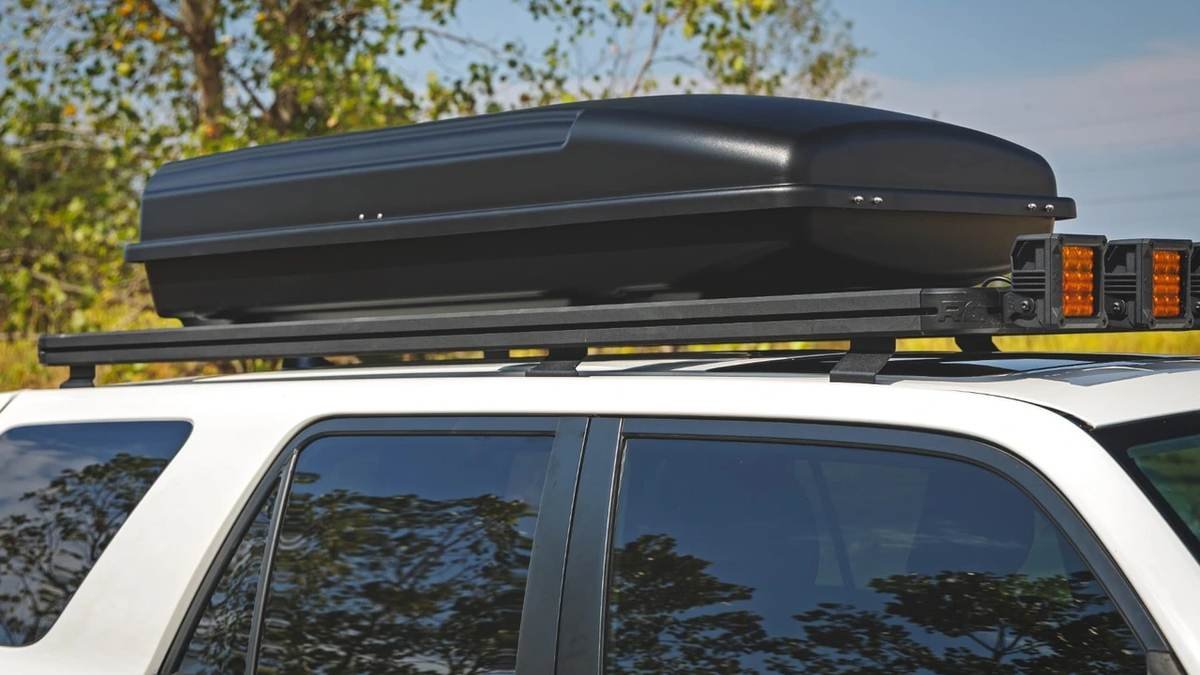
When the inside of the 4WD is full — and on a proper touring setup, it will be — the roof is the next frontier. The best rooftop cargo boxes Australia has for touring add 300–600 litres of storage for the light, bulky stuff: swags, sleeping bags, camp chairs, clothing duffels. But Australia adds two complications the overseas reviews never mention: bulldust, which infiltrates seals that are fine in Europe, and strict dynamic roof load limits that cap what you can legally carry up top. Get the box right and it’s brilliant; get it wrong and it’s a $2,000 dust-filled sail.
For the roof loading rules (weights, what goes up top, securing), see our 4WD packing guide; for the racks they mount to, our roof rack guide.
Hard Boxes vs Soft Bags: The Honest Comparison
| Hard-shell boxes | Soft cargo bags | |
|---|---|---|
| Security | Lockable, genuinely secure | Minimal — a knife defeats them |
| Weather sealing | Good; quality boxes handle rain well | Variable; good ones are waterproof, cheap ones aren’t |
| Dust sealing | Better, but bulldust still finds a way on long dirt runs | Poor — dust infiltrates zips and seams |
| Aerodynamics / noise | Designed for airflow; quieter | Flap and howl at highway speed |
| Weight | 15–25kg empty (eats roof capacity) | 3–8kg empty |
| Capacity | 300–630L | 300–500L typically |
| Price | $1,000–$2,200+ | $100–$400 |
| When parked | Permanent fixture (or garage storage headache) | Folds away when empty |
The verdict for touring: hard boxes for long trips, dusty conditions, and valuable contents; soft bags for occasional use, tight budgets, and when every kilo of roof capacity counts. Many tourers own both — the bag for the annual trip, the box if the lifestyle sticks.
Best Hard-Shell Cargo Boxes in Australia
Rhino-Rack MasterFit — The Local Hero
Rhino-Rack’s MasterFit 530L box (around $1,399) is designed for Australian conditions and the Australian market — dual-side opening, a claimed tool-free mounting system, and sizing that suits local roof racks and platforms. For most touring 4WDs, it’s the default recommendation: local support, local parts, and a price that undercuts the European premium brands significantly.
Thule Motion XT — The Premium Benchmark
Thule’s Motion XT range is the global benchmark for roof boxes — superb aerodynamics, excellent build, and the easiest mounting system in the business. The XL runs around $2,199.95 in Australia. You’re paying for refinement: quieter at speed, better seals, smoother operation. Whether that’s worth nearly double the Rhino-Rack depends on how much highway you’ll do — on a Big Lap, the noise and fuel difference is real.
Note: Thule’s Australian RRPs move with import costs; confirm current pricing with a local stockist before budgeting.
Budget hard boxes
The sub-$800 hard box market exists (various imported brands through auto retailers), and the honest assessment is mixed: the shells are fine, but latches, seals, and mounting hardware are where the savings show. For sealed-road holiday use they’re adequate; for months of corrugations, buy the better box. A failed latch at 100km/h on the Tanami is not a saving.
Best Soft Cargo Bags
Soft bags make sense when budget or weight is the constraint. What matters:
- Waterproof vs water-resistant: demand fully waterproof (welded seams, waterproof zips or roll closures). “Water-resistant” bags wet out in tropical downpours.
- Mounting: quality straps with buckles, not elastic. The bag must not shift — a shifting 30kg bag at highway speed is dangerous.
- Shape: aerodynamic wedge shapes howl less than duffel-style bags.
- Dust: accept that soft bags and bulldust don’t mix. Pack contents in dry bags or tubs inside the cargo bag for outback trips, or reserve the soft bag for sealed-road touring.
Expect $100–$400 for a decent soft bag from the major camping retailers. They’re also the right answer for utes with tubs — a cargo bag in the tub under a tonneau is protected and secure.
The Weight Maths (Don’t Skip This)
A 530L box weighs ~20kg empty. Fill it with 40kg of gear and you’ve used 60kg of your roof’s 75–100kg dynamic rating — before the awning, the roof rack itself, or anything else up top. The box counts, the rack counts, everything counts.
Rules for roof box touring:
- Weigh what goes in the box. Light and bulky only — sleeping bags, swags, clothing, camp chairs. If it’s dense, it lives inside the vehicle.
- Include the box + rack + contents in your roof load calculation, and the roof load in your GVM calculation.
- Fuel penalty: a roof box costs roughly 1–2L/100km depending on shape and speed. Over 30,000km of Big Lap, that’s 300–600 litres of fuel — $600–$1,200 at outback prices. The aerodynamic premium boxes earn back some of this.
- Height awareness: a 4WD with a roof box is often 2.2m+ tall. Car parks, drive-throughs, and low branches become hazards. Know your total height.
Dust-Sealing: The Australian Problem
Bulldust is finer than any European road dust and it defeats seals that are perfectly adequate elsewhere. For outback touring with a roof box:
- Pack sensitive contents (clothes, bedding) in dry bags or sealed tubs inside the box. Belt and braces.
- Check and clean seals regularly — dust-caked seals don’t seal.
- Positive pressure helps: some tourers run a small 12V fan into the box on dirt roads. It sounds absurd; it works.
- Accept that after 500km of the Tanami, everything is dusty. The goal is less dusty, not dust-free.
Mounting and Security
- Crossbars vs platform: boxes mount to crossbars or flat platforms. Platforms (Rhino-Rack Pioneer, etc.) give more flexibility and double as general cargo space when the box is off.
- Lock the box to the rack as well as locking the box itself — a locked box that’s easily unbolted is just a convenient carry case for thieves.
- Don’t store valuables in a soft bag at a roadhouse stop. Obvious, but worth saying.
- Check mounting tension after the first 100km and at every fuel stop on corrugations. Vibration loosens everything.
For the full roof setup — racks, awnings, and boxes working together — our roof rack guide and drawer systems guide complete the picture.
Cargo Box Buyer’s Checklist
Before spending $1,000–$2,200 on a box, confirm these:
- Capacity vs need: 400–450L suits most touring; 500L+ is for families or long expeditions. Bigger isn’t better — an oversized box tempts you to fill it, and every litre is weight on the roof.
- Opening direction: dual-side opening (both sides) is worth the premium — single-side boxes force you to access from one side only, which gets old fast at camp.
- Length compatibility: measure your roof/platform. Long boxes overhang windscreens and tailgates — check clearance with the tailgate open and the bonnet’s sight lines.
- Mounting system: tool-free quick mounts (Rhino-Rack’s MasterFit system, Thule’s PowerClick) make seasonal removal a 10-minute job. U-bolt systems are cheaper but slower — and slow removal means the box stays on permanently, costing fuel year-round.
- Lock quality: test the locks in the shop. Flimsy locks on a $1,500 box are insulting — and a locked box is only as secure as its weakest latch.
- Weight: compare empty weights. A 25kg box vs a 15kg box is 10kg of roof capacity difference — significant when the total budget is 75–100kg.
- Warranty and parts: latches, keys, and seals are the parts that fail. Confirm the brand stocks spares in Australia — a broken latch with no replacement part turns a $2,000 box into a very expensive roof ornament.
Mounting and Loading Technique
- Centre the load. Position the box centrally on the roof — fore-aft and side-to-side. An offset box affects handling and looks absurd.
- Heavy items low in the box (relative to the box — it’s all high, but lower is better). Dense items at the bottom, light bulky items on top.
- Pack to prevent movement. Soft bags, towels, or packing cubes as filler — contents that shift at highway speed create noise and dynamic load spikes. A tightly packed box is a quiet box.
- Strap check routine: after the first 50km, then at every fuel stop on dirt. Mounting hardware loosens with vibration — the check takes 30 seconds and prevents the nightmare scenario.
- Height clearance: measure total vehicle height with the box fitted and write it on a sticker on the dashboard. Shopping centre car parks (2.1–2.2m clearances), drive-throughs, and low branches are the enemies. Know your number.
- Removal and storage: between trips, remove the box (10 minutes with quick mounts) and store it hung from the garage ceiling or on wall brackets. Your fuel bill and your roof seals will thank you.
Soft Cargo Bags: When They Win
Hard boxes get the glory, but soft bags deserve a proper hearing — for many tourers, they’re the smarter buy:
- Weight savings are real. A 3–8kg soft bag vs a 15–25kg hard box frees 10–20kg of roof capacity — on a 75kg roof limit, that’s the difference between legal and not. Weight-constrained tourers should do this maths first.
- Cost: $100–$400 vs $1,000–$2,200. The $1,500+ saving buys a lot of fuel — or a better fridge, or the DC-DC charger you actually need.
- Versatility: a soft bag works on roof racks, in ute tubs, on roof platforms, and strapped to trailers. One bag, many roles. Hard boxes only do one thing.
- Storage: fold it away when empty. Hard boxes need garage ceiling space or become permanent fixtures (with permanent fuel penalties).
Choosing a good soft bag: fully waterproof construction (welded seams, not just “water-resistant” fabric), quality buckles and straps (not elastic), a shape that doesn’t catch wind excessively, and reinforced attachment points. The cheap $60 bags fail at the straps first — usually at highway speed, which is exciting in all the wrong ways.
The dust problem, solved practically: soft bags and bulldust are enemies — accept it and pack accordingly. Dry bags or sealed tubs inside the cargo bag for clothes and bedding; reserve the soft bag’s direct contents for items that don’t care about dust (chairs, tarps, empty containers). For sealed-road touring, none of this matters and the soft bag is simply the rational choice.
Best use cases: the annual 2-week trip (not worth a $2,000 box), utes with tubs (bag in the tub under a tonneau = protected and secure), weight-critical setups, and anyone who wants cargo flexibility across vehicles.
Frequently Asked Questions
Are rooftop cargo boxes worth it for touring?
Yes, if you’re genuinely out of interior space and the contents are light and bulky. They’re the right answer for swags, bedding, and chairs — not for tools, water, or anything dense. Do the roof weight maths first.
How much does a roof box affect fuel consumption?
Roughly 1–2L/100km depending on the box’s aerodynamics and your speed. Over a 30,000km Big Lap that’s $600–$1,200 in extra fuel — the premium aerodynamic boxes earn back part of this.
Can I leave a cargo box on permanently?
You can, but it costs fuel and adds height permanently. Most tourers remove the box between trips — quality mounting systems make this a 10-minute job. Store it hung from the garage ceiling.
Do roof boxes leak in rain?
Quality hard boxes handle heavy rain well. Cheap boxes and most soft bags are the risk — check seals, and pack sensitive gear in dry bags inside as insurance. In tropical downpours, assume nothing is fully waterproof.
What’s the weight limit for a roof box setup?
Most vehicle roofs/racks are rated 75–100kg dynamic (driving) — and that includes the box, the rack, and the contents combined. Check your vehicle’s manual for the exact figure; exceeding it affects handling, insurance, and legality.
Can I put a roof box on crossbars instead of a platform?
Yes — most boxes mount to standard crossbars. Platforms offer more flexibility and double as cargo space when the box is off, but crossbars are lighter, cheaper, and perfectly adequate for a box alone.
Are roof boxes waterproof or just water-resistant?
Quality hard boxes are effectively waterproof in normal rain — sealed lids and gaskets handle downpours well. But no box is submarine-grade: in tropical deluges or high-pressure car washes, some seepage is possible. Pack sensitive gear in dry bags inside as insurance.
← Back to our complete guide: Best Roof Racks for 4WD Touring Australia 2026