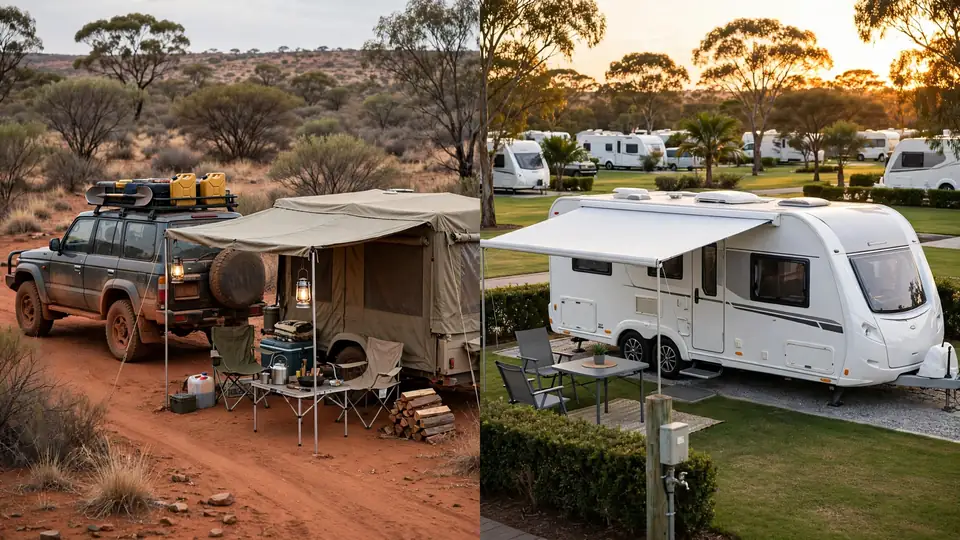
Camper Trailer vs Caravan: An Honest Guide for Aussie Buyers
Disclosure: We may earn a small commission if you purchase through our links, at no extra cost to you.
The camper trailer vs caravan debate comes up at every campfire sooner or later, and the honest answer is that neither is better — they’re built for different trips. A camper trailer is a tent on wheels: light, tough and made for getting off the beaten track. A caravan is a small home on wheels: comfortable, self-contained and made for long, easy miles. This guide compares the two on the things that actually decide it — cost, towing, setup effort, comfort, running costs and where each one wins — so you can match the rig to the way you travel.
Camper trailer vs caravan at a glance
If you want the short version before the detail:
- Camper trailer: lighter and cheaper, tows behind most mid-size SUVs and utes, goes properly off-road, but needs 10–15 minutes of setup at each stop and leaves you more exposed to the weather.
- Caravan: comfortable and self-contained with a real bed, kitchen and bathroom, ready to live in the moment you unhitch — but heavier, dearer, thirstier on fuel, and mostly happiest on sealed roads and in caravan parks.
The rest of this guide digs into what those dot points cost you in dollars, effort and weekends.
Upfront cost: camper trailer vs caravan
Price is where most people start, and the gap is real. As rough ballparks for new rigs, camper trailers commonly run from around $10,000 for a basic soft-floor model up to about $50,000 for a well-built hard-floor or off-road unit. Caravans start higher — roughly $30,000 for a simple on-road van — and climb past $150,000 for big, fully fitted tourers, with serious off-road caravans typically sitting between $90,000 and $250,000. Hybrid campers, which split the difference, generally land around $45,000 to $85,000.
Treat those as indicative ranges, not quotes — prices move with the market and the options list. The used market changes the maths a lot: a few-year-old camper trailer or van can save you a third or more off new, and buying used is the smartest way to test whether you actually like the lifestyle before committing big money. Either way, budget beyond the sticker price — registration, insurance, a brake controller, towing mirrors, weight-distribution gear and your first round of accessories all land in the first year.
Towing and your tow vehicle
This is the question that catches people out, because the rig you buy can dictate the car you need. Camper trailers are the easy win here: most weigh in at a fraction of a caravan, so a mid-size SUV or dual-cab ute will tow one without breaking a sweat. You’ll barely notice it on the highway and your fuel economy takes only a modest hit.
Caravans are a different proposition. A family-sized van can weigh two to three tonnes loaded, which means checking two numbers before you buy: the trailer’s ATM (aggregate trailer mass, on its compliance plate) and your vehicle’s rated braked towing capacity. Most full-size dual-cab utes sold in Australia are rated to tow 3,500kg braked, but plenty of SUVs and older vehicles are rated well below that — and towing over your limit is illegal as well as dangerous. Factor in the fuel penalty too: dragging a tall, heavy van into a headwind across the Nullarbor can add several litres per hundred kilometres to your consumption compared with a low camper trailer.
Rule of thumb: if you already own a capable tow vehicle, a caravan is an easier decision. If you’d have to upgrade the car as well as buy the rig, a camper trailer keeps the total spend far lower.
Setup and pack-down effort
Be honest with yourself about this one, because it shapes every single trip. A camper trailer takes real setup: unfold the tent, peg it out, set up the kitchen and awning, sort the beds. With practice most owners get it down to about 10–15 minutes, and hard-floor models with quick-erect designs are faster than soft-floor ones. Pack-down in the rain, with everything damp and sandy, is the true test of the relationship.
A caravan asks almost nothing of you. Unhitch, wind down the stabilisers, plug in if there’s power, and you’re done — five minutes, cuppa in hand. For one-night stopovers on a big trip, or for travellers who move camp every day or two, that difference is enormous. If you’re the type who likes to base up for a week in one spot, setup time matters far less and the camper trailer’s other advantages start to outweigh it. Either way, do a practice setup on the driveway before your first trip — discovering a missing pole at dusk is a lesson best learned at home.
Comfort, space and weather
A caravan wins on comfort without much of a contest. You’re sleeping on a real mattress in a hard-walled, insulated box with an indoor kitchen, a bathroom and a dining area. When a summer storm rolls through or a cold snap hits the high country, you close the door and put the kettle on. For families with small kids, older travellers, or anyone doing months on the road, that matters more than any spec sheet admits.
A camper trailer is camping with upgrades rather than a home on wheels. The bed is usually comfortable, the kitchen is typically an outdoor slide-out under the awning, and the toilet and shower — if fitted at all — are often external or optional extras. In good weather it’s glorious: you’re outside, under the stars, with a fraction of the setup of a tent. In bad weather you’re managing canvas, condensation and wind flap. Before you decide, check the BOM forecast for a typical trip you’d take — if your holidays regularly cop sideways rain, weight the caravan’s hard walls heavily.
Where each one wins: matching the rig to your touring style
This is the section that actually answers the camper trailer vs caravan question for most buyers. Forget the brochures and think about your last five trips — or the five you dream about.
Choose the camper trailer if your happy place is at the end of a dirt road. Beach driving, national park tracks, station stays and free camps are where camper trailers shine: they’re narrower, lighter and far more forgiving on corrugations and soft sand than a big van. They’re also the pick for weekend warriors who want to keep costs down, for smaller tow vehicles, and for anyone short on storage space at home — a camper trailer tucks into a garage or down the side of the house where a 20-foot van won’t fit. If you’re heading properly remote, pair it with proper recovery gear — the tracks a camper trailer opens up are exactly where you’ll need it.
Choose the caravan if comfort and convenience top your list. The big lap, long grey-nomad stints, wintering up north, travelling with kids or grandparents, working on the road — all of these favour the van. Caravan parks are built around them, with drive-through ensuite sites and all the amenities, and the ability to pull over for lunch or a night without any setup changes how you travel. Couples doing months at a time consistently report that the caravan’s bathroom and indoor living space are what make long trips sustainable rather than just survivable.
Consider a hybrid if you’re genuinely torn. Hybrids combine a hard-bodied caravan-style interior with fold-out canvas beds and off-road running gear — most of the comfort, most of the capability, at a price between the two. They’re worth a look, though they inherit a bit of each side’s compromise: heavier than a camper trailer, less roomy than a full van.
Running costs and resale
The purchase price is only the entry ticket. Over five years of ownership, the running costs stack up on both sides: registration and CTP every year, comprehensive insurance (higher for caravans, reflecting their value), servicing for brakes, bearings and suspension, replacement tyres, caravan park fees, and the extra fuel a heavy van drinks. A caravan kept in storage you pay for, rather than at home, adds another ongoing bill — measure your parking spot before you fall in love with a 22-footer.
On resale, both depreciate like any vehicle, but there are differences worth knowing. Caravans lose more in absolute dollars simply because they cost more to begin with, and mass-produced vans can drop sharply in the first few years. Well-built Australian-made camper trailers and off-road caravans tend to hold their value better, because buyers trust them for the conditions they’ll actually face. Buying a quality used rig, maintaining it well and keeping the service history is the closest thing to depreciation-proofing either option.
One cost people forget: power. Whichever rig you choose, most of the best campsites have no powered sites, so sizing a battery, solar and 12V setup correctly with our camping power calculator will save you from flat batteries and spoiled food in the first season.
Camper trailer vs caravan: the honest verdict
There is no winner — there’s only the right answer for your trips. Buy the camper trailer if you want to go further off-road, spend less upfront and on fuel, tow with the car you already own, and don’t mind 15 minutes of setup as the price of adventure. Buy the caravan if you want to travel in comfort for weeks or months at a time, need a bathroom and a real kitchen, or travel with kids or in variable weather.
And if you’re not ready to spend five figures to find out which camper you are, there’s no shame in starting with a good tent for a season. The tracks and parks will still be there when you’ve worked out exactly what you want — and you’ll buy the right rig once instead of the wrong one twice.
Frequently Asked Questions
Can I tow a camper trailer with a regular SUV?
Usually, yes. Most camper trailers are light enough for a mid-size SUV or dual-cab ute to tow comfortably. Always check your vehicle’s rated braked towing capacity against the trailer’s ATM on its compliance plate, and remember the loaded weight — water, gear and accessories — counts, not just the empty tare weight.
How long does it take to set up a camper trailer?
With practice, around 10–15 minutes for most soft-floor models — unfolding and pegging the tent, setting up the kitchen and awning. Hard-floor and quick-erect designs are faster. Pack-down takes a similar amount of time, longer if everything is wet. A caravan, by comparison, is liveable within about five minutes of unhitching.
Is a camper trailer better off-road than a caravan?
Generally, yes. Camper trailers are lighter, narrower and built with off-road suspension and ground clearance as standard, so they handle corrugations, sand and rutted tracks far better than a standard caravan. Dedicated off-road caravans close the gap but cost significantly more and are still bulkier on tight tracks.
Do camper trailers have toilets and showers?
Most don’t as standard. Basic camper trailers have an outdoor kitchen and a bed, full stop — the toilet is the bush dunny or the campground amenities block. Some hard-floor and premium models offer an external ensuite tent with a portable shower and toilet, but if an indoor bathroom is non-negotiable, a caravan is the answer.
Which holds its value better, a camper trailer or a caravan?
Well-built Australian-made rigs of either type hold value best. In absolute dollars, caravans lose more because they cost more upfront, and mass-produced vans depreciate fastest in the first few years. A quality used camper trailer bought well and maintained properly is one of the cheapest ways into the lifestyle with minimal depreciation pain.
Can you live in a caravan full-time?
Yes — thousands of Australians do it, from grey nomads on the big lap to remote workers. A caravan’s insulation, bathroom, kitchen and storage make full-time living practical in a way a camper trailer can’t match. You’ll want to budget carefully for park fees, fuel, insurance and maintenance, and check the van’s build quality suits year-round use.