Free Camping Spots in Queensland
Disclosure: We may earn a small commission if you purchase through our links, at no extra cost to you.
Free camping in Queensland works differently to the southern states, and plenty of travellers learn that the expensive way. The free camping spots Queensland actually offers are almost never in national parks — they are council camps, community reserves and rest areas, mostly inland. This guide is honest about that split, names the free camps worth detouring for, and explains the permit system that covers everything else.
Start with the rule that shapes everything: camping in Queensland’s national parks and state forests under Queensland Parks and Wildlife Service (QPWS) is permit-based and paid per person, booked in advance through the Queensland Parks booking service, with the permit displayed at your site. There is no free tier. What is free is the parallel network of local-government and community sites — and in outback and regional Queensland, some of them are excellent. Details and permits for the paid system are at Queensland Parks camping; everything below is the free network.
- Queensland national park camping is never free: it needs a paid QPWS permit booked in advance.
- Genuine free camps are council and community sites — Lake Elphinstone, Bedford Weir, Fletcher Creek and Bluewater Park are the standouts.
- Stay limits are set site by site (often 24 hours to a few weeks) and signage beats any guide, including this one.
Lake Elphinstone, near Glenden
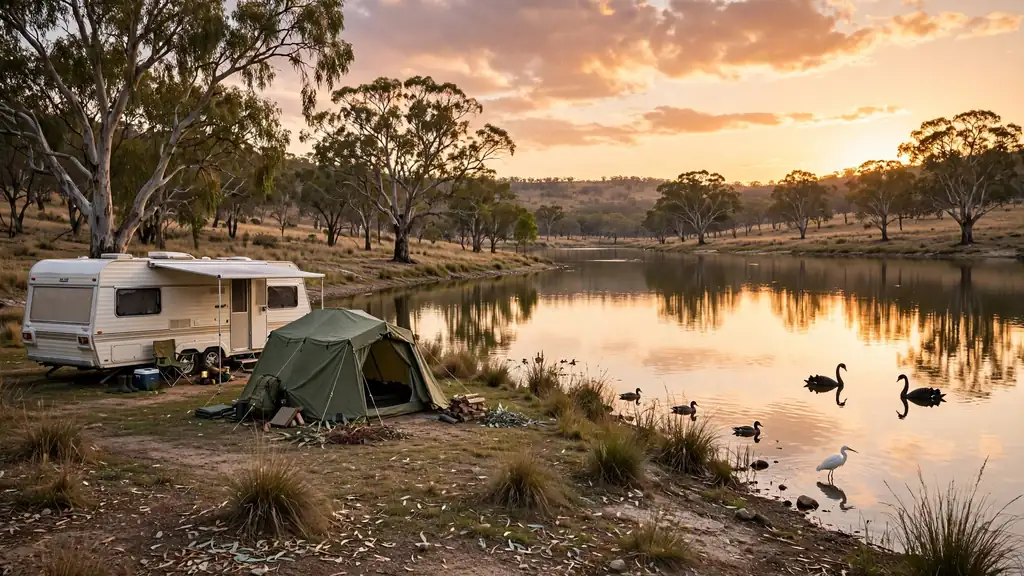
Lake Elphinstone is the free camp other travellers tell you about in person rather than online. A natural lake in the Isaac Region, roughly two hours west of Mackay, with a big, free camping area on its shore managed locally through Isaac Regional Council. Travellers report flushing toilets, cold showers, picnic tables, wood barbecues and a boat ramp — a lot of infrastructure for a free camp — and the lake itself is the entertainment: fishing, kayaking, water skiing and serious birdlife. Pets are welcome and the maximum stay is generous by free-camp standards (council signage on site is the authority — check it on arrival, as limits are reviewed). Bring your own drinking water and supplies; Glenden is the nearest town and it is not next door.
Bedford Weir, Blackwater
Bedford Weir is a free camp on the Mackenzie River, about 25 kilometres north of Blackwater in Central Queensland, on a man-made weir pool that locals use for fishing, kayaking and water skiing. The camping area has toilets, hot showers (traveller reports consistently praise them), shaded barbecues and a playground, and it is big enough for large rigs with a stay limit of about a week. It is a working example of a council investing in travelling campers: Blackwater gets the grocery and fuel spend, campers get a genuinely good free night or three. Saratoga and barramundi in the weir are the fishing draw.
Fletcher Creek, near Charters Towers
Fletcher Creek, off the Gregory Highway south of Charters Towers near Dalrymple National Park, is wild camping with facilities: a large free area by the creek with toilets, cold showers, barbecues and a dump point, and a maximum stay measured in weeks rather than hours (travellers report up to four weeks). It fills in the winter touring season with southerners chasing the warmth, and empties in the wet. The creek is the swimming and fishing spot, the birdlife is constant, and Charters Towers — one of Queensland’s great gold-rush towns — is an easy day trip.
Bluewater Park Rest Area, Townsville
Not every free camp is a destination; some are just perfectly placed. Bluewater Park, about 29 kilometres north-west of Townsville on the Bruce Highway, is a Townsville City Council rest area that allows free overnight vehicle camping, with toilets, picnic areas and a dump point. It is the model of a highway rest area done right — a legal, safe overnight for self-contained travellers that keeps tired drivers off the road. Respect the overnight-only nature of it: rest areas are for stops, not stays, and councils withdraw the privilege when people treat them as campgrounds.
Mary Kathleen, between Cloncurry and Mount Isa
The strangest free camp in Queensland is a town that no longer exists, and the drive out to it through the Cloncurry shire country is half the experience on its own. Mary Kathleen was a uranium-mining township between Cloncurry and Mount Isa, abandoned in the 1980s; today the concrete slabs of its streets and houses form a free bush camp with an atmosphere nothing else matches. Facilities are minimal — you are camping on a ghost town’s foundations — and one safety rule is absolute: the old mine pit’s vivid blue water looks inviting and is not safe to swim in. Stay on the town site, explore on foot, and treat it as the overnight curiosity it is rather than a base.
Rules, limits and crocodile country
Queensland free camping runs on local rules, and the free camping spots Queensland travellers rely on share the same basic deal. Councils set maximum stays (48 hours at highway rest areas up to several weeks at destination camps), many sites expect self-contained vehicles, and camping outside designated areas — beach access tracks, town streets, undesignated road reserves — is enforced, particularly on the coast. In the north, add the crocodile rule: free camps near estuaries and northern rivers are camping-only, never swimming, and Be Crocwise signage tells you where that line sits. The system works when travellers spend a little in the towns that host them — fuel, groceries, a pub meal — which is the entire economic point of a council free camp. For how Queensland fits the national picture, see our best camping spots in Australia guide and the companion guide to free camping spots in NSW, where the state forest system makes free camping even easier.
More free camping spots Queensland travellers use
The pattern repeats across the state’s touring routes once you know to look for it. Lloyd Jones Weir, on the Alice River near Barcaldine in the central west, is a large, shaded free camp with toilets, a dump point, picnic tables and firepits — the overnight that turns the long Barcaldine stretch into a pleasure, and a base for the Tree of Knowledge town itself. Showgrounds are the other quiet network: many regional Queensland towns open their showgrounds to travelling campers free or for a donation, Collinsville’s being one travellers single out, with town facilities a short walk away. These sites rarely advertise; they exist because councils understand that a traveller who stays spends money in town. Ask at the visitor information centre in any regional town and you will usually be pointed at a legal free or low-cost option within a few kilometres — local knowledge beats every database for this category of camp.
Free camping spots Queensland winter travellers fill
Timing decides how easy free camping is in Queensland. From June to August the southern migration fills the good free camps by mid-afternoon — Lake Elphinstone, Fletcher Creek and the weir camps run near capacity, and arriving at dusk is a rookie error. The same camps in the shoulder months are half-empty and at their best. Self-containment is the other winter reality: the more a free camp is used, the more councils expect grey water contained, toilets on board or nearby, and rubbish removed, and the popular sites are patrolled. None of this is onerous — it is the price of a system that stays free because travellers keep it clean and towns keep it welcome. Plan to arrive by mid-afternoon in winter, stay within the posted limit, spend something in the host town, and Queensland’s free network will carry you from the border to the Gulf more comfortably than any other state’s.
Cumberland Chimney and the Gulf country run
Out on the Savannah Way, the Cumberland Mine Historic Site near Georgetown is the kind of free camp that defines a Queensland road trip: a tall brick chimney standing over the remains of an 1800s gold battery, a dam that draws birdlife at dawn, and a free camping area beside it used by generations of Gulf travellers. There are no facilities worth the name and that is the point — it is a self-sufficient camp in big-sky country, an overnight between the Tablelands and the Gulf that turns a driving day into a memory. Treat the historic structures with care, carry everything out, and let the site stay exactly as undeveloped as it is.
What “self-contained” really means at a Queensland free camp
The phrase appears on signs across the state and confuses people, so here is the practical version. A self-contained vehicle can camp without leaving anything behind: it carries its drinking water, contains its grey water, has a toilet on board or the camp provides one it actually uses, and removes all rubbish. Some councils formalise this (a recognised self-containment certification), most simply enforce the outcome — no waste on the ground, nothing left but tyre tracks. If your setup can’t meet that standard at a site with no facilities, that site isn’t for you; choose the camps with toilets and bins, like Lake Elphinstone or Bedford Weir, instead. The distinction matters because Queensland’s free network survives on it: the towns that host these camps keep them open while campers keep them clean, and the councils that close sites almost always cite the same two causes — waste and overstaying. A traveller who arrives self-contained, stays inside the limit and spends a little locally is the entire business case for free camping in Queensland, repeated one camp at a time.
A free-camping run up the Queensland inland
Watch how the network chains together on the classic inland run, linking the free camping spots Queensland’s inland towns host into a single route. From Brisbane, the first legal free overnights are council rest areas on the Warrego and Matilda Way corridors — short-stay stops to break the drive, not destinations. Barcaldine gives you Lloyd Jones Weir for a proper night or two; Longreach and Winton country runs on showgrounds and community camps; then the run north-west offers Mary Kathleen as the curiosity stop before Mount Isa, and Cumberland Chimney on the Savannah Way if you turn toward the Gulf. Coming down the coast side instead, Fletcher Creek, Bedford Weir and Lake Elphinstone space the inland return from Townsville and Mackay so neatly that the whole descent can be free nights with a paid park or caravan park only where you want a long shower and a washing machine. That is the honest shape of free camping in Queensland: not every night, not on the coast, but a working system for the inland half of the state — if you plan around its geography instead of wishing it were NSW.
Frequently asked questions
Is there free camping in Queensland national parks?
No. All Queensland Parks and Wildlife Service camping — national parks and QPWS state forests — requires a paid camping permit booked in advance, displayed at your site. Anyone offering “free national park camping” in Queensland is describing illegal camping. The free options are council and community sites outside the QPWS system.
What are the best free camping spots in Queensland?
Lake Elphinstone (Isaac Region) is the standout destination free camp, with facilities and a long permitted stay. Bedford Weir near Blackwater and Fletcher Creek near Charters Towers are the other two travellers consistently rate, and Bluewater Park near Townsville is the best highway rest-area overnight in the north.
How long can you stay at a free camp in Queensland?
It depends on the site: highway rest areas are typically 20–48 hours, destination council camps range from about a week to several weeks. Limits are set by the managing council and posted on site signage, which overrides any general guide.
Can you free camp on Queensland beaches?
Beach camping in Queensland is mostly inside national parks and recreation areas (such as K’gari and Cooloola), which means QPWS permits and fees — and vehicle permits on top in recreation areas. Informal beach camping outside designated areas is illegal and actively enforced in coastal council areas.