Snake Safety Camping Australia: A Calm, Practical Guide
Disclosure: We may earn a small commission if you purchase through our links, at no extra cost to you.
Snakes are part of the Australian bush, and most campers will go years without seeing one up close. But when you’re sleeping on the ground in snake country, it pays to know exactly what to do — before anything happens. This guide covers snake safety camping Australia-wide: which snakes you’re likely to come across, the campsite habits that make encounters unlikely, and the first-aid steps backed by Australian resuscitation and health authorities.
Nothing here is guesswork. Every first-aid instruction comes from the Australian and New Zealand Committee on Resuscitation (ANZCOR), state health departments, or St John Ambulance Australia.
Snake Safety Camping Australia: Know the Snakes You Might Meet
ANZCOR notes that many Australian snakes are capable of delivering a lethal bite, including taipans, brown snakes, tiger snakes, death adders, black snakes and rough-scaled snakes. As a camper, three species account for most of the encounters you’ll hear about around the fire.
Eastern brown snake. NSW Health toxicology expert Dr Geoff Isbister says brown snake bites are probably the most common snake bite nationally and in NSW. They deserve special respect: ANZCOR warns that an initial collapse or confusion, followed by apparent partial or complete recovery, can be the only evidence of envenomation.
Tiger snake. Brown snake and tiger snake antivenoms are the two most commonly used in NSW — which tells you how often tiger snakes are involved. They’re common across the southern states, including Tasmania.
Red-bellied black snake. Widespread along the east coast — NSW Health notes there are “lots” of them — and their bites are treated with tiger snake antivenom.
Snake bites traditionally increase through spring, ahead of a peak in late December and January, according to NSW Health — so the whole warm half of the year calls for good habits. And per St John WA: snakes generally prefer to escape. The danger arises when people surprise them, step too close, or inadvertently corner them.
Snake Safety Camping Australia: Campsite Habits That Reduce Encounters
You can’t make a bush campsite snake-proof, but you can make it uninteresting: snakes visit camps for shelter and food, so remove both and they’ll pass on by.
Choose your patch with care
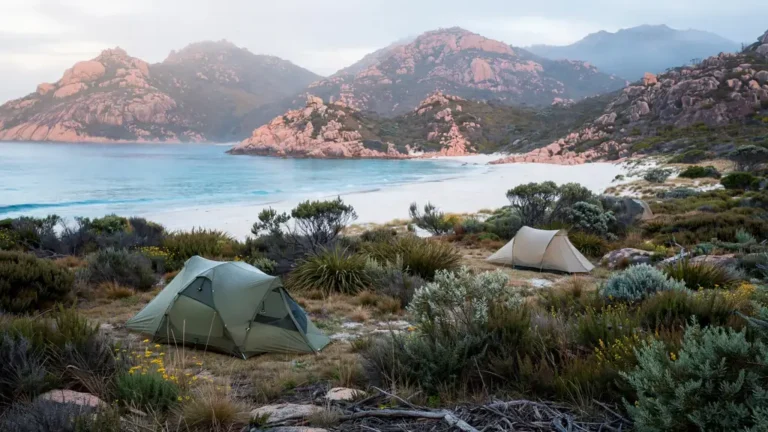
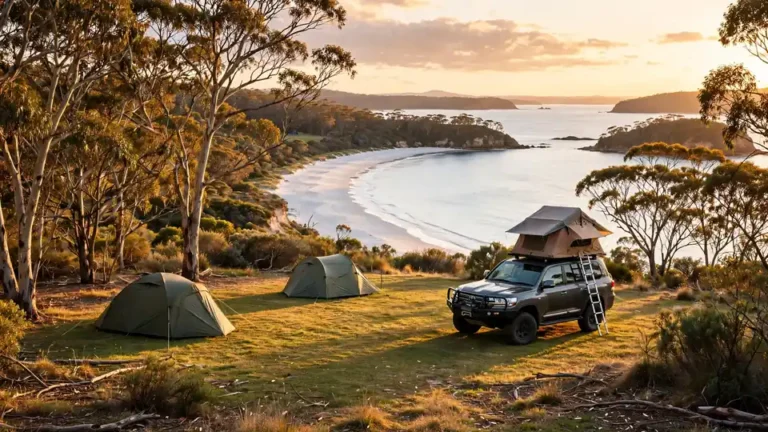
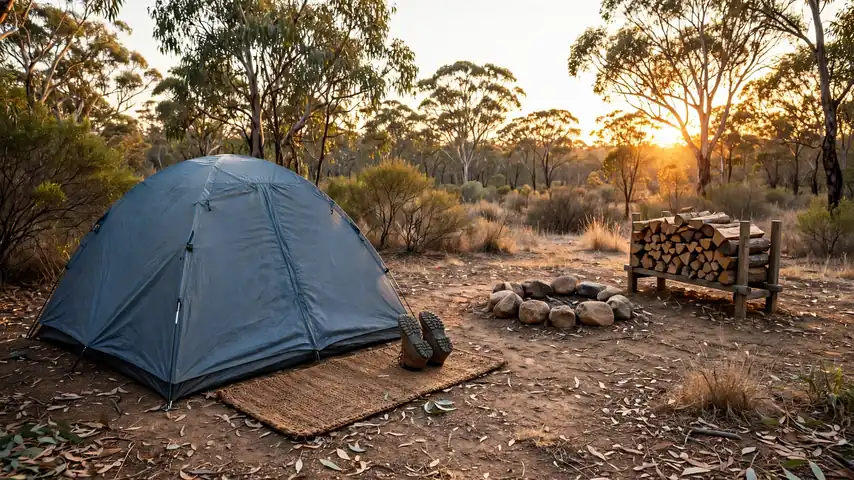
Pick a clear area away from long grass, woodpiles, rock piles and dense leaf litter — that’s where snakes shelter. When weighing up our round-up of the best camping spots in Australia, favour open, well-used sites. St John WA recommends a clear camping area and avoiding long grass and woodpiles.
Keep your tent and swag zipped shut
A snake will happily curl up in an open tent or boot overnight. St John WA’s advice: keep tents and swags zipped closed, and check shoes and equipment before use — especially anything left on the ground overnight. Make it a ritual: shake out boots each morning and check gear before packing up. A tent with reliable zips makes this easy — see our guide to the best camping tents for Australia if yours is getting tired.
Manage food, rubbish and firewood
Food scraps attract rodents, and rodents attract snakes. Secure rubbish and food scraps, and keep firewood off the ground and away from tents — straight from St John WA’s camper guidance. A sealed container or your car is a far better pantry than a bag left by the fire.
Boots, long pants and a torch
NSW Health’s advice is simple: wear long pants and boots where snakes are present, and don’t interfere with snakes. Thongs are a poor choice on a bush track at dusk — and after dark, carry a torch, since most accidental encounters happen because someone steps close to a snake they never saw.
Kids and pets
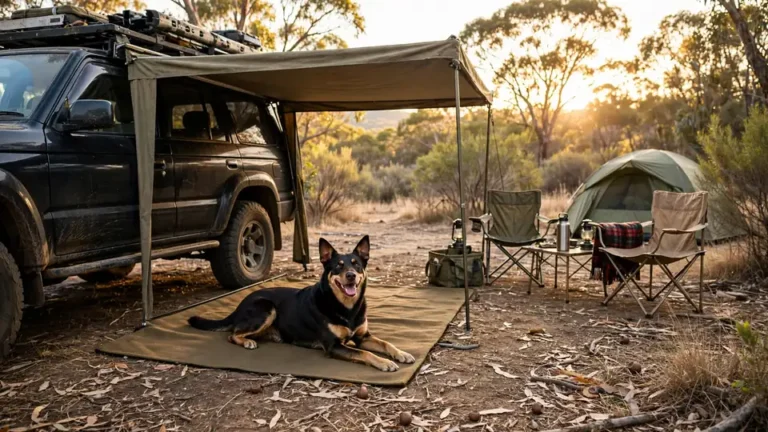
Teach children never to touch snakes — a Queensland Poisons Information Centre top tip. Keep dogs close and under control (St John WA); a curious dog nosing into a woodpile is a classic way encounters start.
What to Pack for Snake Safety at Camp
Snake safety camping Australia-wide starts in your first-aid kit — NSW Health specifically reminds people to pack one, particularly when camping. For snake country, make sure yours includes:
- Two broad elasticised or crepe bandages (10–15 cm wide). Crepe is best for the pressure immobilisation technique, but any flexible material — even clothing or a towel — will do in a pinch (Queensland Poisons Information Centre).
- A splint — a proper one, or a stick, piece of wood or rolled-up newspaper.
- A marker pen for marking the bite site and writing down times.
- A charged phone — plus a PLB or satellite communicator beyond mobile range, so you can always reach 000.
Run through our camping checklist for Australia before you leave so none of this stays in the garage. And learn the technique below before you need it — fumbling through instructions while someone is bitten is nobody’s idea of fun.
What to Do If You See a Snake at Camp
Spotting a snake near your tent is startling, but the correct response is boring — and that’s the point. St John WA’s advice:
- Stop moving. Freeze and work out where the snake is and where it’s heading.
- When safe, slowly back away. Give it space and a clear path to leave. Do not run, make sudden movements, or try to herd it off the track.
- Keep other people and pets well away until it has gone.
- Never attempt to touch, catch or kill the snake.
ANZCOR states plainly: as many of Australia’s snakes are protected species, it is not recommended to kill the snake — and you risk further bites. A digital photograph may help with identification, but only if taken safely from a distance. Once it’s moved on, note where it went and steer clear of that area.
Snakebite First Aid: The Pressure Immobilisation Technique
A snakebite is a medical emergency, full stop — treat all snake bites as dangerous and every bite as life threatening (Queensland Poisons Information Centre; St John WA). Two facts make fast action essential: a bite may be painless with no visible marks (ANZCOR), and symptoms might not appear for an hour or more (Queensland Poisons Information Centre). Don’t wait for symptoms — start first aid immediately.
Step by step: bite on an arm or leg
This is the pressure immobilisation technique recommended by ANZCOR, the Queensland Poisons Information Centre and St John WA. Most snake venom spreads through the lymphatic system, not the bloodstream — firm bandaging plus immobilisation slows that spread while you wait for help.
- Call Triple Zero (000) and ask for an ambulance. No signal? Send someone else for help or activate your PLB/satellite device.
- Lie the person down and keep them completely still and calm. Don’t let them walk — bring transport to them.
- Remove rings, watches and constrictive clothing from the bitten limb, in case of swelling.
- Apply a broad pressure bandage directly over the bite site as soon as you can.
- Bandage up the limb. For a leg, work upward from the lower part of the leg, wrapping as high as possible. For an arm, start at the fingers and bandage as much of the arm as possible. Firm — like a sprained ankle — but not cutting off circulation.
- Splint the limb so it can’t move: bind a stick, branch or rolled-up newspaper firmly along as much of it as possible. For an arm, add a sling.
- Mark the bite site on the bandage and note the time of the bite and when the bandage was applied.
- Keep the person lying still until the ambulance arrives. Don’t remove the bandage or clothing — hospital staff do that.
- If the person becomes unresponsive and isn’t breathing normally, start CPR — there’s normally no venom risk to the rescuer (ANZCOR).
Bites on the trunk, head or neck
The bandaging technique is for limbs. For a bite to the chest, abdomen, pelvis or back, the Queensland Poisons Information Centre advises calling 000 and applying firm pressure over the area if possible — without restricting chest movement — while keeping the person still. For head and neck bites, keep the person still and apply no first aid to the area.
Symptoms to watch for
ANZCOR lists the signs that may follow a snakebite: paired fang marks (often just a single mark or scratch), headache, nausea and vomiting, abdominal pain, blurred or double vision, drooping eyelids, difficulty speaking, swallowing or breathing, swollen tender glands in the groin or armpit of the bitten limb, limb weakness or paralysis, and respiratory weakness. Brown snake bites can cause collapse or confusion followed by apparent recovery — don’t be reassured by someone “feeling better”.
What NOT to do
ANZCOR is explicit: do NOT cut or incise the bite, do NOT use an arterial tourniquet, and do NOT wash or suck the bite. Washing is counterproductive — venom left on the skin or clothing can help the hospital identify the snake. Don’t apply ice or heat packs, don’t try to catch the snake, and don’t let the person walk or drive themselves to hospital. Each of these either wastes time or makes things worse. NSW Health’s snake and spider safety advice is a solid one-page refresher.
When and How to Call 000
Call 000 for every suspected snakebite — ANZCOR’s first instruction is to send for an ambulance for any person with a suspected snake bite, no exceptions. Have this ready: your exact location (GPS coordinates if you have them), what happened, when the bite occurred, the person’s symptoms, and how many people are involved. Beyond mobile range, a PLB or satellite communicator is your lifeline. The Poisons Information Centre (13 11 26) operates 24 hours a day across Australia.
Snake Myths vs Facts Campers Should Know
Myth: “Snakes chase campers.”
Fact: St John WA says snakes generally prefer to escape. Bites happen when people surprise a snake, step too close, or corner it.
Myth: “Suck the venom out or cut the bite open.”
Fact: Never. ANZCOR says do not cut, wash or suck the bite, and do not apply a tourniquet. These folk-remedy moves delay the one thing that helps: a pressure bandage and an ambulance.
Myth: “Kill the snake so doctors can identify it.”
Fact: Don’t. ANZCOR advises against killing the snake — many are protected, and you risk a second bite. Venom traces on skin or clothing help the hospital identify the snake, which is another reason not to wash the bite.
Myth: “No pain and no marks means no bite.”
Fact: A bite can be painless and leave barely a scratch (ANZCOR), and symptoms can take an hour or more to appear (Queensland Poisons Information Centre). Treat every suspected bite as dangerous.
Myth: “Walk it off and drive to hospital yourself.”
Fact: Movement spreads venom through the lymphatic system. Lie the person down, keep them still, and bring transport to them (Queensland Poisons Information Centre; WA Health).
Myth: “You need a fancy snakebite kit with a suction device.”
Fact: The essentials are broad elasticised bandages and something to splint with — clothing or a towel works if that’s all you have (Queensland Poisons Information Centre). Technique and stillness matter far more than gadgets.
That is snake safety camping Australia in a nutshell: a clear camp, a zipped tent, and calm, still first aid.
Disclaimer: general information only, not medical advice — consider a first aid course with St John Ambulance Australia. In an emergency, call Triple Zero (000) immediately.
Frequently Asked Questions
What is the first thing I should do if bitten by a snake while camping?
Call Triple Zero (000) immediately, lie the person down and keep them completely still. Then apply the pressure immobilisation technique: a broad, firm bandage over the bite and up the whole limb, then splint it. Do not wash, cut or suck the bite, and do not use a tourniquet — the ANZCOR recommendations for all Australian snakebites.
Should I try to catch or kill the snake to identify it?
No. ANZCOR advises against killing the snake — many are protected, and you risk being bitten again. A photo taken safely from a distance may help, and venom traces on skin or clothing assist hospital testing.
How tight should a snakebite pressure bandage be?
About as firm as you’d bandage a sprained ankle — snug enough that you can’t easily slide a finger underneath, but not cutting off circulation. Bandage from the fingers or toes upward, covering as much of the limb as possible, then splint it (Queensland Poisons Information Centre).
Can a snakebite really be painless?
Yes. ANZCOR notes a bite may be painless and leave no visible marks — and symptoms might not appear for an hour or more (Queensland Poisons Information Centre). That’s why every suspected bite is a medical emergency, even if the person feels fine.
How do I make my campsite safer from snakes?
Good snake safety camping Australia-wide comes down to habits: choose a clear site away from long grass and woodpiles, keep tent and swag zipped shut, shake out boots each morning, secure food and rubbish, store firewood off the ground and away from tents, wear long pants and boots, and use a torch after dark (St John WA; NSW Health).