Best Camp Ovens Australia 2026
Disclosure: We may earn a small commission if you purchase through our links, at no extra cost to you.
Few pieces of gear say “Australian camping” like a camp oven. It’s the original camp cooker — a heavy lidded pot that bakes damper, roasts lamb, slow-cooks stew, and fries eggs, all on campfire coals. The camp ovens Australia campers buy today come in two materials, half a dozen sizes, and a price range from $60 to $300+, and the choice matters: the wrong size frustrates, the wrong material rusts, and an unseasoned oven sticks everything. This guide covers the best camp ovens you can buy, how to choose size and material, seasoning, and the temperature-control techniques that turn coals into an oven.
Cast Iron vs Spun Steel: The Big Decision
Cast iron camp ovens
The traditional choice. Pros: superb heat retention and even cooking — once hot, it stays hot, which is exactly what baking needs; nearly indestructible; improves with age as seasoning builds. Cons: heavy (a 9-quart oven weighs 8–10kg), rusts if neglected, slower to heat up, and thermal shock (cold water on a hot oven) can crack it. Best for: car camping, base camps, and bakers who want the best results.
Spun steel camp ovens
Lighter pressed-steel ovens. Pros: much lighter (roughly half the weight of cast iron), heats faster, won’t crack from thermal shock, cheaper. Cons: poorer heat retention (temperature swings more), thinner walls mean hot spots and easier burning, seasoning is less durable. Best for: hikers who still want oven cooking, 4WD tourers watching weight, and beginners who don’t want to babysit seasoning.
The honest summary: cast iron cooks better; spun steel carries easier. Most Australian camp-oven devotees — the damper-at-dawn crowd — use cast iron and accept the weight, because a camp oven lives in the ute, not a backpack. If you’re choosing your first oven and you car camp, buy cast iron.
Size Guide: Quarts, Serves, and Reality
Camp ovens are sized in quarts (roughly litres). The size determines what you can cook, not just how much:
- 4.5 quart (~4L): serves 2–4. The couples/small family oven — stews, small roasts, a modest damper. Lighter and easier to handle. The Campfire Pioneer 4.5QT set (~$119.95) is the classic entry point.
- 9 quart (~8.5L): serves 4–8. The Australian standard — the size most recipes assume, the size that fits a whole chicken or a leg of lamb. If you buy one oven, buy this size. Campfire 9QT around $66 is remarkable value.
- 12+ quart: serves 8+. For big groups, scout troops, and camp-oven cooking competitions. Heavy, hungry for coals, glorious.
Two practical notes: a bigger oven needs more coals and more time to heat — don’t buy a 12-quart for two people. And the lid matters as much as the pot: a proper camp-oven lid has a lip to hold coals on top (that’s what makes it an oven rather than a pot) and doubles as a frypan in many designs.
What to Look For
- Lid design: lipped lid for holding coals, a handle that works with a lid lifter, and ideally a lid that doubles as a skillet.
- Legs vs flat base: traditional camp ovens have legs to stand over coals; flat-based “camp ovens” suit gas stoves and heat beads better. Legs are authentic and versatile; flat is more stable on tables.
- Pre-seasoned: many modern ovens come pre-seasoned — a genuine head start, though you’ll still build your own seasoning over time.
- Wall thickness: in cast iron, thicker is better (heat retention); in spun steel, look for even pressing without thin spots.
- Accessories in the kit: lid lifter, carry bag, and trivet add real value — the Campfire 9QT kit (~$119.99–$134.99) bundles these.
- Bail handle: for hanging over fire and safe carrying. Check it’s sturdy — a full 9-quart oven is heavy.
The Best Camp Ovens in Australia for 2026
Campfire 9QT Cast Iron Camp Oven — best overall value
Around $66 at Tentworld, the Campfire 9QT is the default recommendation for a reason: proper cast iron, lipped lid, legs, at a price that makes camp-oven cooking accessible to everyone. It’s the oven most Australian families learn on. At this price, buy the oven and spend the savings on a good lid lifter and a season of practice.
Campfire 9QT Camp Oven Kit — best starter bundle
Around $119.99–$134.99 depending on retailer, the kit adds the carry bag, lid lifter, and accessories that you’d buy separately anyway. For a first oven, the kit is the better buy — it removes every excuse not to start cooking. Check Tentworld, BCF, and Anaconda for current kit pricing.
Campfire Pioneer 4.5QT Set — best small oven
Around $119.95, the Pioneer set suits couples and small families who don’t need the big 9-quart. Same Campfire quality in a more manageable size — lighter to carry, faster to heat, less coal-hungry. The set format includes the extras.
Camp Chef DO12 (9 quart) — best premium cast iron
Around $99.99, the American Camp Chef DO12 brings tighter quality control and better pre-seasoning than budget options. For campers who’ll use their oven weekly, the premium in casting quality pays off in more even cooking and easier seasoning maintenance.
Spun steel options — best lightweight
For hikers and weight-conscious tourers, spun steel ovens from the major camping brands offer real oven cooking at half the weight. Expect to pay similar money to cast iron for less cooking performance — the trade is weight, not price. Check BCF’s camp oven range for current spun-steel options.
Camp Ovens Compared
| Camp oven | Material | Size | Serves | Price (AU) | Best for |
|---|---|---|---|---|---|
| Campfire 9QT | Cast iron | 9 qt | 4–8 | ~$66 | Best value first oven |
| Campfire 9QT Kit | Cast iron | 9 qt | 4–8 | ~$119.99–$134.99 | Starter bundle |
| Campfire Pioneer 4.5QT Set | Cast iron | 4.5 qt | 2–4 | ~$119.95 | Couples/small families |
| Camp Chef DO12 | Cast iron | 9 qt | 4–8 | ~$99.99 | Premium quality |
| Spun steel ovens | Spun steel | Varies | Varies | Check BCF | Hiking/weight saving |
Browse the full range at BCF’s camp oven section, and protect your investment with a carry bag — the Blacksmith 9qt bag (~$54.90 at Snowys) keeps the seasoned oven clean and your car clean.
Seasoning: The Non-Negotiable Ritual
Seasoning is polymerised oil baked onto the iron — a natural non-stick surface that also prevents rust. Pre-seasoned ovens have a factory head start, but real seasoning builds over months of cooking. The process:
- Strip (new unseasoned ovens only): wash with hot soapy water to remove factory coating, dry immediately and completely.
- Oil thinly: wipe the entire oven — inside, outside, lid — with a high-smoke-point oil (grapeseed, canola). Then wipe it off — the layer should look dry, not wet. Too much oil makes sticky seasoning.
- Bake upside down: 200°C+ for an hour (home oven, BBQ, or campfire). The oven smokes as the oil polymerises — that’s correct.
- Cool in place, then repeat 2–3 times for a new oven.
- Cook fatty foods first: bacon, roast chicken, fried potatoes — they build seasoning faster than anything.
Maintenance: after cooking, clean with hot water and a stiff brush (no soap on a well-seasoned oven — though a little soap won’t kill modern seasoning, despite the myth), dry on heat, wipe with a thin oil layer while warm. Never soak, never dishwasher, never leave wet. A well-seasoned oven used regularly needs almost no maintenance; a neglected oven rusts, and rust means starting over.
Temperature Control: The Heat Bead Method
Camp-oven temperature control is the skill that separates damper from charcoal. The standard method uses heat beads (charcoal briquettes) rather than open flame — consistent, countable heat:
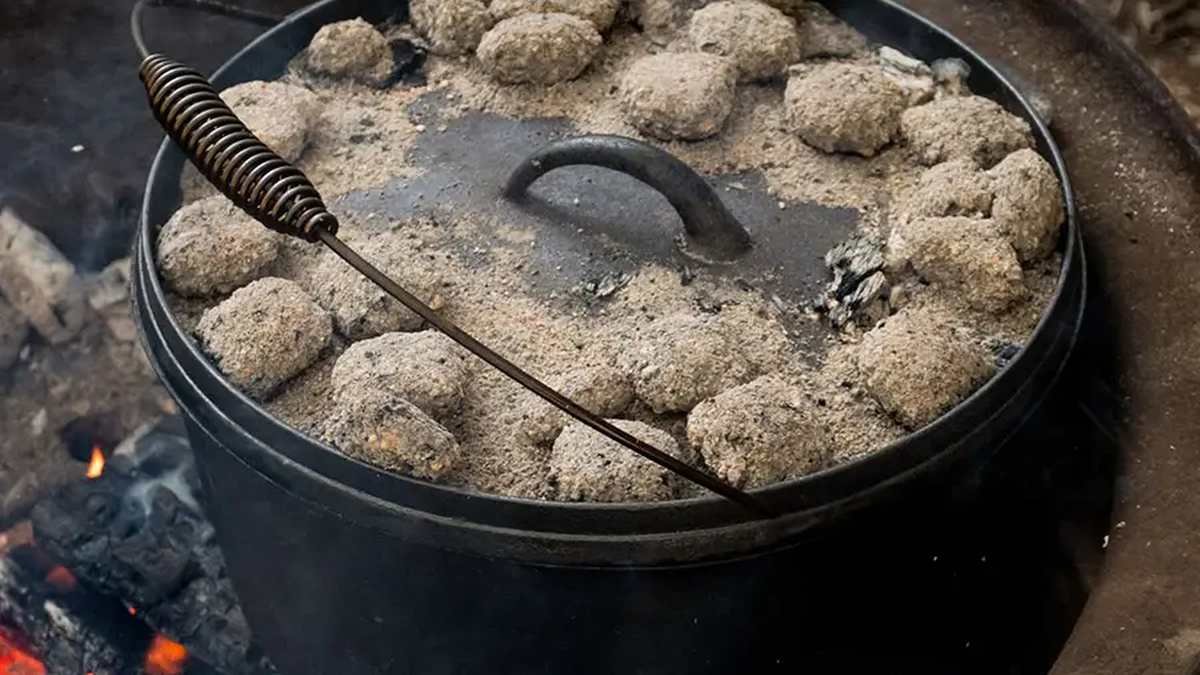
- The rule of thirds: roughly one-third of the heat below the oven, two-thirds on the lid. Heat rises; the lid needs more coals to bake the top.
- Counting beads: as a starting guide, the oven’s quart size in beads gives roughly 180°C — so a 9-quart oven wants ~9 beads below and ~18 on top for moderate baking. Adjust for wind (add beads), cold (add beads), and experience.
- Rotate: turn the oven a quarter-turn every 15 minutes, and the lid a quarter-turn the other way — evens out hot spots.
- Preheat: get the oven hot before food goes in, just like a home oven.
- Resist peeking: every lid lift drops the temperature significantly. Trust the timing.
For full technique with recipes, see our beginner’s camp oven cooking guide.
What Can You Actually Cook? More Than Damper
Damper is the gateway, but a camp oven is a complete outdoor kitchen: roast meats (lamb, chicken, pork) with vegetables; slow stews, curries, and casseroles; bread, pizza, and cakes; breakfast bakes and frittatas; even popcorn in the lid-as-skillet. The oven’s superpower is time — low, slow, unattended cooking while you fish, walk, or sit by the fire. A stew that simmers for three hours on a handful of coals while you do nothing is the camp-oven promise, and it delivers.
Camp Oven Safety and Fire Rules
- Fire bans: camp ovens on open coals are an open fire — during total fire bans, use heat beads in a contained BBQ or a gas-fired camp oven setup instead, and check local rules.
- Handling: a loaded 9-quart oven weighs 12kg+ and it’s all 200°C — use a proper lid lifter, wear welding gloves (not tea towels), and keep kids and dogs clear of the cooking area.
- Ground protection: coals under the oven scorch ground — use a fire tray, old BBQ plate, or established fire pit. Leave No Trace applies.
- Thermal shock: never plunge a hot cast-iron oven into cold water — it can crack. Let it cool naturally.
- Storage: store with the lid ajar (a folded paper towel between lid and pot) to prevent moisture trapping and rancid oil smells. A carry bag keeps everything contained.
Camp Oven Accessories Worth Buying
The oven is the start; the accessories make it practical:
Lid lifter: non-negotiable. A proper camp-oven lid lifter hooks the lid handle securely — using sticks or pliers with a 200°C lid full of coals is how burns happen. If your kit didn’t include one, buy one before your first cook.
Welding gloves: cheap, heatproof to far beyond camp-oven temperatures, and far safer than oven mitts for handling the oven body. Keep a pair in the camp box permanently.
Trivet: a wire rack that sits inside the oven, lifting food off the base — essential for roasting (keeps meat out of its own fat and prevents base burning) and for baking (air circulation underneath).
Carry bag: a seasoned oven is oily; a canvas carry bag (like the Blacksmith 9qt bag, ~$54.90) keeps the oil off your car and gear, and protects the seasoning from knocks. Worth it from day one.
Charcoal starter / chimney: getting heat beads lit evenly and quickly without lighter fluid (which taints food) — a chimney starter is the clean method.
Spray oil bottle: for seasoning touch-ups and pre-cook oiling. Easier and more even than wiping.
Restoring a Neglected Camp Oven
Inherited a rusty oven? Don’t bin it — cast iron is nearly immortal. Scrub the rust with steel wool or a wire brush (power tools with wire wheels work for bad cases), wash, dry on heat, then run the full seasoning process 3–4 times. Surface rust is cosmetic; only deep pitting (rare, from years of neglect) truly ruins an oven. A restored vintage oven often cooks better than a new one — decades of seasoning don’t wash off easily. Check op shops and farm clearances: old ovens sell for a few dollars and restore beautifully.
Frequently Asked Questions
Cast iron or spun steel camp oven: which should I buy?
Cast iron cooks better (heat retention, even baking) and suits car camping where weight doesn’t matter. Spun steel is half the weight and heats faster, suiting hikers and weight-conscious tourers. First oven for car camping: cast iron, 9 quart.
What size camp oven do I need?
4.5 quart serves 2–4 (couples, small families); 9 quart serves 4–8 and is the Australian standard — most recipes assume this size. Buy bigger only for large groups; oversized ovens waste coals and time for small meals.
How do you season a camp oven?
Wipe thin oil over the whole oven, bake upside-down above 200°C for an hour, cool, and repeat 2–3 times. Then cook fatty foods to build seasoning naturally. Clean with hot water and a brush, dry on heat, oil lightly while warm.
How many heat beads for a camp oven?
Starting guide: the oven’s quart size in beads below and double on the lid for ~180°C — so ~9 below and ~18 on top for a 9-quart. Add beads for wind and cold; rotate the oven and lid every 15 minutes.
Can you use a camp oven on a gas stove?
Yes — flat-based ovens sit well on gas burners, and legged ovens work on sturdy camp stoves. It’s a great fire-ban workaround: the oven still bakes and roasts on gas heat. Use a diffuser for very high-output burners to avoid hot spots.
← Back to our complete guide: Best Camping Stoves Australia 2026