Best Portable Fridges Camping Australia
Disclosure: We may earn a small commission if you purchase through our links, at no extra cost to you.
A 12V portable fridge is the single biggest upgrade to camp food in Australia — no more ice runs, no more soggy eskies, no more guessing whether the chicken is still safe. But the portable fridges camping Australia wide range from $350 to $1,400+, and the price tag is only half the story: power draw determines whether your battery survives the night, and reliability determines whether your food survives the trip. This guide compares the best portable fridges on real numbers — price, power consumption, weight, warranty — and explains the battery maths you need before you buy.
Single Zone vs Dual Zone: Which Do You Need?
Single zone fridges hold one temperature — fridge or freezer, not both. Simpler, cheaper, lighter, and more energy-efficient for the volume. For most campers, single zone is right: set it to 3–4°C and everything stays cold.
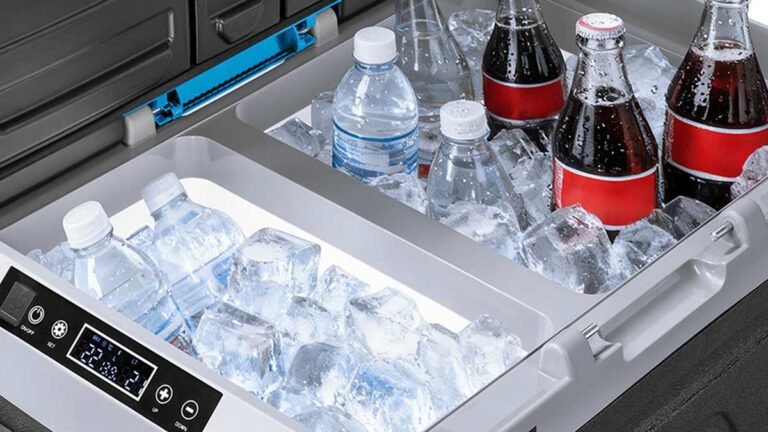
Dual zone fridges have two compartments at different temperatures — typically fridge plus freezer. Brilliant for long trips (frozen meat for week two, cold drinks for today), families, and anyone who wants ice. The cost: more money, more weight, higher power draw, and the freezer compartment steals volume from the fridge side.
The decision: if your trips are under a week and you eat fresh, single zone saves money and battery. If you tour for weeks, hunt, fish, or feed a family, dual zone earns its keep. Note that some single-zone fridges can run as freezers (set to -18°C) — you just can’t do both at once.
Power Draw: The Number That Actually Matters
A fridge’s purchase price is a one-time cost; its power draw is a daily tax on your battery. Here’s how the contenders compare on real consumption figures:
| Fridge | Capacity | Weight | Power draw | Warranty | Price (AU) |
|---|---|---|---|---|---|
| Engel MT-V45F | 40L (single) | 24kg | 2.6A | 3yr (+2) | ~$1,349 |
| Dometic CFX3 45 | 46L (single) | 18.7kg | ~1.03Ah/h | 3yr (+2) | ~$1,249 |
| myCOOLMAN 44L | 44L (single) | 23.4kg | ~0.80Ah/h | 3yr (+2) | ~$910 |
| Brass Monkey 50L Dual | 50L (dual) | 15.5kg | ~0.87Ah/h | 3yr | Check retailers |
| Kings 45L | 44L (single) | 23.6kg | 0.7–1.0Ah/h | 5yr | ~$589 |
| OZtrail 45L | 45L (single) | 21kg | 3.75A | 2yr | Check retailers |
| Evakool Infinity 47L | 47L (single) | — | — | — | ~$1,400 |
| Brass Monkey 22L | 22L (single) | — | — | 3yr | ~$349 |
What these numbers mean: a fridge drawing ~1Ah/h consumes ~24Ah per day. A typical 100Ah deep-cycle battery gives you ~50 usable Ah (never drain lead-acid below 50%), so roughly two days of fridge runtime without charging — less in 40°C heat when the compressor works harder. This is why fridges and batteries are a system: the fridge choice dictates the battery and solar you need.
Portable Fridges Camping Australia: Best Picks for 2026
Engel MT-V45F — the reliability king
Around $1,349 at BCF, the Engel is the fridge that 4WD tourers trust with a month’s worth of food in the Simpson Desert. The legendary Sawafuji swing motor has one moving part, sips power (2.6A), and Engels famously run for decades — there are 20-year-old Engels still cooling. It’s heavy (24kg) and basic (no Bluetooth, no app), but if reliability is the brief, nothing beats it. The 3-year warranty extends to 5 with registration.
Dometic CFX3 45 — best features
Around $1,249 at Tentworld, the CFX3 is the tech-lover’s fridge: Bluetooth and WiFi app control, USB charging port, rugged construction, -22°C capability. Dometic (formerly Waeco) has decades of Australian presence and service networks. Power draw is higher than the Engel, but the feature set — remote monitoring from the swag is genuinely useful — justifies it for many. Check user reviews on ProductReview for long-term ownership reports.
myCOOLMAN 44L — best mid-range
Around $910 at Snowys, the myCOOLMAN hits the sweet spot: quality compressor, 0.80Ah/h efficiency, dual 12V sockets (handy for charging devices), and a 3-year warranty extendable to 5. It’s the fridge for buyers who want 90% of the Engel/Dometic experience for 65% of the money. The brand has built a solid Australian following among tourers.
Brass Monkey range — best value
The Jaycar house brand disrupted the market: the 22L at ~$349 is the cheapest path to 12V refrigeration, while the dual-zone 45L (~$633.95), 50L (~$518.65), and 60L (~$528.40) offer dual-zone versatility at prices the big brands can’t touch. Features punch above the price (Bluetooth app, USB port, 3-year warranty). The trade-offs: higher power draw than premium brands, and long-term durability doesn’t match Engel — but at half the price, many campers accept that. The 50L dual at ~15.5kg is notably light for its capacity.
Kings 45L — cheapest big brand
Around $589 at 4WD Supacentre with a 5-year warranty, the Kings fridge is the budget-tourer favourite. The long warranty inspires confidence, but independent comparisons note reliability concerns versus the premium brands — it’s the classic “great until it isn’t” value proposition. For the price of one Engel you can buy two Kings; whether that’s wisdom or false economy depends on your luck and your trips.
Evakool Infinity 47L — the Aussie-made option
Around $1,400, Evakool’s Infinity series is designed and built in Australia for Australian conditions — fibreglass cabinet, excellent insulation, and a reputation among serious tourers. Premium money for a genuinely premium, locally-supported product. If buying Australian matters to you, this is the pick.
Battery and Solar: The Maths
A fridge without a power plan is an expensive esky. The basic setup:
- Second battery: a 100–120Ah deep-cycle (AGM or lithium) dedicated to the fridge. Lithium gives more usable capacity (80–90% vs 50%) and half the weight, but costs 2–3x more.
- DC-DC charger: charges the second battery from the alternator while driving — essential for modern smart-alternator vehicles. A 25A DC-DC charger replenishes a day’s fridge use in 1–2 hours of driving.
- Solar: a 120–200W panel keeps the battery topped up when stationary. In good sun, 160W roughly covers a 45L fridge’s daily draw.
- Battery protection: all the fridges above have 3-stage low-voltage cutout — set it correctly so the fridge shuts off before killing your starter battery (if running off the main battery, which you shouldn’t).
Rule of thumb: budget roughly as much for the power system (battery + DC-DC + solar) as for the fridge itself. A $600 fridge on a $600 power setup outperforms a $1,300 fridge on a dying starter battery.
Size Guide: How Big a Fridge Do You Need?
- 20–25L: couples on weekends, drinks only, or a second “drinks” fridge. The Brass Monkey 22L owns this segment.
- 35–45L: the sweet spot — a week’s food for two, or a long weekend for a family. Most buyers should land here.
- 50–60L: families, long trips, dual-zone freezer needs. Check it’ll fit your vehicle’s cargo area — measure before buying.
- 75L+: base camps, big groups, serious tourers. Heavy, power-hungry, glorious.
When in doubt, go one size up from what you think — fridges run more efficiently full than half-empty (thermal mass), and you’ll always find things to fill the space.
Fridge Tips That Extend Food Life and Battery Life
- Pre-cool at home on 240V before the trip — starting cold saves hours of compressor work on battery.
- Pre-chill food and drinks before loading; room-temperature groceries are a massive heat load.
- Keep it full: fill dead space with water bottles — thermal mass smooths temperature swings and reduces compressor cycling.
- Park in shade, ventilate: fridges work harder in heat; 5°C of ambient difference is measurable in power draw. An insulated cover helps in summer.
- Set realistic temperatures: 3–4°C for the fridge, -15–-18°C for the freezer. Colder settings burn battery for no food-safety benefit.
- Minimise lid openings: organise so the thing you want is on top. Every opening dumps cold air.
- Level ground: compressor fridges prefer level operation; extreme angles reduce efficiency and can damage some models.
For the full food-safety picture — temperatures, the danger zone, and outback strategies — see our camping food safety guide. And if you’re weighing a fridge against a quality esky, our esky vs portable fridge comparison runs the economics.
Compressor Types: Why Engel Owners Are Smug
Most portable fridges use a Danfoss/Secop-style reciprocating compressor — the same technology as a home fridge, miniaturised. They’re efficient, proven, and used by Dometic, myCOOLMAN, Brass Monkey, Kings, and most others. Engel uses something different: the Sawafuji swing motor, a single-piston design with one moving part. Fewer moving parts means less to wear out, less vibration, and remarkable efficiency — it’s why 20-year-old Engels still run and why Engel owners talk about their fridges the way LandCruiser owners talk about their utes.
Does the compressor type matter to your buying decision? At the premium end, yes — it’s the core of Engel’s reliability reputation and a genuine engineering difference, not marketing. In the mid-range, the Secop compressors are all good; differences between brands come down to insulation quality, thermostat accuracy, and build quality rather than the compressor itself. At the budget end, compressor quality control matters more than type — a well-made budget compressor beats a poorly-made premium one, which is exactly why warranty length and local service networks deserve weight in your decision.
One more factor: insulation thickness. It’s invisible on the spec sheet but decisive in 40°C heat. Premium fridges have thicker polyurethane insulation; budget fridges cut it to save cost and weight. The symptom is a fridge that holds temperature fine at 25°C ambient but runs constantly at 40°C, hammering your battery. If you camp in the outback or the Top End, insulation quality — hard to verify before buying, which is why owner reviews and the ProductReview fridge category matter — is worth paying for.
The True Cost of Fridge Ownership
The sticker price is the beginning. Five-year ownership maths for a typical 45L setup:
- Budget path: $589 fridge (Kings) + $200 AGM battery + $150 DC-DC charger + $200 solar panel = ~$1,140 all-in.
- Premium path: $1,349 fridge (Engel) + $500 lithium battery + $250 DC-DC charger + $300 solar = ~$2,400 all-in.
The premium path costs double but the fridge will likely outlive the car; the budget path gets you camping this weekend. Both are rational — the mistake is buying the $1,349 fridge and running it off a tired starter battery, or buying the $589 fridge for a 3-month outback tour where failure means losing $400 of food and a week of plans. Match the fridge tier to the trip tier.
And the hidden cost nobody mentions: food savings. A family that camps monthly and currently buys ice ($5–$10 per trip) plus replaces spoiled food will save $200–$400 a year with a fridge. Over five years, even the premium setup roughly pays for itself in ice and food alone — before counting the convenience. Add the resale value — quality fridges (Engel, Dometic) hold their value remarkably well on the secondhand market — and the true cost of premium ownership drops further.
Frequently Asked Questions
What size portable fridge do I need for camping?
35–45L suits most campers — a week’s food for two or a long weekend for a family. Go 20–25L for drinks/weekends, 50–60L+ for families and long tours. Measure your vehicle’s cargo space before buying big.
How long will a portable fridge run on a car battery?
A 45L fridge drawing ~1Ah/h uses ~24Ah/day. A 100Ah deep-cycle battery (50Ah usable) gives roughly two days without charging — less in extreme heat. Don’t run a fridge off your starter battery without a low-voltage cutout.
Engel vs Dometic vs Brass Monkey: which is best?
Engel for maximum reliability and efficiency; Dometic for features and app control; Brass Monkey for value — dual-zone versatility at half the price, with higher power draw and less proven longevity. All three are legitimate choices at different budgets.
Do I need solar for a camping fridge?
If you drive daily, a DC-DC charger may suffice. If you stay put for days, solar (120–200W) is essential — otherwise the battery dies and so does the food. Budget for the power system alongside the fridge.
Can a portable fridge run as a freezer?
Yes — most compressor fridges reach -18°C to -22°C. Single-zone models run as either fridge or freezer; dual-zone models do both simultaneously. Freezer mode roughly doubles power consumption.
← Back to our complete guide: Best Camping Stoves Australia 2026