Best National Parks for Camping in Queensland 2026
Disclosure: We may earn a small commission if you purchase through our links, at no extra cost to you.
Queensland does national park camping differently to every other state, and the best national parks camping Queensland have to offer demand a bit of homework before you go. The booking system confuses first-timers, beach camping needs separate vehicle permits, and some of the best parks are 4WD-only — which the brochures mention in smaller print than they should. Get it right, though, and you’re camping on the world’s largest sand island, in granite country under freezing winter stars, or in ancient Gondwanan rainforest.
This guide covers the parks worth building a trip around, with real campground names and the booking quirks for each. For the apps that help you find sites between parks, see our free camping apps guide.
Best National Parks Camping Queensland: How Booking Works
Queensland’s system has quirks that trip up visitors from other states:
- Pre-booking is mandatory. You must book your campsite in advance through the Queensland National Parks booking system. Unlike NSW, you generally can’t book a specific site — you book the camping area, and your actual site within it is first-come, first-served. Arrive early on Fridays and in holidays.
- Beach camping needs vehicle permits too. Places like K’gari and Teewah Beach require a separate vehicle access permit on top of the camping booking. The permit and the campsite are different bookings — don’t confuse them.
- 4WD-only means 4WD-only. Several of the best parks are genuinely inaccessible to 2WD vehicles — soft sand, no exceptions. Check access requirements before booking; “high clearance” in Queensland often means actual 4WD.
- Christmas and Easter book out months ahead in South East Queensland. If you’ve missed out, check for cancellations — spots do open up as people change plans.
- Dingo safety is serious on K’gari. Dingoes are wild animals, not camp dogs. Secure all food, never feed them, and follow QPWS dingo-safe guidelines. Fines apply.
1. K’gari (Fraser Island) — The Sand Island
The world’s largest sand island needs no introduction, but the camping logistics deserve one. K’gari is 4WD-only — the “roads” are sand tracks, the beach is the highway (with road rules, speed limits, and give-way protocols for aircraft landing strips), and getting there means a barge from Rainbow Beach or Hervey Bay.
Camping: designated camping zones along the eastern beach and at inland sites near the lakes. Facilities vary from basic to good depending on zone. Highlights within easy reach: Lake McKenzie’s impossibly white sand and clear water, Eli Creek’s gentle float, the Champagne Pools, and Waddy Point and Orchid Beach for fishing.
Know before you go: you need both a vehicle access permit and a camping booking. Take recovery gear (our recovery gear checklist applies double here), know the tide times (beach driving at high tide is dangerous), and carry a tyre pressure gauge — you’ll be airing down to 16–18psi the moment you leave the barge.
2. Girraween National Park — Granite Country
About 260km south-west of Brisbane near Stanthorpe, Girraween is Queensland’s granite wonderland — massive balanced boulders, the Pyramid’s steep granite dome, and some of the darkest, coldest winter nights in the state (below freezing is normal June–August, so bring a proper sleeping bag).
Camping: three camping areas off the main entrance — Castle Rock (the older area, open sites with shade and tent platforms), Terrawambella (dedicated open area for caravans and camper trailers), and Kambuwal (bush setting, mix of tent and van sites). You book the area, not the site.
Know before you go: the famous hot showers are gone — it’s BYO shower now (the cubicles remain, minus taps and heads). Winter is spectacular but freezing; spring brings wildflowers (Girraween means “place of flowers” in the local Indigenous language). The Pyramid walk is steep but the views are worth it; The Junction walk along Bald Rock Creek is the easy, pretty option.
3. Bunya Mountains National Park — Ancient Bunya Pines
The Bunyas are Queensland’s most accessible mountain escape — ancient bunya pines (descendants of Gondwanan rainforest), wallabies and pademelons at dusk, and cool mountain air an easy drive from Brisbane and Toowoomba. It’s 2WD-accessible, which makes it the family-friendly counterpoint to K’gari.
Camping: the Dandabah camping area has good facilities including hot showers — a genuine luxury in the national park world. The park’s walking tracks range from short rainforest loops to the full-day Mount Kiangarow track. In summer the mountains are 5–8°C cooler than the plains, which is exactly why it fills in January.
4. Lamington National Park — Gondwanan Rainforest
Part of the Gondwana Rainforests World Heritage Area, Lamington is ancient, misty, and spectacular — 500+ waterfalls, 160km of walking tracks, and birdlife (bowerbirds, catbirds, paradise riflebirds) that draws twitchers from everywhere. O’Reilly’s and Binna Burra are the two main bases, both 2WD-accessible.
Camping: bush camping areas with good facilities; the park also suits day visits if you’re based nearby. The Box Falls and Toolona Creek circuits are the classic walks. Leeches in summer are enthusiastic — bring repellent and tuck your socks in.
5. Great Sandy National Park (Teewah Beach) — Beach Camping Classic
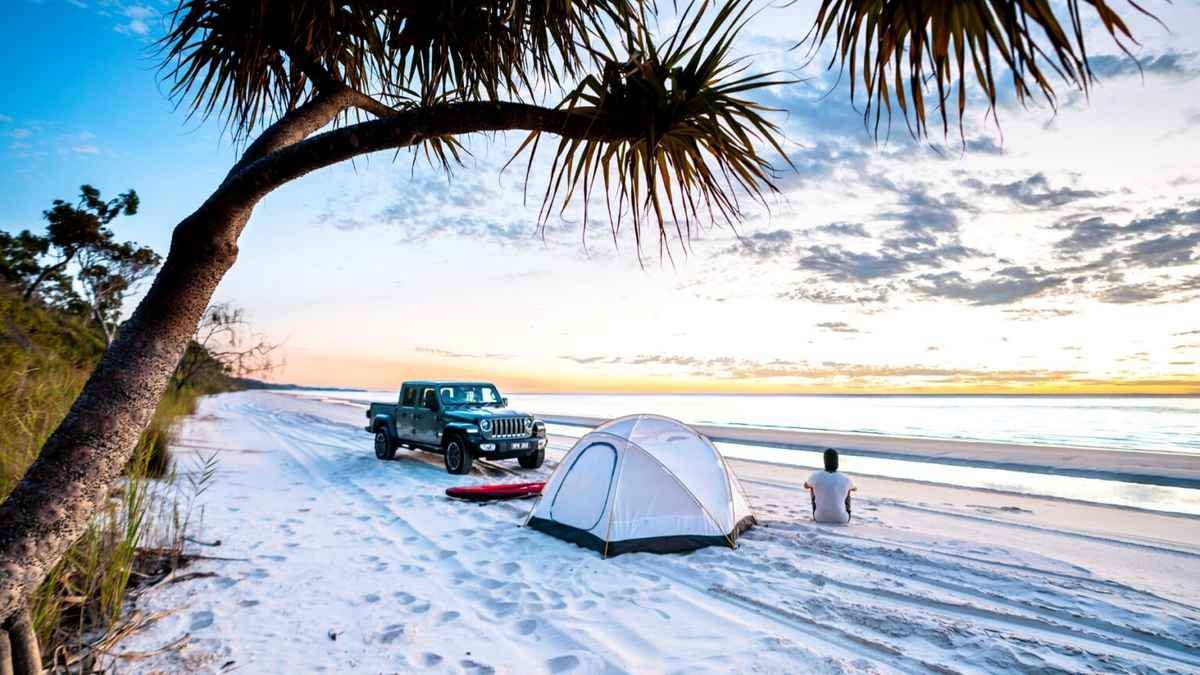
Teewah Beach is Queensland’s most famous beach camp — kilometres of surf beach between Noosa and Rainbow Beach, with designated camping zones right on the sand. Cross by barge from Tewantin (eftpos accepted, book return tickets together).
Know before you go: a portable toilet is mandatory — rangers check, and fines apply. Pick your camping zone when booking (Zone 3’s grassy sites are popular). It’s 4WD country: air down, know the tides, and carry recovery gear. The coloured sands and Double Island Point lighthouse are the side trips that make it special.
6. Bribie Island National Park — The Easy 4WD Beach
Bribie is the gentle introduction to Queensland beach camping — 4WD beach driving and beachfront camping much closer to Brisbane than K’gari or Teewah, with a more relaxed feel. Drop toilets and cold showers at the beach camping areas; it’s deliberately basic, which keeps the crowds manageable.
Know before you go: you still need the vehicle access permit and camping booking, and you still need to air down. Check the QPWS site for current access conditions — the ocean beach can close after storms.
7. D’Aguilar National Park — Brisbane’s Backyard Bush
Twenty minutes from Brisbane’s CBD, D’Aguilar (formerly Brisbane Forest Park) is the weeknight-escape park — bush camping, mountain biking, and walking tracks in eucalypt forest, with most camping areas 4WD-access. It’s not a destination park like K’gari, but as a shakedown-trip venue or a Friday-night escape, it’s unbeatable for south-east Queenslanders.
Water, Supplies, and Self-Sufficiency
Queensland’s parks punish the unprepared more than most states, because the distances between services are real and the heat is serious:
- Carry more water than you think. Many QLD park campgrounds have no potable water. Our water storage guide covers how much to carry per person per day.
- Fuel up before the park. K’gari has limited fuel; Girraween means a run into Stanthorpe; Teewah has nothing. Never enter a remote park under half a tank.
- Summer storms are violent. November–March brings intense storms and the occasional cyclone in the north. Check the Bureau of Meteorology before and during trips — flash flooding closes causeways and beach access fast.
- Crocodiles in the north. North of roughly Gladstone, treat every waterway as croc habitat. “Be crocwise” isn’t a slogan; it’s survival advice. Swim only in signed safe areas.
Queensland Camping Seasons
- Winter (June–August): the premium season for most of Queensland. The south-east is mild and perfect (though inland nights drop below freezing — Girraween, the Granite Belt, and the Darling Downs get genuinely cold). The north is in its glorious dry season: 25°C days, low humidity, accessible roads. This is when the southern states’ caravans migrate north — book early.
- Spring (September–November): wildflower season in Girraween and the Granite Belt, warming weather, and the last comfortable weeks before the build-up. October–November in the north brings rising humidity and “the build-up” — spectacular storms, oppressive mugginess, and the sense that the wet is coming.
- Summer (December–February): the wet season in the north — heavy rain, flooded roads, closed parks, and serious heat. Not the time for Cape York or the Gulf. The south-east is hot and stormy but campable; the mountains (Bunya, Lamington, Main Range) are the cool refuges. Summer is also stinger season on northern beaches (October–May roughly) — swim inside the nets.
- Autumn (March–May): the wet recedes, roads reopen, and the north enters its shoulder season — fewer crowds, full waterholes, green landscapes. Arguably the best-value season for northern Queensland: dry-season beauty without peak-season competition.
Cyclone awareness: November–April is cyclone season for coastal Queensland. If you’re travelling the coast in these months, monitor the Bureau of Meteorology, know that parks and roads close with little notice, and never try to outrun or wait out a cyclone in a tent. The season is predictable; being caught by it isn’t bad luck, it’s bad planning.
Queensland’s Booking System: Step by Step
Queensland’s system confuses people because it differs from every other state. Here’s exactly how it works:
- Create your account on the Queensland National Parks booking system before you need it — not at 9pm the night before a trip when the confirmation email decides to take an hour.
- Search by park or region, select your dates, and choose a camping area (not a specific site). The system shows availability per area — when an area shows as available, sites remain within it, but they’re first-come, first-served on arrival.
- Book vehicle access permits separately for beach parks (K’gari, Bribie Island, Teewah). This is a different product in the system — the camping booking doesn’t include vehicle access, and rangers check both.
- Pay online at booking. Camping fees are charged per person per night in Queensland — check whether children are charged at your destination (policies vary).
- Save/print your booking confirmation. Mobile reception at park entrances is unreliable; a saved PDF or screenshot is your proof. Some parks have self-registration for late arrivals — read your confirmation’s arrival instructions.
- Arrive early for site choice. Since sites within an area are first-come, arriving Friday afternoon of a long weekend means choosing from leftovers. Thursday arrival or early Friday morning gets the pick of sites.
- Cancellation terms: read them at booking — they vary by park and season, and peak-period bookings have stricter terms.
The Christmas/Easter problem: South East Queensland’s parks book out months ahead for school holidays. If you’ve missed out, check for cancellations weekly — spots genuinely do open up as people’s plans change. And consider the shoulder: the week after school holidays ends is often glorious and empty.
Frequently Asked Questions
Do you need to book Queensland national park campsites in advance?
Yes — pre-booking through the Queensland National Parks booking system is mandatory. Note that you book the camping area rather than a specific site, and your actual site is first-come, first-served within the area. Beach parks also require separate vehicle access permits.
What is the best national park for camping in Queensland?
K’gari (Fraser Island) for the iconic 4WD beach island experience; Girraween for granite country and winter stars; Bunya Mountains for easy family mountain camping; Lamington for World Heritage rainforest. Each suits a different trip style.
Can you camp on the beach in Queensland?
Yes, in designated areas: K’gari’s beach camping zones, Teewah Beach (Great Sandy NP), and Bribie Island all allow beach camping with permits and bookings. A portable toilet is mandatory at Teewah. Random beach camping elsewhere is generally not permitted.
Is K’gari suitable for beginner 4WDers?
It’s challenging but doable with preparation: air down to 16–18psi, understand beach driving basics (tides, momentum, no sharp turns), carry recovery gear, and travel with another vehicle if possible. Our sand driving guide covers the technique.
Are there crocodiles in Queensland national parks?
In the north, yes — treat all waterways north of about Gladstone as potential crocodile habitat. Swim only where signs explicitly say it’s safe, never clean fish or prepare food at the water’s edge, and camp well back from the water.
← Back to our complete guide: Best Roof Racks for 4WD Touring Australia 2026